Archive for the Uncategorized Category

The Divine Reversal

Posted in Uncategorized on March 21, 2013 by thecrossingchicago

Palm SundayMy dad is an interesting character.  He likes to tell fish stories with the big fish getting exponentially bigger each time he tells them.  He would tell me stories of guys at work who would comment on his strength and hard work and how men half his age couldn’t do a tenth of the work that he does.  One form these stories usually take is of young men trying to move a pallet or perform some function that requires strength (interestingly enough they never require wit) such as a young guy in his 20s couldn’t lift up a pallet to get the forks under it, but he was able to do so.  The more he tells the story, the more guys there were trying to lift the pallet together where he was able to do so by himself.

I have often enjoyed writing short stories and one such story that I wrote a number of years ago was called Death of a King.  I got the idea to write this because of a story my dad often tells about how our family has inheritance rights to a lot of property in England because it has gone unclaimed by our other family members.  In this first-person oriented story my father has recently died.  He claimed many times that our family was descended from royalty and was in fact heirs to the throne of some country or another.  As the story progresses and the funeral begins, there is imagery of two funerals happening simultaneously.  In one funeral, a king’s coffin draped with purple cloth is being processed very slowly through masses of people up a rainy road and into a large cathedral.  The king’s wife and young son fight to keep their composure as the casket slowly approaches and the royal orchestra plays Kyrie Eleison  from Mozart’s Requiem.  This is the funeral that would have been if my father were telling the truth.  In reality, another funeral took place with an old feeble minister whose shaky hands took frequent sips from a glass of water as he delivered a eulogy to the eight or nine people sitting in the sultry country chapel on hard wooden pews.

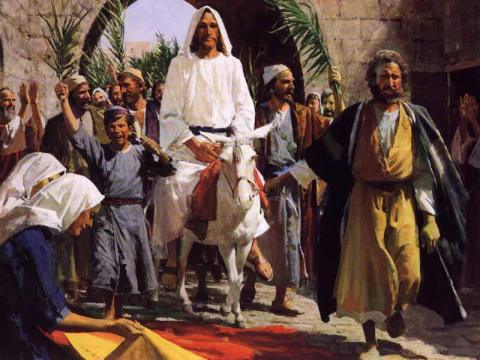
This is the kind of irony and juxtaposition that we find Jesus in as he approaches Jerusalem on a young donkey on Palm Sunday.  He approaches the gates to Jerusalem from the east while a rag tag bunch waves palm branches and throws their cloaks on the ground as he processes.  They hail him as a king and as the son of God, but he looked like anything but with his modest crowd and pathetic animal.  From the west, another king approached the gates of Jerusalem.  Pontius Pilate, appointed governor of Jerusalem rode in to the city on a large magnificent war horse led by royal banners and followed by well-armed soldiers.  Pilate would enter the city to ensure his brand of peace as the Jews celebrated their annual events.  This one was particularly important to watch over because it was the day they celebrated being freed from another oppressor almost 1500 years before.  Pilate had to make sure that nobody got any foolish ideas of revolt if the celebration got out of hand. This man also represented the son of God as the Emperor Tiberius was believed to be.  One man represented peace as a matter of submission and love, the other represented peace because it was enforced militarily.  Pax Christi vs Pax Romana.  Son of YHWH vs Son of Apollo.

Jesus is fully aware of the procession that is taking place on the other side of the city as he enters the East gate.  I get a kick out of the way he sends the two disciples to get a donkey for him and to tell them “The Lord needs it” if they ask any questions.  The disciples get the donkey and say as they were told when asked what they are doing.  The funny thing is that we read this and think how amazing it is that the owner of the donkey knew who Jesus was and perhaps the disciples were thinking the same thing.  This is funny because (Jesus wasn’t stealing because he was only borrowing) he knew that when the owners were told the Lord needs it, they were thinking about Pilate, not Jesus.  There is no way that they would argue when the Roman government says it needs something.  This was a great example of Jesus’s great wisdom.  Jesus knew that he would ride in like a “king” while the real king was coming in the other side who would crucify him like a criminal.

Jesus embodied the wisdom of God while Pilate embodied common wisdom.  Jesus carried within himself a wisdom that pointed to peace and to God in a way that the common culture could not comprehend.  Pilate made a lot more sense.  If you want peace and order, show your might and kill anyone who threatens that order.  Jesus’s brand of wisdom made no sense.  It was an image of God that was not judgmental or coercive, but rather loving and compassionate.  It is a wisdom that is so ingrained in and at the core of all of creation and even within our selves that Jesus said if we do not proclaim it, if we do not live it, “even the rocks will cry out.”

The amazing and somewhat frightening thing is that we embody both.  We carry around with us every day the wisdom of the world and the wisdom of God.  Because the wisdom of the world makes more sense to us, we often submit to it.  We just tell ourselves that “that’s just the way things are done.”  But we also suffer because something at the very core of our being tells us that it doesn’t have to be that way.  We make choices and carry on in a way that makes sense to us because its what we see all around us, all the while something gnaws at us from the inside as even the rocks cry out as if to say “there is another way!”  Jesus spoke of that way.  Jesus pointed to that way.  Jesus sat on a lowly donkey and followed that way himself.

When we embrace the wisdom of God, we make the decision to follow the road less traveled by.  This is the road of Godly wisdom instead of conventional wisdom knowing that it leads to a kind of death – a death of our old selves.  But we also rejoice knowing that after death comes resurrection in some mysterious way that we cannot quite comprehend.  As Easter and the celebration of our own resurrections approaches, let us come to the point when we can say proudly like the old poem that ends, “Two roads diverged in a wood, and I, I took the one less traveled by, and that has made all the difference.”

The Ballad of Judas Iscariot

Posted in Uncategorized on March 18, 2013 by thecrossingchicago

780px-Caravaggio_-_Taking_of_Christ_-_DublinIf anyone in the Bible gets a bad rap, it’s Judas Iscariot.  We have been taught since we were little that Judas was the great betrayer who, as the devil incarnate, turned Jesus over to the authorities to be crucified.  Judas went to the high priests and offered to hand Jesus over to them.  He got a nice sum of money for it, too.  In his gospel, John makes it quite clear that Judas was a good-for-nothing.  He inserts commentary everywhere he can to say that Judas was stealing money from the community purse, that he didn’t care about the poor, and that he was that bad dude who would stab Jesus in the back.  Dare we, however, take another look at the story?

During the end of Jesus’ ministry he told his disciples that he must suffer and die.  He even went so far as to call Peter Satan when Peter said it couldn’t be so.  As Jesus and his disciples made their way to Jerusalem for the Passover celebration, Jesus tells them that the time is drawing near.  The disciples, however, act like they don’t believe it or don’t care and carry on like nothing is wrong.  They are greatly surprised, then, when Jesus actually is captured at Jerusalem and killed.  All except for Judas.

There are numerous theories about what Judas did and who made him do it.  Some accounts say that it was Jesus who told Judas to go talk to the high priests, because he knew he must be captured and wanted it as peaceful as possible.  This is perhaps why Jesus looked at Judas at the Last Supper and told him to go do what he must.  Another account from the Gospel of Barnabas says that it was actually Judas who died on the cross and not Jesus.  This story says that Jesus had already ascended to heaven when the soldiers came to arrest Jesus and so Judas was transformed to look like Jesus and was taken in his place.  The Gospel of Judas says that Judas was Jesus’s closest disciple to whom he revealed the mysteries of the universe.  Jesus then had Judas turn him in so that he could be freed from his body and returned to his eternal form, but the other disciples couldn’t comprehend this so they stoned Judas.  The most popular version, of course, is that Judas was possessed by Satan and betrayed Jesus for money.  Regardless of which is actually correct, let’s look at a more simple possibility.

Judas Iscariot, son of Simon, grew up in Kerioth in Judea.  Simon did the best he could for his family, but he was by no means a rich man.  Judas grew up always telling himself that he would not let his kids be poor as he was.  He was going to make a better life for his family than the one that he had been given.  After Judas was called by Jesus, he was commissioned with the task of keeping the community purse.  As such, he was the one who would have to go to pay the temple tax when it came due.  Judas may have dipped in to the pot to make ends meet on occasion, and maybe not.  If he did, was he any worse of a sinner than anyone else?  After all, he had mouths to feed and no way to provide because he had decided to follow this carpenter’s son.  Sure, it was a tough decision to leave his family behind, but although Judas wasn’t really sure who this guy was, he knew that there was something about him and that he just might be the one to lead the revolt against the Romans that oppressed them so much.  So, Judas followed Jesus, listened to his teachings, and did what he was told.

As he and the rest of the disciples made their way to Jerusalem, Jesus kept talking about how he was going to be captured and killed.  This worried Judas.  If this happened, then there was no way that Jesus could help them conquer their occupiers.  When they arrived in Jerusalem, Judas went out to deliver the temple tax like he did every year at Passover.  The high priests see him and said, “Hey Judas.  Come over here a minute.  We realize that you travel with Jesus and we have been hearing about all of the amazing things that he has been doing.  We were especially amazed when we heard that he had raised a man named Lazarus from the dead.  We realize that it is in all of our best interests to ally with Jesus because it does nobody any good if we are against each other.  Clearly with so much power, God’s favor rests upon this man.  We would like to talk to Jesus about this, but it is important that we keep this hush-hush so as not to insight any trouble from the Romans.  Can you help us get a meeting with him?  In fact, here, this is really important to us and for all of Israel, so we want to offer you payment for doing this.  We realize it isn’t easy, so here you go.”

And there it was.  Judas was being given today’s equivalent of $100,000 to do what was right!  Finally, he wouldn’t have to worry about feeding his wife and children.  He was being asked to be a liaison between Jesus and the high priests.  What a huge role!  Finally, Jesus could partner with someone in power to overthrow the Romans AND he was getting paid to make the arrangements.  God truly does bless!

And so, we know the rest of the story.  Judas goes and tells Jesus about the arrangement.  He will kiss him so that the authorities know which one he is and they will take him in and they can talk in private.  Jesus agrees and when it is time, Jesus tells him to go and do what he needs to do.  Later that night, he returns, but something is wrong.  He notices that the high priests are accompanied by Roman soldiers.  Judas starts to panic, but then he thinks, “Maybe the Romans won’t let the high priests do anything on their own, so they had to come with.  Then, when the priests are alone with Jesus and the soldiers are gone, they can have their talk.  Ok, stay cool.”  But we all know it didn’t work out that way.  Jesus ends up on the cross and Judas realized that he had been duped.  He feels so bad, so guilty for not only causing the death of his teacher and friend, but also for letting down the people of Israel and destroying their chance at a good future, that he gives the money back to the priests and then hangs himself.

Poor Judas.  He probably didn’t do anything wrong, but because people have their agendas, he was painted as the ultimate of bad guys.  Regardless of what really happened, there was something that Judas was missing.  It is something that I, too, have overlooked or mistaken at times.  When I work out I like to listen to podcasts.  I usually listen to a particular podcast where a couple of theology nerds called Trip and Bo sip craft brews and host a program called Homebrewed Christianity.  On this program they host a number of theologians and scholars of the church.  A few weeks ago I was listening to one with Diana Butler Bass.  As they went to a Q&A session, the first question that was asked of Diana was one that stumped me, too.  The person asked, “If we are telling people that they need to come to church so that they can help the poor and the oppressed, then what do we do when those people respond that they already do these things through a non-profit?  What, then, are we to tell people is the reason to come to church.”  I had to think about this for a good while.  I eventually realized, that I, like Judas, had something to learn from Mary Magdalene.

Jesus was at the home of Lazarus, Mary, and Martha to celebrate the resurrection of Lazarus.  Jesus had just told them all again that he would be killed soon.  Sure enough, when the authorities heard that Jesus had raised Lazarus they got very worried that this powerful of a person could cause some real trouble.  So, as the text says, they plotted to kill him.  Mary knew a thing or two about burials.  After all, she had just done her brother’s.  Mary anointed Jesus not as a king from the head first, but as a corpse, from the feet first.  She realized the importance of ritual in difficult times.  She knew that in times of great sadness and great joy like birth, death, and the journey to death that we need friends, support, rituals, and meaning to help carry us through these times.  This, you see, is what both Judas and I were not seeing.  This is why the Jews begin preparation for death with rituals and stories while the person is still alive.  This, is why we gather together every Sunday morning to support one another, uplift each other, and to celebrate through ritual, our births, our deaths, and the many resurrections we experience throughout our lives.


The Prodigal Me

Posted in Uncategorized on March 8, 2013 by thecrossingchicago

ProdigalMy brother has always been the type who could get away with pretty much anything.  Being the younger of the two of us, he would just get a “Now Trent, don’t do that” from my mom, where I would get a pretty stern talk or a kind pat on the rear for doing the same thing.  I remember that I would always take a sort of joy in the rare occasions when he actually got what he deserved like when my grandma chased him through the department store trying to wallop him with her purse for darting around inside the clothes racks.  One time I actually set him up.  He was just learning to write his name, so after getting his handwriting down I took my mom’s lipstick and wrote his name on the wall.  I put the lipstick back in the bathroom drawer and then ran to mom saying, “Mom!  Look what Trent did!”  He got it pretty good for that.  I kind of felt bad.  Kind of.  It felt pretty good to see him get what he deserved for a change – even if he didn’t actually deserve it that time.

Last week we talked about people getting what they don’t deserve.  This week we talk about the same thing in a different way or maybe about people not getting what they deserve – depending on how you look at it.  The Pharisees are chiding Jesus for eating with “those people” when he in essence tells them three stories rolled in to one.

First, he tells of a father who had two sons.  The oldest son is the good son and does everything that he is supposed to.  The youngest son took his inheritance and left town.  It was tough for the father because he realized what his son was saying when he asked for his inheritance.  In essence, he was telling his father that he wished he was dead.  Even so, the father bucked the customs and sold the family land so that he could pay out the inheritance.  You see, Jews would NEVER sell their land because along with a king, the Torah, and their temple, the land was something that God gave them as a special gift.  He knew that when he did this his name would be mud and he would be ridiculed by the town folk, but wanting his son to be happy, he went through with it anyway.  As much as it pained him, he sold the land and let his son go.

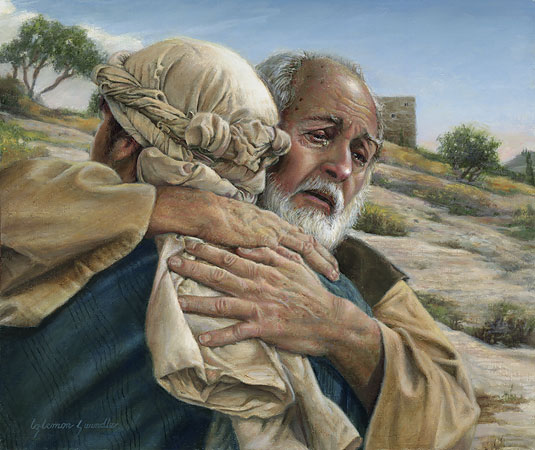
After a long time of wondering if he had made the right decision and being concerned that perhaps he should have exerted a little more control of his son for his own good, he was sitting as he did most days, staring down the road.  Then, suddenly, he saw a figure approaching.  It was a figure that rippled because of the heat rising up off of the desert floor.  Today wasn’t a delivery day.  There were no buyers or sellers scheduled for today that he knew of.  He squashed any glimmer of hope that his son was alive and well and finally returning for fear that he would be disappointed just like he was every time he saw an unexpected visitor make his way up the road.  But today would be different for his heart leapt when he saw his son approaching and he yelled out to the servants to prepare a party because his long-lost son had finally returned.  In anticipation that this day may come, he kept a robe, a ring, and some sandals in a small box next to his chair and so he picked it up and took off running down the road.  It was highly uncustomary for a man of his age and stature to be running as it was not perceived as being stately, but he could care less.  He had to run because he needed to get to his son as fast as he could.  Not only did his heart ache to embrace his son, but he also knew that the neighbors would want to stone his son for causing the Levitical laws to be broken.  He looked around frantically to make sure that nobody had noticed his son and was poised with rocks to hurl, and caught up with his son engulfing him in his arms, ready to take any stone that was thrown.  His son started to say something, but he couldn’t hear it through his own sobs of joy and after placing his finger on his son’s lips to silence him, he bent over and picked up the box that he had dropped at his feet and pulled out the robe and placed it lovingly over the shoulders of his beloved son.

You see, though, this wasn’t just a story about a father who got his son back and loved him unconditionally.  Within this narrative there was also the story of an older brother who did everything “by the book” just as he was supposed to.  He stood to automatically inherit two thirds of his father’s estate, but he still did all of the things that were required of him.  Even when his bratty younger brother caused strife in the family and community by talking his easy-going father into selling part of their land, he kept on following the rules because he knew those who did what they were supposed to got the good things in life.

Sure, he loved his younger brother, but he really didn’t care either way if he came back.  He had already caused enough trouble and had chosen his path, so he figured he could just stick with it.  The last thing he needed was the spoiled kid coming back and ruining things for him again.  He had already done enough damage.  So, when he heard that his brother had returned and that his father was having a party for him, he was furious!  His father never did anything for him!  His brother chose to go out and throw his life away on booze and whores!  And now, he had come back to mooch off of him because all that was left belonged to the brother for his inheritance.  Besides, he should have to live with the decisions he made and pay the price for his actions.

Then, finally, there is the son whom we call the prodigal. We’ll call him Jesse for today.  Jesse was always bored on the farm.  He heard about others who got to see the world and about how much more exciting it was out there.  His father was kind of a dunce and did an ok job of raising him after his mother died, but he didn’t feel that close to his father.  Sure, dad tried to be close, but Jesse just wasn’t feeling it.  And his brother – well, his brother was quite a bit older than him and they didn’t talk much.  Whenever they did talk, it was mostly his brother telling him how he was doing something wrong.  He didn’t hate his father, but in some guilty secret way, he did wish that his father would die so that he could get his inheritance.  Life would be so much better when he could have his one third of the estate and get out of there.  Sure, it was unheard of and against tradition that he should leave, but to heck with tradition.  He would let his self-righteous brother deal with keeping tradition since he was so good at it.

He felt so out of place there and the urge to get out overwhelmed him to the point that he mustered up the courage and went and did what he had thought of so many times.  Yes, he realized that what he was about to do would be the same as telling his father to his face that he was dead, but he didn’t care anymore.  His brother raised a stink just as he knew he would, but his father acceded and made the wrath-inviting announcement that he would be selling the back 40.  He realized that he wouldn’t get top dollar for it, but he knew that his son wanted to get his money as soon as possible.  The townsfolk were shocked, but many jumped at the opportunity to get his land at such a cheap price.  Once the money was in hand, he took his donkey and headed out for his new and exciting life.

Well, as we all know, it didn’t turn out to be as exciting as he wished.  You see, Jesse thought his money would last forever.  It never occurred to him that someday he would have to work get a job and learn how to support himself.  He realized that the money was going fast and unlike in the beginning when he was spending it on whatever pleasured him at the moment, he became a little more frugal.  It wasn’t enough, however, and he eventually found himself destitute.  This is when he realized that because he had been living off of his father, he had really never acquired any skills beyond the simple tasks that he performed on the farm.  Had he been in his own land, people would have known who is father is and given him a decent job, but out here he was just another snot-nosed rich kid who blew all his money and was left to beg for work.  Eventually, he found a job doing the most demeaning thing a Jew could imagine – slopping out pig stalls.  He knew his father’s servants even had it better than he did.  He supposed that he could try going back home, but he wasn’t about to listen to his whiny brother say, “I told you so.  You got what you deserve and now you have nothing!”  After heat and the stench and the hard physical labor became too much to bear, he started rehearsing a speech in his head.  “Father, I’m sorry.”  No, not good enough.  “Father, please forgive me.”  Better, but not formal enough.  “Father, I have sinned against heaven and against you . . . .” Yep, that would work!  And so, he threw down his shovel, grabbed his satchel with what little he had left, and started for home.

I wonder which one I am.  I wonder which one Jesus wanted his listeners to identify with.  Maybe he’s telling me that I should be unconditionally loving and forgiving like the father.  Maybe he’s telling me that God is like this and when I stray, and like the prodigal son, choose to turn back and go home, God will be waiting to embrace me.  Perhaps, Jesus is warning me not to be self-righteously indignant like the older brother.  And just maybe – Jesus is saying that depending on the day, the hour, or even the minute, I am all three of these people.  Maybe Jesus is telling me, telling you, telling all of us, that we are indeed any of these people at any given moment, but most importantly, that we are all prodigals and that we are all invited to the banquet regardless of our differences or idiosyncrasies.

Sinners in the Hands of an Angry God . . .?

Posted in Uncategorized on March 2, 2013 by thecrossingchicago

america-repent-perish-battaile-politics-1353334621Almost two years ago now I was in bed sleeping when my wife came up and woke me at about one in the morning.  She said that her brother had just called and said there had been a large earthquake and tsunami that hit the Tohoku region of Japan.  Her grandparents live in that region, so I sprang up wondering if they were ok.  They only sustained a little bit of damage, but when I turned on CNN, I could see this massive wall of water traveling at over 500 miles per hour and destroying everything in its path.  15,880 people died in that natural disaster including my friend’s cousin and his family.  He was at work when the earthquake hit and being concerned about his wife and three month old baby he left the office which was up in the hills and, as you might have guessed, was taken along with his family when the tsunami reached their home.  His dad – my friend’s uncle – who was a very happy person who liked to tell jokes, was left with the task weeks later of walking through rows and rows of bodies looking for his son, daughter-in-law, and grandson.  When he returned home after finding them and after seeing so much death and destruction he locked himself in his room and still does not talk very much to this day.

When such tragedy strikes, we can’t help but ask ourselves why such things happen.  I guess when we think about it this disaster makes sense in a way.  After all, only about one percent of Japan’s population is Christian.  So, it only makes sense that God would want to punish such a heathen nation and give them a wake up call to turn to Christianity.  Even the text in Luke 13 talks of God’s wrath.  Repent or perish!  Just to prove the point even further, Jesus tells a parable about a tree that just takes up space.  This obviously is talking about humans who do not obey God and God’s desire to wipe them out, but Jesus the gardener becomes our intercessor and pleads our case for us.  Oh well, there’s nothing much that we can do about it other than start evangelizing as much as we can so that God does not become too angry.  God is God and God can do whatever God wants, we will just have to learn to live with it.

Or will we? Maybe this isn’t what this passage says at all.  The word repent in the  original Greek actually means to change one’s mind and as a result change one’s actions.  When Jesus is asked if those who died did so because of the degree of their sins, Jesus says “No!”  That’s not how God works.  He warns them, however, that if they do not change their minds and therefore their actions, then they too will meet a horrible end.  Jesus is not talking about divine retribution, he’s talking about natural cause and effect.  If you go around ticking off the ruling powers and go do things that you are not supposed to, you will eventually be crushed.  Jesus knew this.  He knew the end that he would fall to as a result of his challenge of Roman authority.

And the fig tree?  Jesus was a first century Jew.  He understood the Levitical laws that forebode harvesting before the fourth year.  A fig tree, once planted, was supposed to give off its first fruits on the fourth year!  So, if God is anywhere in this parable, it is not as the mean illogical master, but in the gardner who reassures us by saying, “I wouldn’t do that to you.”  This passage is teaching us that God does not expect the impossible from us, but loves us and supports us to be the best that we can be.

We learn a certain way of seeing things we start to build frames and walls around ideas.  Eventually, these frames become so solid and unchanging that they become absolute truths.  Reading this text is proof of that.  We read this and we hear God saying something that God NEVER says to us.  But, because we were taught a certain way, we are afraid to chance seeing things anew.  We are afraid to repent, that is, change our minds, because it’s scary territory and what if we’re wrong?

Unfortunately, this isn’t the only text that we misinterpret.  I think the Church – the universal church – can stand to do some repenting.  In the 5th century, one of the church fathers named Cyprian declared that there was no salvation beyond the church.  It made sense that he would say this because it was not long before that Constantine declared that the Roman Empire would be Christian.  The Roman occupiers were tired of contending with those hard-headed Christians who weren’t afraid to die for their faith, so they decided if they couldn’t beat them, they could own them.  The church and the government became one and in order to ensure that the people listened, church leaders who were controlled by the government such as Cyprian said, in essence, you need Jesus for salvation, you can only find Jesus through the church, and we hold the keys to the church.  So you better listen to and obey what the church says!  Such thinking of the church as a rule-making body in the name of God has almost made the church disappear in North America.

I think that the Church needs to start changing its mind and actions about long-held beliefs.  Many who are leading the transformation in the worldwide church have said that it’s time to rethink what church means.  Many people outside of these walls see churches and think – “There’s another judgmental institution that wants to tell me how to believe and has sunken into the abyss of irrelevance.”  We have an amazing opportunity here at Tri-C.  We have the opportunity to be a beacon of light to the community around us and start asking ourselves, what does it mean to be the church anyway? We have the chance to show them that they’re wrong and the church still is relevant today.  It just may not be as a bastion of legislating God’s laws and enforcing them, but it may be some amazing expression of love that we never could have imagined.  WE have the opportunity to say we are willing to set a new standard, to say that we are willing to change our minds and start seeing things the way that God sees them.  NOT necessarily the way that we were taught growing up.  Who knows, the ONA discussion may just be the place to start.  We have been blessed with this calling to show that we realize that the God who made creation and loves creation and who is constantly flowing toward the greater good still has some wonderful things to do – through us.

Into the Lenten Wilderness

Posted in Uncategorized on February 16, 2013 by thecrossingchicago

stone-desert-near-monastery-mar-musa-in-syriaWhen I was living in Japan, I would often attend the Buddhist temple that my father-in-law attended.  I gleaned a lot of good insight and in fact learned how to be a better Christian there.  How’s that for irony?  We would occasionally have special guests come and talk to us and on one such occasion a priest and professor came from Otani University in Kyoto.  I will never forget what he said.  He explained that a tadpole will naturally become a frog; however, a human child will not naturally become a humane human being.  A human must intentionally exhibit love, compassion, and empathy in order to consider him or herself a humane human being.  Before we perform any action or utter any word, we must consider the effect that it will have on those around us. This, he told us, is what it means to be enlightened.  This is what it means to be a Buddha.

When I heard this explanation I let it roll around in my head for a while as I pondered it imagining that there was some great significance until it eventually sunk into my heart – Eureka!  This is what it means to be more Christ-like!  This is the essence of being Christian!  When we are able to shed our attachments to a level that we are actually capable of considering another before ourselves every time we do something, then not only will be a living example of the love that Jesus taught, but we will also necessarily experience God so much more deeply as Jesus also taught.

Now, as I use the word “attachment”, I realize that I have to be cautious and clear about what I mean.  In the traditional Buddhist definition, an attachment is something that we create that leads to suffering.  For example, if I am getting off work after a rough day, I might think of how great it will be to get home, pop the top off of a cold one (whatever a “cold one” is in your definition), and watch a ball game.  The day has been rough, but with that cold one and ball game in mind, I can make it all better.  In fact, I equate those things with happiness.  So, I am driving home and I get stuck in traffic.  I get upset because they are getting in the way of me and my happiness.  I may start to road rage or at the very least just have a very stressful drive.  Sound familiar?  How many attachments in our lives do we create that just make us suffer?  Wealth?  Power?  Our own image of bodily perfection?

The desert fathers and mothers of the early church recognized how much these attachments and distractions could interfere with our experience of God.  Certainly there was persecution that they were running from and they against the eventual marriage of church and state as a viable form of spirituality, but mostly, many engaged in the practice of Hesychasm – a form of solitude where practitioners could encounter God in spiritual disciplines.  The Hesychasts realized that our attachments could lead to temptations, because, after all, if we are not attached to something it cannot tempt us.  So, through the practice of spiritual disciplines, they sought detachment which led to less temptations, which led to a stronger and deeper experience of God.

Jesus realized this also.  We often look at Jesus’s temptations as a malevolent being trying to take advantage of Jesus when he is at his weakest point.  He’s hungry, he’s apparently hopeless, and assumedly feeling powerless.  I think such a reading doesn’t really do justice to the story or to its point.  I don’t think that Jesus was weak at this point.  I think he was strong because he was in solitude and fasting.  He practicing spiritual disciplines out away from the distractions and all he had to contend with was his own mind.  Sometimes it’s our own wandering thoughts that are our biggest enemy.  Look at that beautiful car, I’d be happy if I had that!  Look how much money they have, man, if I was loaded like that I would never have to worry about a thing!  It must be nice to have so much power.  I could do whatever I want if I had that kind of power!

Jesus goes away from these things and finds himself able to overcome these temptations.  Jesus became quite popular with the people and many of them wanted to make him king.  He could have easily claimed power and riches for himself, but that wasn’t what he was about.  Because he was intentionally seeking God in all things, he found himself able to overcome the temptations when they were thrown at him.  Jesus doesn’t, however, say that overcoming attachments and the temptations that they lead to will be easy.  Just ask the disciples.  One rebuke followed another when the disciples were seeking power and prestige for themselves at the right hand of Jesus.  As we saw last week in the transfiguration story, Peter especially is always getting himself in trouble because of his attachments even though Jesus constantly keeps pointing the way toward God.

I wonder what it would look like if we followed Jesus’s example.  I wonder what it would feel like if we intentionally sought solitude and centered ourselves while shedding our attachments.  It would probably lead to less temptation.  Imagine that we aren’t as phased and stressed by the things that life throws at us and when things don’t go our way we just roll with it.  Imagine if we weren’t constantly looking ahead to some time in the future when things will be alright and we take what we have and say it is alright right now.  Why don’t we take these 40 days of Lent and start own own journey into the wilderness to find solitude and find God?

Imagine the renewal that would take place in ourselves and in the entire church if we were at such peace that we didn’t have to say “I’ll be happy when I get that bonus, or when this is done or that is done, or I get this or that,” but instead say “I am not going to let myself be attached to those things.  Instead I am going to sit right here and appreciate, recognize, focus, and experience the fact that I am in the presence of God.”

Down Here in the Valley

Posted in Uncategorized on February 9, 2013 by thecrossingchicago

Saint Columba's BayMy daughter is quite a simple human being.  If you smile at her, she will smile back.  If you laugh at her or sing to her, usually she will laugh or sing back.  When she is hungry, she cries.  When she is full, she sleeps.  When she thinks she’s alone she gets anxious and when she realizes we are near, she is at peace.  She sees the world as being full of endless possibility and accepts it as it is in all of her, and its, simplicity.

I haven’t asked her, but to the best of my knowledge, she does not lie there and ponder why my wife is feeding her or with what motives we smile at her.  I doubt she calculates the probability and timing of her next feeding and assesses our characters based upon how often she is fed.  Instead, she encounters us and the rest of the world around her in wide-eyed amazement, accepting life as it comes along.

Unfortunately, though, at some point in her life, she will do as the rest of us do.  Somewhere along the way she will lose this ability to appreciate life and to see the world with eyes of simplicity and gratitude.  At some point, we all begin to feel the need to make sense of everything and start to put everything in to its own logical category.  Thinking about this made me realize that rarely ever is theology actually done.

I realized at some point in seminary that I was not actually studying theology, but rather the history of other people’s theology.  We were given the categories and options and asked to choose which one fit us best.  While saying that we were free to choose, the professor would inevitably nudge us ever so gently in a particular direction lest we should go astray.  But rarely if ever were we asked how we encounter God and where.

This may be an overstatement, but I am hard pressed to find any place in the New Testament where Jesus described God.  There are plenty of places where he talks about experiencing God, but none where he gives a theological treatise on the existence of God.  Jesus set an example that was experiential that embraced the closeness of God.

It didn’t take the early church long to start pushing God away.  As human beings we have a great fear and dis-ease around mystery, so we feel compelled to explain everything.  How can Jesus be God, the Holy Spirit be God, and God be God when we are monotheists who only believe in one God?  Oh, well let me tell you about this formula I came up with.  We’ll call it the trinity.  How can God be good, but if God is the creator of all, then doesn’t that mean God also created evil?  Let me figure that one out.  I’m not at all saying that we shouldn’t think.  We should!  There is definitely a time and place for thought and reflection.  But we keep on coming up with ideas (some old and some new) to understand God and make sense of who and what God is.  In doing so, all we do is push God farther and farther away out of the realm of possibility for a genuine encounter.  We make that which is to be experienced at the very depths of our being into a mere cognitive theory.

Recently, one of the regular attendees of The Crossing handed me a book.  She said, “This is for you.  It’s Father Moon’s formula for the Original Principle of the Divine Substance and the existence of God.”  I smiled kindly and told her thank you.  But in my mind I was wondering, “Are we humans really that presumptive to assume that we can reduce the essence of all of existence to a single formula?  Are we so deluded that we think we can build a logical shelter to contain God for the benefit of our own understanding?

Peter tried to do that.  Rather than be astounded and silenced by the fact that he was standing in the presence of God, during the transfiguration he basically says, “This is great that we’re all gathered here!  Let’s build some little tabernacles for you holy folk to memorialize this event. Let’s concretize this so that we can come back and ponder on it later.”

We could sit and try to figure out what happened that day.  We could study the text carefully and consider in its context and judge the validity and facticity of the statements made in it.  Were they really on a mountain or even a hill?  Were Elijah and Moses actually physically standing there with them?  I don’t think it matters.  Elijah had encountered God on a mountain.  Remember that in 2 Kings?  He went up the mountain and there was a wind and fire and God was in neither.  Instead, God was in the sound of sheer silence.  Or what about Moses?  Westyn just read to us that in Exodus Moses climbed a mountain and after encountering God was aglow from the experience.  Now Peter and the others are on the mountain or wherever they are with Jesus and Peter is told “This is the one who knows how to experience me.  Be quiet for a change and just listen.  Don’t talk, don’t conjecture, don’t make up formulas, just be still and aware that you are in the presence of God.”

The next day, when they head back to be with the others they are met with a crowd.  A frantic man who seems to understand more than even the disciples meets Jesus and begs him to heal his son who is having some sort of fit.  A demon?  Epilepsy?  Some mental disorder?  We don’t know.  It’s not important.  What matters is that Jesus heals the boy in some way that we don’t even need to try explaining.  Being so close to God, having encountered the God of creation and been set aglow by the experience, Jesus is able to calm this boy in a way that none other could.

But Jesus is upset.  Not at the man for coming to him, but at the disciples for not doing anything.  “I begged them to cast out the demon, but they couldn’t do it,” the boy’s father said.  In the beginning of chapter nine in Luke, Jesus had commissioned the disciples and told them that they too could heal.  He told them that they too could do the things that he was doing.  But like Peter, they were too busy panicking, too busy trying to figure out what to do, too busy with their ideas to realize that an encounter with God and the amazing effects that come with it were right there at their fingertips.

In Celtic Christianity it is believed that there are places where the veil between this world and the world of the sacred is thin.  Barbara Brown Taylor says that “thin places are those places on this earth where the veil between this world and the next is so sheer that it is easy to step through.”  Although these thin places can be out in nature with beautiful scenery all around, she says “But thin places aren’t always lovely places, and they’re not always outdoors.  Hospital rooms can be thin places.  So can emergency rooms and jail cells.  A thin place is any place that drops you down to where you know you’re in the presence of the Really Real—the Most Real—God.”

I would imagine that each of us can recall at least one time where we were somewhere or doing something and we suddenly became aware that we were in the presence of the sacred or standing on sacred ground.  I’m sure we have all been to a thin place where the hairs on our neck and arms stand up on end and we just can’t explain, but we take it in and enjoy the presence of God rather than think of it.

When I was in college, I was learning so much about the Bible and what people thought about God that it kind of shook up my faith.  I still remember when my wife was pregnant with Westyn, the professor congratulated me and said, “See?  In those ultra sounds can’t you see proof that God exists?”  I told him no.  The other day my wife said that she couldn’t believe that Selah was nothing before the cells that came together and grew formed her and she was eventually born.  Although I realize that he was using the existence of babies to prove the existence of God, I came to understand what my professor was saying even if he didn’t mean it this way.  Cradling a baby who is so much more aware than we of the simplicity, yet amazing wonder of this creation is to be in a thin place.

The thin places are everywhere.  We don’t have to build a tabernacle on the mountain to commemorate an experience.  We don‘t have to figure out just the right formula to be in the presence of God, but instead, we can find God even right here by merely listening and being aware of the presence of our creator.  We can have an encounter with the divine that will set us aglow and make us feel like we have been to the mountaintop right here – even down here in the valley.

The Gospel According to . . . ?

Posted in Uncategorized on January 26, 2013 by thecrossingchicago

what is the gospelIn 1972, Bruce Anderson arrived at Fort Hood after a tour in Vietnam.  He was from Toledo and went outside of the base to a nearby gas station to see if he could get a ride.  A man named Larry Johnson was a traveling salesman who happened to be gassing up at the station and upon seeing the approaching young man in an army uniform carrying a duffel bag asked where he was headed.  Anderson replied that he was heading home to Toledo and Johnson said he could get him as far as Chicago.

As they headed northeast, Bruce, who was a devout Christian, kept feeling a nudge to tell Larry about his faith.  He kept fighting it because he didn’t want to upset his ride and wasn’t sure how his kind driver would take it.  Finally, at about St. Louis, Bruce began to talk about his faith with Larry and explained to him that Jesus had died for his sins and by simply believing in the fact he could avoid hell and have eternal life. After about an hour, Larry pulled over the car and the two prayed.  Larry dedicated his life to Christ there on the side of that highway.

Larry dropped Bruce off at the bus station in Chicago and left to make the short drive home.  Roughly five years later Bruce was in Chicago on business and decided to look Larry up.  With a name like Larry Johnson, he wouldn’t have been easy to find, but Bruce remembered that he said he lived in the Western Roger’s Park area of Chicago.  Bruce parked his car across the street from the simple brown brick bungalow and trudged up the sidewalk and steps to the front door.  A tired looking woman came to the door and after Bruce asked for Larry, the woman informed him that she had been Bruce’s wife.  Bruce had been killed in a car accident not far from home on his way back from a business trip to Texas.

Bruce’s widow invited Larry in for tea and he explained that Bruce had given him a ride from Texas and dropped him off at the bus station on that fateful day.  He explained how Bruce had pulled over the car on the highway outside of St. Louis and given his life to Christ.  The widow began to weep and said that she could finally have peace because she had always been trying to get Bruce to accept the gospel.  Finally, at the bidding of a stranger, he had accepted his Lord and Savior as his own before meeting his death.

Phew!  Thank goodness.  I hope that in hearing this story not too many of you are feeling moved.  This story didn’t happen.  It’s a made up tale on a website on the internet for pastor’s to find sermon illustrations.  Apparently when you’re not preaching what Jesus actually said, you have to find cute little made up stories to make your point.  It’s a terrible example of what the church calls the gospel.  It may have happened in some form or another at some time or another, but it didn’t happen like this.  Neither did the gospel, not the church’s version anyway.  This story is supposed to be a warm fuzzy example of someone being saved by the gospel.  But it isn’t.  If we are to go along with what the church has painted as the gospel over the centuries, then Jesus is the most divisive, condemning person who ever walked the face of the earth.  And I’m here to tell you he’s NOT!  As a matter of fact, when Jesus read from Isaiah 61:1-2, he purposely left out the last part of verse two – “and the day of vengeance of our God”.  See?  That wasn’t Jesus’ message.  He intentionally shows that condemnation is NOT his game.  The idea that everyone has to believe one specific way wasn’t and still isn’t the gospel.

It is no accident that Jesus starts off his ministry with this speech.  He comes and tells people what he has come to proclaim, not do.  And then, the funny or sad thing, depending on how we want to look at it, is that Jesus says “Today this scripture has been fulfilled in your hearing.”  Nope.  It wasn’t.  Yes, in one way he was saying that the reading of this scroll fulfills Isaiah’s prophecy, but two thousand years later the church has forgotten what the gospel is and is preaching a warped version.  This is not to say that all churches are this way, but one doesn’t have to go far to find Christians who think that John 3:16-18 is the gospel.  Well, ain’t that good news?  So, the church is left making stories like the one that I told to make the gospel what it means – good news.

Imagine with me, if you will, that the church one day decides it’s going to rediscover the gospel and be honest about what it means.  Imagine that the church takes Jesus seriously when he says that the kingdom of God is within us.  Everything that Jesus teaches points to us doing things.  When I was hungry, you fed me.  When I thirsted, you have me drink.  These 5,000 people are hungry?  You feed them.  Seriously.  Just take a moment to imagine hundreds of thousands of churches with billions of members actually doing the gospel as Jesus described it.  This means that the gospel is a verb.  It’s about the doing, not about the believing.

In my typical sermonic form, this would be the spot where I insert an illustration of what the gospel according to Jesus would look like.  I was going to tell a true story about someone who actually brought freedom to the oppressed, release to the captives, sight to the blind or good news to the poor.  There are in fact many stories like this, but I don’t think Jesus said and did what he did just for us to sit around and talk about them.  So I’m not going to give an example.  Instead, let’s go out and make some stories of our own.  Not fake ones to match up with a fake version of the gospel, but real ones to reflect the real gospel based on acts that we actually do.

I still have faith that some churches are starting to get it.  I maintain hope because some churches, like this one, are willing to go straight to the horse’s mouth, so to speak, and find what the gospel really is.  I am convinced that some day we will wake up and realize that the Kingdom of God has come, not because of some supernatural or cataclysmic event, and not because the church decided to agree on a particular view of Jesus, but because the church decided to take Jesus seriously and start doing the gospel instead of arguing about what it is.

I’m Baaaaaack!

Posted in Uncategorized on January 25, 2013 by thecrossingchicago

cyber-crime-handcuffsI’m glad to be back at blogging!  Over Christmas, a kind person whom I will not name at this point took it upon herself to hack several accounts including this one.  She deleted the blog, but luckily WordPress was able to recover it.  So, between the hacking, harassing phone calls and emails, and a bunch of other stuff, I have just let the Attorney General deal with things.  Because this person is out of state, most of her crimes are federal.  According to the AG, she currently has 87 counts against her with separate sentences including harassment, cyber crime, hacking, cyber stalking, etc.  The calls are all forwarded directly to the AG’s office, so I’m not sure if she’s still calling.  Each call is a separate charge.  They have also been working with the FBI (since they are interstate crimes) and apparently even with the IRS.  They won’t give me any info on that since it doesn’t relate to me.

So . . . I’m left with the conundrum of either pressing charges or turning the other cheek.  The AG says we should wait and see if she keeps harassing to get the maximum charges, but I do have a soft spot that feels sorry for her.  Anyone who would waste their time in such a fashion instead of using their time to better themselves or the world must have issues.  Without any sarcasm whatsoever, I do hope that she can find some better meaning in life and be able to enjoy her family more often.  In the meantime, there is always the statute of limitations . . .  Hopefully she will just leave me alone and we can go on with our lives doing the things in the world that we are supposed to.

A Light Shines in the Darkness

Posted in Uncategorized on December 22, 2012 by pastoralb

moonstarMany of us will be greatly disappointed on December 26th.  The fog of Christmas and the blinding that comes from Christmas lights will fade away and we will be able to see.  We will see that things are the same as they were a few days before and we will wonder.  We will wonder why every year we anticipate, commemorate, celebrate the birth of hope into the world only to find that nothing changes.  Sure, we will have those who will make the concerted effort to be less abrasive over the holidays, but once the Christmas cheer has worn off it will be business as usual.  And then we will feel let down.  We will feel that somehow we have been shafted or maybe even lied to.  We will ask ourselves where this great hope is and what the point is of celebrating this false expectation.  We may even start to think about the story itself and become cynical wondering how anyone can believe in such a story anyway.  Then we will sit in this mindset until advent next year when we start to tell ourselves again, just maybe.  Maybe this time things will be different . . .


A few days ago I told my oldest son that we were going to the Hanover Park Community Center to hand out food and toys to the underprivileged children and he got mad.  My youngest was asking me if he could go and was excited to do it, but my oldest wanted to sit and play video games and was upset that I dare interrupt his game time with something as mundane as handing out stuffed animals.  How dare I?  I told him it was ok, he didn’t have to go.  I would just tell Jay that he had better things to do than help children who were less fortunate than him.  He threw down his controller and said “FINE!” and went along begrudgingly.


When we arrived I gave him a bag of stuffed animals and stepped back to watch.  His eyes got bigger and bigger as these children, some barely walking and some older than him, had their faces lit up as they received gifts that they could not have otherwise received.  Mothers and fathers sat with tears in their eyes as their children were given a Merry Christmas that they could not afford to provide.  More than once my eyes welled up with tears.  When it was time to leave we ran through the snow that had started to fall heavily and jumped into the car to get warm.  I heard a voice from the back seat.  “Did you see that?  Did you see how happy they were?  Those cute little kids were so happy with things that I wouldn’t even think of.  Wow.  We really are lucky.  You were right dad.  That was a lot better than playing video games.”


It sure is funny how pleased we can be with things that aren’t what we expected.  But we can also be pretty disappointed when we expect something out of misunderstanding and it never comes.  I wonder if this is what we have done with the Christmas story.  Jesus is born under a time of great oppression.  A time when the Jews felt that God had become far from them.  It was also near the winter solstice – the longest night of the year.  Wow, what imagery!  Into the darkest night comes the brightest light . . .  Immanuel, God with us.  The word, the light had come to dwell among humankind.  What if these scriptures are trying to tell us something?  What if Jesus was trying to tell us and remind us of a great truth that we completely misunderstood and as a result led to great disappointment and hopelessness?


Isaiah 9 says “The people who walked in darkness have seen a great light; those who liven in a land of deep darkness – on them a light has shined. . . For the yoke of their burden, and the bar across their shoulders, the rod of their oppressor, has been broken.”  And so we wait.  We wait for this to come true.  We wait with great expectation for the day when bad things don’t happen anymore and the burden upon our shoulders – life, death, debt, loss, sickness, hunger – is finally lifted.  We wait and wonder why Jesus doesn’t hurry up and do something and how can God be cruel enough to make us wait like this.  But what if, just what if we missed something very important?


John 1 tells us that the light shines in the darkness, but the darkness did not overcome it.  Jesus carried the light of God.  The spark of the divine.  The kingdom of God.  What if Jesus actually meant it when he said “the kingdom of God is within you.”  What if John 1 is telling us that Jesus showed the way for us to realize that we, too, have the spark of the divine within us?  After all, we are told that we are made in the image of God.  What if Jesus meant it when he said “go and do as I have done.”  WHAT IF, the whole time Jesus was telling us that, as carriers of the light of God, that we can actually bring hope to life and that this is the meaning of the Christmas story – when our world is in darkness, sadness, great need and oppression, a child of God is born as a light to the world and that great light is in each of us.  Perhaps by this understanding we can see that we need not be disappointed on December 26th, but instead should rejoice and sing because God is truly with us and working in and through us!  Then again, that would mean that we have a lot of work to do . . . I think we can handle it.  Let us experience great joy to the depths of our souls in knowing that regardless how bad life gets, no matter how much we endure, no matter how heavy the burden, God is with us and we do not have to bear the burden alone.  Let us so let our light shine among humankind that a new hope is restored and that EVERY day we can say unto us a child is born, unto us a child is given.”


Spiritual, but not religious

Posted in Uncategorized on December 13, 2012 by pastoralb

photo (4)

Many couples that I encounter when I am doing weddings and many people in society that I chat with tell me that they consider themselves “spiritual, but not religious.”  It is easy to hear such a self-categorization and take it as a cop-out of sorts.  It sounds like an excuse not to go to church and that is often how we in the church take it.  We are very quick and ready to accuse such people of being irreverent heathens.  But what does it really mean to be spiritual?  What does it mean to be religious?

In my own mind, I equate religion with church buildings, mosques, synagogues, temples, and the like.  I associate it with the rituals and practices of organized sacred institutions and the list of creeds and beliefs that we subscribe to.  Spirituality, on the other hand, seems to me more equatable with the search for or awareness of the divine.  In other words, I would opine that spirituality is the encounter of the sacred and religion is the material remnant that is created to commemorate those encounters.  If this is the case, then Abraham Heschel’s quote about religion (one of many) makes perfect sense to me:

“It is customary to blame secular science and anti-religious philosophy for the eclipse of religion in modern society. It would be more honest to blame religion for its own defeats. Religion declined not because it was refuted, but because it became irrelevant, dull, oppressive, insipid. When faith is completely replaced by creed, worship by discipline, love by habit; when the crisis of today is ignored because of the splendor of the past; when faith becomes an heirloom rather than a living fountain; when religion speaks only in the name of authority rather than with the voice of compassion–its message becomes meaningless.”
― Abraham Joshua HeschelGod in Search of Man: A Philosophy of Judaism

If Heschel is correct here, then the post-modern individual’s rejection of religion should come as no surprise.  We have numerous choices to find religion.  There are literally hundreds of churches and other places of worship in any area that we live in, but to today’s society, this is not good enough.  It is not what they are looking for.  So what is it they are looking for?  I think first and foremost we need to ask and have the discussion.  This time, it is the Church’s turn to listen.  For millennia the Church has been giving decrees and telling folks the way it’s gonna be, but isn’t it time that the church start listening to culture for a change?  I plan to have this discussion at my church very soon.

In the meantime, however, I have some idea of what is happening here.  At my own seminary (Northern Theological Seminary) most people are evangelical and set in their beliefs.  On the surface, there doesn’t seem to be much searching.  At other seminaries that I have had the opportunity to study at, however, it is another story entirely.  Surely there are those who are already “convinced” that their beliefs are correct and feel no reason or inclination to seek.  I have encountered many people recently, however, who are in seminary and mentioned that they have been Buddhist, Jewish, Episcopalian, UCC, Southern Baptist, etc.  Sometimes this is one person undergoing all of these conversions!  Are these people just fickle and ridiculous?  Perhaps.  But I would rather think that they are searching for something profound that they don’t seem to be able to find.  Namely – God.

I don’t think that it is too unrealistic to see that, in many cases, the Church has divorced religion from spirituality at the expense of pushing rituals and doctrines that must be entertained at the intellectual (or not) level, but have not left room for a true encounter with the divine.  What would it look like if we had a genuine discussion with the “spiritual, but not religious” and then actually did something with what we learned?  What if we not only “allow” folks to be spiritual, but help and guide them in the process?  Perhaps, then, we could reconnect the spiritual aspects with the religious aspects once again giving meaning to the Church?  Then again, we could just stick with the status quo.  Let’s not forget though that like the old proverb says – if we do not change our direction, we are likely to end up where we are headed.