Memento Mori, Memento Vivere

Posted in Uncategorized with tags , , , , , , , , on July 31, 2024 by thecrossingchicago

This print is hanging on the wall to the right of my desk. It may seem a little macabre at first glance, but to me it is a reminder to memento mori (remember I will die) and to memento vivere (remember to live).

There are many variations of this painting that Georges de la Tours did from the 1600s. In the painting above, Mary is touching the skull and the skull hides most of the candle. There is a small mirror that only reflects the skull and part of the book that it sits on. In other variations, the flame is on the other side and the viewer can see it clearly. In some versions, the flame is what is being reflected. In others, there is no mirror and the skull rests upon a large open book or two books that are resting on top of a cross that is lying on the desk.

In all of these variations, it is interpreted that the flame represents the spark of the divine, the skull represents the reminder of death – perhaps of both Jesus and of her brother Lazarus – and the mirror represents self reflection. Mary, who is believed to have led a sinful life before meeting Jesus, is penitent, and therefore looking rather morose. There are, of course, numerous interpretations of what de la Tours could have been trying to convey in this painting, but let’s see ourselves in it.

I have this print hanging on my wall because it represents so much more than just Mary Magdalene. Sure, doing an analysis based on her life according to the scriptures would be rather interesting, but I would rather consider what it says to me and what I see rather than how I think Mary is feeling or how Georges is representing her here.

In one sense, I see the family caregiver in this painting. The loved one has died and due to difficult family dynamics, there is complex grief which exacerbates the already present conflict. She is at peace with the death itself, but is reflecting on what it means to her, who she is in the midst of it all, and what the next right step looks like.

The flame glows with her own enlightenment throughout the loved one’s dying process. The intransigence of her siblings or other family members has left her distraught and yet, at the same time, there is a peace that she finds as she reflects on the fragility of life. She is remembering in this moment that we all must die, but that we also have the agency to harness our benisons and live life as we will – hopefully to its fullest.

This image of the family caregiver gives me passion about what I do. Bringing some semblance of hope to the family in the midst of their grief and loss that doesn’t just begin when the loved one dies, but long before. Things done and not done, things said and not said all contribute to the grief that lingers and settles in with its finger-like tendrils like a cold draft on a late autumn night.

But the grief doesn’t have to be foreboding. Yes, within the grief there is fear and sadness and so many other emotions, but there is also joy. It is even the tiniest point of light seeping in through a crack – a crack that at any point could break open leaving the person awash with incomprehensible peace. But even if it is just the smallest bit, that can be enough.

Working with people in these difficult situations is enlightening. It prepares me for my own death or for when I again experience the death of someone I love. Losing someone close to me scares me much more than the prospect of my own death. But that, too, will come in its own good time. I just hope that when it does, I will have learned what the Repentant Magdalene has had to teach me as she holds her penitent pose on my wall. I hope that I will have always memento mori and memento vivere.

Find Your Joy

Posted in Uncategorized with tags , , , , , , on July 25, 2024 by thecrossingchicago

I was recently contemplating what services we could add to our senior and veterans in-home care business.  I have had a number of requests for cleaning, so I thought that made enough sense to engage and move forward on.  After all, it was the same clients, referral sources, and workers.  If our caregivers wanted to get extra hours, they could clean.  It all looked good on paper and was logical enough. Perfect!

But was it really?

When I think about marketing cleaning services, there isn’t one modicum of excitement that I can manage to muster up.  For me, I might as well be selling door stops or nose plugs for guinea pigs.  

At this stage in my life as I get ready to turn 45, I have been reflecting on things.  What’s really important?  What would I regret on my deathbed if I didn’t do it in this life?  Am I being fully present?  What brings me joy?

That last question has been particularly prevalent lately.  

In my journey of self growth which includes spiritual practices, sobriety, practicing awareness, and trying to always “be here now,” I have realized that I need to focus on going deeper and not wider.  I have a great propensity to just keep adding things to my life and all they manage to do is add anxiety and weigh me down.

After a period of soul searching, I applied the formula that Frederick Buechner gave us: “The place God calls you is the place where your deep gladness and the world’s deep hunger meet.”  

I like to add one more variable to this equation: skill.  So, in sum, our vocation/calling = our current skills x our greatest passion x the world’s deepest immediate need around us.  

When I did the math, I came up with death.  No, I don’t have a desire to disappear into the ether and see what lies beyond the veil of mystery.  I hope I have plenty of time to conjecture about that.  What I mean is, with a background in geriatrics and coaching and a great love for end of life work, it made sense that I would study to be a death/end-of-life doula.  And because I have ADHD and can never just leave things alone, why not throw in mortuary science?  I know, the inner hamster sometimes gets carried away on its little wheel of ideas.

Some of my deepest moments of joy have come from conversations with the dying and their families.  There are so many types of grief that occur before and after death that manifest in different ways.  What about how we want to die and what we want to have done with us when we’re gone?  Cremation, terramation, hydro cremation, green burial, composting, and so on are all options.  How about the funeral or memorial service?  Even before death there are lessons to be learned about advance directives, long term care, hospice and what it really is or isn’t, and so much more.  Heck, what about how we die?  How does a family know when their loved one is actively dying and how do they cope with all of the physiological, spiritual, and psychological changes that happen in this process?

Helping families navigate these things and helping the dying person have a dignified and good death are things that bring me great joy.  

I think it’s important here to note that (in my feeble mind anyway) happiness and joy are not the same thing.  My definition of happiness is something like: happiness is the feeling elicited as a result of how I think about what is being done or has been done to me.  In other words, it’s very subjective.

Joy, on the other hand, is something that exists on its own.  It’s like the muses that speak to us in those moments when creativity is birthed forth from the face of the deep.  It’s the feeling of being at one with all that is.  It is complete peace and utter contentment.  And . . . I don’t think it ever comes from stuff.  We will never find joy in a new car or a shiny new watch.  

The touch of a lover’s hand as they caress the back of your neck just because they adore you elicits joy.  

Standing on top of a mountain and taking in the majestic vista around you elicits joy.  

Joy is being fully present and still with no other place you would rather be.  Or that’s how I experience it anyway.

Hearing the symphony of birdsong in the forest next to a river or lake as the sun glimmers on its surface while you have a complete at-one-ment with anything and everything that is and ever was elicits joy.

So, what brings you joy – complete, soul-lifting, exuberant, titillating joy?  Whatever it is, do it.  There are lots of things that we can do.  There are plenty of skills that we all have and things that we can get by with, but why settle when there are vocations calling us for this time – here and now?

These words from the mystic may help you as you figure out the equation for yourself: “Don’t ask what the world needs.  Ask what makes you come alive and go do it.  Because what the world needs is people who have come alive.”

Go forth and find your joy and emanate the light of joy as you do.

Don’t Worry, Be Happy

Posted in Uncategorized with tags , , , , , , , on July 22, 2024 by thecrossingchicago

There are so many lenses that we carry and look through.  Our Western Christian lens is patriarchal, of course, and lends to anything that points to Lordship and Kingship and the dominance of God and Christ.  But if we take a deep breath and see through the fog of hegemonic ideology, we find a great depth of mindfulness in the teachings of Jesus.  

Seek ye first the kingdom of God was and still is for many (if not most) about attaining perfection in the eyes of God while propitiating “his” favor.  It was to establish a kingdom, and by so doing, push out all others who did not fit within the construct of said kingdom.  But what’s another way to see it?

Strive for the kingdom of God.  The kin-dom.  The beloved community.  Jesus spoke often about this potential reality where love, kindness, respect, and compassion were the way of life and being.  Seek this reality.  Live into it.  Do what is right in the essence of all that is in full awareness of our interconnectedness and this kin-dom will be made manifest.  What it becomes a reality, we will also be blessed.  Not only will we have everything that we need, but in order to create and live into such a reality, our mindset must change.  Metanoia.  Therefore, we won’t experience such great need and the trivial things will fall away leaving us with gratitude and awareness.

Do not worry about tomorrow, for tomorrow will bring worries of its own.  As many wise teachers have said, “Pain is inevitable, suffering is optional.”  We do not need to seek out nor hold on to things that may or may not happen.  We do not need to attach to things that have happened and compound their effect.  This is non-attachment.  Notice the events, take note of their effects, check in with ourselves and ask why it is having such an effect on us.  Do the inner work to discover the real cause of our pain.  Rarely is it because of the act itself.  

It doesn’t mean we simply don’t care or have no feelings.  We are not automatons and we aren’t called to be.  As in meditation when our minds wander, take note and watch the thought float by.  When the ego shows up and tells us we aren’t good enough or that someone else isn’t good enough just to make ourselves feel better when we really don’t feel that good, take note and watch it float on by.  

Yes, ego.  I see you.  I hear you.  I’m curious as to why you have shown up in this way.  

Yes, pain.  I see you.  I hear you.  I feel you.  I’m curious as to why you are attaching to this event and choosing to suffer because of it.

Lean into the discomfort and the dis-ease and the confusion.  That’s where the breakthrough is waiting to happen.  We usually shy away from these feelings and then become frustrated because we are constantly stuck in the same place.  Lean into the frustration, too.  

We have the tendency to be looking for what’s next and wondering where we are supposed to be.  Rarely do we sit and experience where we are and breathe in the fullness of the present moment.  Archimedes said the shortest distance between two points is a straight line.  But the reality is the shortest distance between two points is where you already are.

Be non-attached from the clothes, the food, the drink.  Practice gratitude and awareness.  Be fully present.  To do so, our eye, our inner eye, must be clean and focused so that it can see reality and not illusion.  Having a clouded or dirty inner eye leads us to be selfish, to subscribe to unhealthy ideologies, and to do things to get what we want at any cost to the end that we and those around us suffer.  We become prisoners of our own delusions.  After all, The same God through which God sees me is the eye through which I see God.

Gifting Yourself

Posted in Uncategorized with tags , , , , , , on June 3, 2021 by thecrossingchicago

I once had a spiritual director who asked me how I felt about being complimented.  I told him that it felt yucky and that I would quickly shrug them off as the other person “just being nice” or my imposter syndrome telling me that they would soon discover that I wasn’t so great. 

He then asked me, “What if, when someone compliments you, you were to say, ‘Thank you.  I’m grateful for that gift as well?’”

Now that was different.  It not only helped me to finally put my imposter syndrome to rest, but it helped me realize that using my gifts and being grateful for them didn’t amount to hubris.

My ancestors have been healers.  My grandfather was a Mormon bishop who healed my sister at the age of four when the doctor had given her a death sentence from spinal meningitis.  His grandfather was also a healer and a mystic.  He was considered a prophet in the church and performed “miracles” that are even marked by a monument in the town that was named for him: Byron, Wyoming.

Then there is me.  I have healed and I would certainly consider myself a mystic.  I have used this healing ability on others with a heavy dose of skepticism and very little gratitude.  Even talking about it still seems a little strange like I am being too esoteric. Now, I am grateful for this gift.  Some have reminded me that it is important to embrace the numinous and to use what we have been gifted with grateful abundance – even amidst our skepticism.

One area I have not used healing (or Reiki or any other title you might want to call it) is on myself.  Perhaps I thought I wasn’t worthy of healing.  Maybe I was just too skeptical to bother.  But I have been recently reminded that this is a gift for myself, too. 

Ultimately, my call is to gift myself; to be a gift to others while I receive them for myself as well.  There is no reason to leave something that God, the Universe, the Cosmos has somehow decided to use through me to lie fallow.  

When I write, I too am blessed.  When I heal, I feel the gladness of wellness.  When I teach or preach or coach or just be a listening presence for someone, I too reap the benefits of a heart that is lightened.  

I am grateful for these gifts as well.

What about you?  What is it that you should be doing that you are just leaving there to remain dormant?  What do you need to be doing for yourself?  What gift are your grateful for?

Use it and use it well.  And don’t forget to use it on yourself, too, because you are beautifully and wonderfully made and more than worth it. 

Inherit the Wind

Posted in Uncategorized with tags , , , on May 27, 2021 by thecrossingchicago

I wonder what us “religious folk” are so afraid of.  This is not to say that all who profess a certain faith system have this white-knuckled trepidation, but there are plenty who are unable to let go of ideas that keep them blinded to the full view of what the universe has to offer.  One area that is particularly shunned by those with a more fundamentalist religious bent is science.

Parker Palmer once shared how he came to become a Quaker.  He was at a meeting when a woman suddenly began speaking and said:

“Many of us seek unity amid human diversity.  But we seem to think the the way to get there is ‘upward,’ into abstraction, where our differences get blurred and we can harbor the illusion that we are one.  But instead of becoming one, we lose our identities, our unique stories, and cannot forge meaningful relationships because we do not show up as who we are.

The way to unity is not up into abstraction, but down into particularity.  If each of us will go deep enough into our own story, into the well of our own experience, we will find ourselves drinking from the same aquifer of living water that feeds all the wells.  That’s where true unity is to be found . . . .”

It doesn’t come as much surprise to me that those who shun scientific discovery are also those who would deny themselves the self discovery that comes from contemplative practices; those who wouldn’t dare going “down into particularity.”  It is as though the very thing that they fear knowing about the cosmos is the same thing they fear discovering within themselves.  This isn’t to say that we don’t all carry that fear with us in some way.  

This diatribe is by no means a criticism of those who adhere to a more “traditional” dogmatic.  What perplexes me is why anyone would deny themself the opportunity to know God and oneself more intimately.  If we claim that God created the heavens and the earth, then don’t we want to experience every facet of that creation more deeply?  Isn’t God big enough to have created life beyond this world?  Isn’t the Divine creative enough to have used science as a vehicle for generativity?

It doesn’t seem that those who would consider themselves secular atheists are as allergic to religious practices or conjecture as it is the other way around.  When atheists Richard Dawkins, Daniel Dennett, Sam Harris, and Christopher Hitchens (dubbed the Four Horsemen) sat down for a two-hour unmoderated discussion, the common themes that arose were: how unwilling very religious folk were to dialogue about faith and science, and how the four of them saw the value in religious practices for the human condition.

Perhaps it is that science shows us the what and the why while religion shows us the how.  That is, for so long, religion has been used to explain what happened, why God allowed it to happen, and how God will comfort those whom God caused to suffer.  To let go of such conflictual thinking is to let go of the idea of an angry, vengeful God who we created in our image.  What if instead we allowed science to show us how things work and the causal relationships that make it thus while letting the rituals of religion bring us solace in the midst of it all?

We cannot prevent a freak accident that takes the life of a loved one.  But we can prevent the destruction of our planet that comes from ignoring science.  We can’t stop some cancers from killing those dear to us.  But while advancing scientific discovery so that we can cure those cancers, we can also have healthy religious rituals to help us find comfort there in the Valley of the Shadow of Death.

The conversation does not lead to an either-or summation nor is it a zero sum game.  It is both.  Henry Drummond reminds us of this truth in Inherit the Wind, as he defends the teacher who dared to teach evolution in a Tennessee classroom based on the famous Scopes Monkey Trial.  When the reporter E.K. Hornbeck is shocked to see that the staunch defender of rationale and logic has a Bible in his briefcase he says:

“You hypocrite.  You fraud.  The atheist who believes in God.  You’re just as religious as he was.”  

Then, after Hornbeck claims that the whole trial had no meaning, Drummond admonishes him:

You have no meaning.  You’re like a ghost pointing an empty sleeve and smirking at everything that people feel or want or struggle for.  I pity you . . . . People love an idea just to cling to . . . . You’re all alone.  When you go to your grave there won’t be anyone to pull the grass up over your head.  No one to mourn you, no one to give a damn.  You’re all alone.”

Hornbeck replies, “You’re wrong Henry.  You’ll be there.  You’re the type.  Who else would defend my right to be lonely?”

Yes.  That.  The truth that dwells in the middle.  We don’t have to fear scientific discovery.  We don’t have to turn a deaf ear to the cheers of scientists who are gazing upward and discovering new planets, nor to the geneticists who are are looking deep down to new awakenings about our genome.   

Our upward gaze to find life on other planets will not lead to abstraction any more than our inward gaze to find God within us.  By holding the two gently together we can in one hand celebrate every new scientific advancement and discovery as another wonder of creation while in the other hand love the mystery that dwells within us and just beyond our grasp.

Clear Windows and Bruised Heads

Posted in Uncategorized with tags , , , , , , , on May 21, 2021 by thecrossingchicago

During my sabbatical, I have taken to asking myself daily what I am curious about. It’s helped me to be aware of my thinking and to process some existential questions. It also serves to keep me present in each moment (well, usually) and to help me completely “be” right where I am.

As I sat down to journal yesterday and I was pondering what to journal about, I asked myself that question: “What am I curious about right now?” It didn’t take long for me to find an object of intrigue as I sat on my friends’ sunporch overlooking a flower garden and numerous bird feeders in an ornithological paradise.

Peering out the window, I could see squirrels running, bluejays swooping in to feed, and bees nestling in to blossoms to receive their sweet nectar. But it wasn’t these that most had me pondering. I could hear a steady thumping against the window and let my eyes readjust for seeing what was near when I saw a bee trying to get into the house. Six or seven times, it hurled itself into the glass to no avail. Apparently, it didn’t realize that there was a clear window blocking its way.

Watching this futile display of unawareness, I wondered if the bee would have acted differently if it would have backed up and noticed that there was a frame, allowing it to have the realization that a window also existed. The intellectual capacities of a bee probably wouldn’t allow for this epiphany, but what about us?

I continued to let my mind wander through the fields of wonderment as I considered myself in this equation. Would I have the sense to take a deep breath and step back so that I can see the full picture? I would like to think that I can answer this in the affirmative, but I am sure that there are plenty of times when I am so triggered and living in my amygdala that such a thing doesn’t even cross my mind. So, there it is – another mindfulness practice to be placed in my quiver for a time such as, well, anytime.

What if humanity were to practice this as well? If we just allowed ourselves the time to step back from the clear glass and see the frame around it, we would have a framework with which to operate. We could see the bigger picture and stop banging our heads against the proverbial glass. As we keep stepping back, we can see the entire house; the system that makes things work the way they do. Then perhaps we won’t be so quick to judge each other.

And, if we keep backing up just a little bit further, we will smell the flowers that those bees are taking joy from and a beautiful bluejay will come and land on our shoulder. Maybe, just maybe, it will whisper in our ear, “It’s ok. I’ve been there, too.”

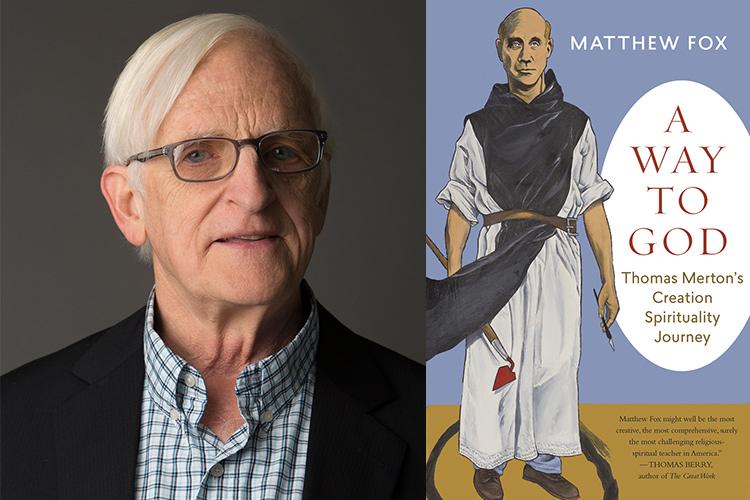
A Way to God

Posted in Uncategorized with tags , , , , , on May 19, 2021 by thecrossingchicago

In a 1967 letter from Thomas Merton to Matthew Fox, Merton wrote:

“I’m glad you are going to work on spiritual theology . . . I do think we are lying down on the job when we leave others to investigate mysticism while we concentrate on more ‘practical’ things.  What people want of us, after all, is the way to God.”

We all have our own way to God.  Writing, meditation, acts of social justice, and many other ways.  I employ all of these, but I am a writer.  

That statement, “I am a writer,” was always a difficult one for me to say.  I have long felt I wasn’t good enough to claim that title for myself.  But, as Fox came to realize himself, “I am a writer.  Because I am so happy writing and putting ideas together and in a form I can communicate with others.  And I learn so much doing this.”

Upon reading War and Peace, Charles du Bos commented, “Life would speak thus if life could speak.”  It reminds me of Parker Palmer’s admonition to let your life speak.  So, why not?

I want to write my way to God.  Perhaps not literally, but I want to compose words that speak to the collective heart of humankind.  I want to create sentences like Merton, Buechner, Brown Taylor, and Lamott.  I want to till the ground for a mystical experience like Tolstoy did for Fox.  Again, why not?

What about you?  What is your way to God?  Are you a singer?  Then sing.  Are you an artist?  Then paint.  Are you a social prophet?  Then speak.  The world is short on people who are living into who they really are and at what cost?

Imagine if DaVinci never painted because he thought he wasn’t good enough.  Imagine if Tolstoy never wrote because he thought his words didn’t matter.  Imagine if Martin Luther King, Jr. never spoke because he thought nobody would want to hear what he has to say.  Imagine if you don’t do that thing that burns like red embers in your soul.  Will yours have been a life well lived?

How would life speak if you were to put it into words?  Some of us need to hear it, so speak.  Some of us need to see the face of God in the work of your hands and heart.  Don’t try to keep it in, because after all, it will consume you if you do.

New Worlds from Dust

Posted in Uncategorized on May 14, 2021 by thecrossingchicago

In his book, The Final Beast, Frederick Buechner writes of Nicolet who bangs an erratic rhythm and asks his friend, Denbigh if he could dance to it if it were the only music that could be heard.  Denbigh replies that he supposes he could, but he’s not quite sure what his friend is talking about.  Nicolet admits that he really doesn’t either.  

“But whatever this is we move around through. . .” He raked his hand slowly back and forth through the air.”  “Reality . . . the air we breathe . . . this emptiness . . . If you could get hold of it by the corner somewhere, just slip your fingernail underneath and peel it back enough to find what’s there behind it, I think you’d be—“

If only we could all write like Buechner.  

What would we find if we were to peel back the corner?  Buechner’s character leaves the door open to endless possibilities.  

Can we let go of the stories that we have inherited or created?  Can we be ok with what we see beneath?  We may just realize the people we thought we knew weren’t who we thought they were.  We may also find that we weren’t either.  Why hide from ourselves?  After all, all things come into the light eventually.

Reality should be held loosely.  For too long have we held on to our own versions of reality so tightly that we can feel it crack in our palms.  We create stories in our minds and tell ourselves that they are truth and not merely the musings of our fragile egos.  

I have known realities.  And I have seen them disappear like fog being cut by the sun.  I have held on to truths.  And I have felt them run through my fingers like sand while my fingernails dug into my palms.  

If our feet are planted so firmly on the ground and our fingers are locked in a death grip, then how can we take the hand of another and dance?  

Nicolet answers some of this sense of wonder after thinking briefly:

“I think the dance that must go on back there,” Nicolet began, “way down deep at the heart of space, where being comes from . . . There’s dancing there, Denbigh. My kids have dreamed it. Emptiness is dancing there. The angels are dancing. And their feet scatter new worlds like dust.” 

I wonder what these worlds would look like.  Walking away from the old ones makes room for the new, whatever that may be.  If only we could let go of being so sure and learn to embrace the mystery, we just might see these worlds take form before our very eyes and hear the gentle clack-clack of angels’ feet just beyond the ether.

The Church

Posted in Uncategorized on May 7, 2021 by thecrossingchicago

Extra ecclesium nulla salus.  

There is no salvation outside of the church.  

This proclamation set a standard for “the church” to dictate who is in and who is out; who is saved and who is damned.  Sadly, this misguided ideology hasn’t worn off much over the years and we have been left with an image of a church that is guarded, judgmental, and hateful.  

I would argue that the idea of “the church” is a fallacy to begin with.  There are many churches,  but not one church.  It is unfortunate that the pervading thought is that there is one church with such a reputation and arguably, deservedly so.  

But what is the alternative?  What would “the church” look like if we were to build it again today?  What would a good template be for individual bodies and communities that seek to be who they are called to be?  

I can recall marching in the Chicago Pride Parade wearing my clerical collar with cutoff sleeves and shorts and having people hug me with tears in their eyes as they thank me for accepting and loving them.  While this is touching, it isn’t right.  Nobody should have to thank anyone for accepting them for the beautiful creation that they are.  

Many churches (though far from all or even enough) have become more open, accepting, and welcoming.  There is a high degree of tolerance, but something is still greatly lacking.  There is a hope for something more like the plea of Pink and Nathan Ruess, “Just give me a reason, just a little bit’s enough just to say that we aren’t broken, just bent, and we can learn to love again.”

I think that’s a big part of it: LOVE.  Love is not exclusive.  Love is not even tolerant.  Love is purely relational and this includes people we don’t agree with and people who are not like us in whatever way.  

1 John 4:17-21 says: 

“Love has been perfected among us in this: that we may have boldness on the day of judgment, because as he is, so are we in this world. There is no fear in love, but perfect love casts out fear; for fear has to do with punishment, and whoever fears has not reached perfection in love. We love because he first loved us. Those who say, “I love God,” and hate their brothers or sisters, are liars; for those who do not love a brother or sister whom they have seen, cannot love God whom they have not seen. The commandment we have from him is this: those who love God must love their brothers and sisters also.”

We need to turn to the core needs of all people when considering building the church.  One of those core needs is love.  We need a safe space to wrestle with the deep difficult questions without fear of being ostracized or fed empty platitudes.  We need a place to marry our intellect with our feelings and yearnings and not have to exclude either.  We need genuine and real community where we can experience connection.  We need room to wander with reassurance that we are still at home and home will be there when we return from our wandering.

I cannot claim to know exactly what this church should look like.  We see glimpses of it in churches that we know and attend, but there is still more that is needed.  What would it look like to not merely be welcoming, but to co-create this community with those who are already there, with those who stumble upon them in their wanderings, and with God?

We have become more and more comfortable with accepting people of other faiths, but are still extremely squeamish with people who approach Jesus in their own unique ways.  It seems that we need to learn to be open to people entering the church with their own mindset and relationships with Jesus and be comfortable and radically welcoming of it.

In fact, we use the language of welcoming for people to come into “our” churches.  But is the church really ours?  Indeed it is not “ex ecclesium nulla salus,” but instead we too are guests on this holy ground prepared for us by God.

What of contemplative practices?  We often turn to eastern religions when wanting to experience at-one-ment with God, the universe, our True Selves, and all that is beyond us.  We seek enlightenment, but overlook the practices that are a part of our own tradition.  Why not embrace all of these practices and delve into them with a great sense of wonder and intentionality?  

Meditate that we might become enlightened.  Do yoga that the kundalini may be full realized within.  Live into the True Self while feeling the white light pour down upon your crown chakra and through you to the ground of being.  And at the same time, embrace the centering prayer, mantras, and all of the contemplative practices of Christianity reflected when Jesus tells us that we are the light of the world, that light dwells within us, and the Kin-dom of God is already a reality waiting to be birthed from within us.

What is the fear?  Why not let go and as Howard Thurman reminds us, trust the ru’ah hakodesh?  Let’s have a conversation and start co-creating this thing together.  Let’s do this that we may hear the “sound of the genuine in one another” and “So that when I look at myself through your eyes having made that pilgrimage, I see in me what you see in me and the wall that separates and divides will disappear and we will become one because the sound of the genuine makes the same music.” 

Sounds Baths and Spiders

Posted in Uncategorized with tags , , , , , , , , on April 20, 2021 by thecrossingchicago

The sound washes over me in waves; undulating, matching the vibration of my own energy until each cell and the bowl are singing in unison. 

“What is your intention?  What do you need to let go of?” The meditation guide asks. This seems to be a recurring theme as of late.

And so as I lie there with eyes closed, body humming, I jump and allow myself to fall.  I fall through layer and layer of clouds trusting that something or someone will catch me eventually.  But then I realize, I don’t need to be caught.  Falling is a safe form of letting go; maybe I’m even falling upward.

As the clouds turn dark and storms form within them, the thunder roars around me filling my ears with ominous sounds until I allow myself to become bigger than the storm and then smaller than the electrons that fuel the lightning.  

I’m becoming myself, my intention while the drum beats steadily and the singing bowls peel away layer after layer of things I don’t need.  The hand that I grasp is my hand and all difference ceases to exist as we are one.  Interconnectedness is manifest there while energy flutters in ebbs and flows like a phoenix flapping her mighty, yet delicate wings.

We are intertwined as the spider makes her way down the web above me.  Then she goes back up and I can almost hear her laughter as she does.  Why do these spiders seem to follow me? 

“Why indeed?” She asks.  “You have feared and loathed that which is you: your own spirit animal.  Creative.  Beautiful in its own way.  In touch with the universe.  Do you see now?”

“Yes, I do,” I reply as I watch her make her way even more directly above my head.  She seems to be showing me my own true self; telling me it’s finally time to go home.  Or better yet, showing me that I’m already there.  All realities made present as I lie there intertwined looking up.

When I am gone, the spider is gone, too.

I drive while I long for just a glimpse of the mountains.  Making my way west I sing to Les Miserables at the top of my lungs.  A concert for an audience of one. 

When I come to the end of the Finale, I cry; loud and hard and quick.  Not knowing exactly what I’m letting go of in that moment, but feeling it leave me. Then it’s over.  And that’s ok, because sometimes that’s what falling looks like on the outside.