Archive for the Uncategorized Category

Straights and Loops

Posted in Uncategorized on May 3, 2016 by thecrossingchicago

IMG_0638The hike wasn’t a particularly arduous one.  There were changes in elevation totaling 680 feet as we worked our way up and down the hills, but few were very steep on the North Kettle Moraine Trail in Wisconsin.  Westyn and I decided that we would take a short trip for spring break and do some backpacking and get some R&R.  I use the term “backpacking” very loosely as we only hiked about eight miles.  But, I was wearing a trail-rated backpack, so I’m technically not exaggerating when I use the term.

The first part of the hike started with a 2.5 mile loop that began at the lookout tower giving views all the way to Lake Michigan.  Once we completed the loop, we took the Ice Age Trail that ran adjacent to it and started heading north on a straight trail that went for some 32 miles.  Our intention was to walk about six miles of it before turning around. 

It occurred to me as we were walking just how much more difficult it was to walk a straight trail than a loop.  While there isn’t the great sense of anticipation that you get with a straight trail as you wonder what you may encounter ahead, the loop gives a certain feeling of comfort knowing that you will eventually come upon familiar ground and know you have completed your journey.  When you are walking a straight trail, you really have no sense of how much farther you have to go and there is the constant desire to turn around due to the nagging reality that the farther you go, the farther you have to return.

I was telling myself to keep going and resisting that lazy instigator in my head that gave me every reason to turn around: It was supposed to rain later.  We might get hungry.  A herd of deer might rush out of the woods and run us over.  We could get attacked by wild rabid rabbits and the nearest hospital was miles away.  You know, all of those perfectly rational grounds for giving up.  Ok, so I may be a little facetious here.  As we made our way past a bog and heard the distressed cry of a heron, the muses broke through the chatter and spoke to me showing me what a great metaphor this trail was for life.  I pointed out to Wes that I had just a momentary stroke of genius – he wasn’t impressed.

Genius or not, the sentiment is true.  We are much more comfortable taking a route in life that will lead us back to where we started.  It might not be a healthy place or one that is in our best interest, but at least it is familiar.  If we dare to take the straight trail and foray into new territory, challenging ourselves, and taking risks that lead to unknown possibilities, there is the disconcerting possibility that we may fail.

But so what?  What if we do fail?  We get up, dust ourselves off, and try a different way.  What’s the worst that can happen?  What are we afraid of?  Some may worry that not enough people will support our endeavors.  If we do what we know we should be with conviction, the right people will follow. 

If God has made us for a certain purpose, aren’t we going to succeed in fulfilling that purpose?  Too many of us are living in fear and timidity because we are uncomfortable with the unknown.  Well, take a chance anyway and see what happens.  See that trail there running alongside the loop?  Take it.  Go as far as you can, and should you stumble, get back up, laugh it off, and keep walking.  Because that trail was made for you and only you can walk it.

The wet touch of a cool, light rain on my head brought me back from my epiphany.  Wes and I looked at each other and nodded as if to say, “Yep.  Better head back just to be safe.”  After all, everyone knows that a sprinkle is just God’s gentle warning to turn around and get back before the Noahic deluge begins.  In the end, I wasn’t really tired at all.  By the time we got back to the campground, the rain had stopped and we played a couple of one-on-one basketball games.  I had all this energy, not even being fatigued and all.  So when he suggested we play a full court game and called me a lazy old man for protesting, I gently reminded him that it would be a long walk back to Chicago.

The Zahir

Posted in Uncategorized on May 1, 2016 by thecrossingchicago
zahir“Zahir, in Arabic, means visible, present, incapable of going unnoticed.  It is someone or something which, once we have come into contact with them or it, gradually occupies our every thought, until we can think of nothing else.  This can be considered either a state of holiness or of madness.”
– Faubourg Saint-Peres – Encyclopaedia of the Fantastic
This idea of the Zahir is one that Paulo Coelho explores deeply in his novel of the same name.  In this tale of journeys and obsession, the main character’s wife, Esther, suddenly disappears one day leaving him wondering why or where to.  For him, she becomes the Zahir that he cannot get out of his mind.  She occupies his thoughts constantly and drives him to a point where he must decide whether she will become holiness or madness for him.
Who or what is our Zahir?  Is it something or someone that is real and tangible or is it an ideal that we have assigned?  As we are all in search of some deeper meaning in our lives, we can easily become attached to that which appears to manifest what we thought we have been seeking.  But does it really?  Is it merely a temporarily satisfactory substitute for what we are really longing for?
These are questions that we have to ask ourselves on a regular basis.  It is our human propensity to become attached to things that fill a provisional need, but as we get older and wiser, we come to realize that we have settled for less than what was meant for us.  Upon this awakening, we are faced with the task of continuing to settle or starting the intentional work of detaching.  Neither is easy, but holding on to a false reality is ultimately more tasking and saps meaning from our lives.
As Coelho says in The Zahir:

“That is why it is so important to let certain things go. To release them. To cut loose. People need to understand that no one is playing with marked cards; sometimes we win and sometimes we lose. Don’t expect to get anything back, don’t expect recognition for your efforts, don’t expect your genius to be discovered or your love to be understood. Complete the circle. Not out of pride, inability or arrogance, but simply because whatever it is no longer fits in your life. Close the door, change the record, clean the house, get rid of the dust. Stop being who you were and become who you are.”

            – Paulo Coelho – The Zahir


Chances are, there is something or someone who “no longer fits in your life.”  Do you have the strength and courage to let go?  I know you do, but do you know it?  As Coelho says, you don’t have to do it out of pride or arrogance, but for your own well-being – and likely theirs.  You can hold on to the representation of the ideal until it drives you to madness, or you can embrace the ideal itself until it leads you to holiness.  It’s your choice.
In the end, our only job is to stop being who we were and become who we are.

The Resurrection of the Christ Within

Posted in Encouragement, true self, Uncategorized with tags , , , , , , on April 11, 2016 by thecrossingchicago

red-cross-jung-resurrectionIn his later years, Carl Jung became a genuine mystic and contemplative.  His theories of psychology eventually superseded the purely cognitive and reached in to the existential.  In his metaphysical journal that would come to be called The Red Book, Jung explored beyond the depths of the human psyche and into the eternal self, seeking the potential of individual humans and the interconnected humanity.

What is important and meaningful to my life is that I shall live as fully as possible to fulfill the divine will within me. This task gives me so much to do that I have no time for any other. Let me point out that if we were all to live in that way we would need no armies, no police, no diplomacy, no politics, no banks. We would have a meaningful life and not what we have now—madness. What nature asks of the apple-tree is that it shall bring forth apples, and of the pear-tree that it shall bring forth pears. Nature wants me to be simply man. But a man conscious of what I am, and of what I am doing. God seeks consciousness in man.

This is the truth of the birth and the resurrection of Christ within. As more and more thinking men come to it, this is the spiritual rebirth of the world. Christ, the Logos—that is to say, the mind, the understanding, shining into the darkness. Christ was a new truth about man. Mankind has no existence. I exist, you exist. But mankind is only a word. Be what God means you to be; don’t worry about mankind which doesn’t exist, you are avoiding looking at what does exist—the self.

In his transcendental thoughts, Jung points out that each of us has a divine potential that is at the core of our being.  The autonomy of the individual is merely an illusion – we are in actuality manifestations of the cosmic Christ and any individualistic tendency comes from a fissiparous human propensity.  Were we to awaken to the cosmic Christ and our own “divine will within,” peace and harmony would become the norm both in society and within our own souls.

While some are obsequious in their literal interpretation of scripture, I have an occasional tendency toward brash skepticism at most, or an intentional awareness of its metaphorical and allegoric nature at the least.  This is not to say that I do not “believe” in scripture, but I believe the way it has been interpreted and handed down over the years by mostly caucasian males has, in many ways, marred it’s true beauty and the divine imprint upon it.

Having said that, Paul’s statement in Philippians 4:13 that “I can do all things through Christ who strengthens me” has, in the past, elicited equal doses of hope and doubt.  If Christ strengthens us, then why do we sometimes feel so worn down and beat up?  Why does Christ choose arbitrarily whom and when to gird and support when needed?  When I look at Paul’s adulation of Christ as something that originates externally with no interaction on our part, I find cynicism bubbling up from within.  However, when I consider Christ to be the logos, the divine manifestation, the source of all being that exists within all of us that calls us to a conversion into our true self, then I do not merely find myself able to nod in intellectual assent, but I am comforted in some place and at some level that I cannot describe.  To know that such strength exists within to draw upon not because it’s occasionally available but because it’s the very nature of our existence creates in me that “peace that surpasses all understanding.”

The Trappist monk, Thomas Merton, spoke of the human conditioned inclination to ignore our true self and choose to make excuses rather than become who we were meant to be.  Many times, we even sabotage ourself and make ourselves into victims who are somehow prevented by ill-intentioned people that prevent us from attaining our true potential.  In reality, we fear what we do not understand and would rather not know who we are supposed to be, let alone live into that reality.

Perhaps I am stronger than I think.  Perhaps I am even afraid of my strength, and turn it against myself, thus making myself weak.  Making myself secure.  Making myself guilty.  Perhaps I am most afraid of the strength of God in me.  Perhaps I would rather be guilty and weak in myself than strong in Him whom I cannot understand.

The only way that we can discover our true selves and experience the resurrection of Christ within is to sit with ourselves in the silent stillness and ask ourselves the powerful questions that we are afraid to answer.  Who am I?  What is my deepest passion?  What gives me joy?  If my life were ideal, what would it look like?  What is preventing me from becoming who God wants me to be?  What am I afraid of?  Ask these questions and you will find that the answers were there all along.  Live those answers and you will finally become who you were meant to be.  When the path seems daunting and fear wracks your mind, just tell yourself that “I can do all things through Christ who strengthens me” because indeed, it is the potential that has existed within you since before you were born.  Claim it for your time for resurrection is now.

In The Presence of God

Posted in Uncategorized on April 7, 2016 by thecrossingchicago

presence of God richard rohrI often say that I find God in the wilderness.  Especially on a ledge overlooking mountain peaks, I can vouch that I find the presence of God there amidst the wind rustling the leaves like a subtle voice whispering my name.  The sound of the waves lapping the shore or the way snow falls softly upon bare branches without a soul in sight except my own basking in the luminescence of the divine.

While I’m not necessarily wrong about going to these places that I find sacred to find God, I realized that I wasn’t completely right either.  Instead of going there because that was the only place that God resided, it is instead that the environment gives me the serenity to be aware of the presence of God that was always there.  This is somehow comforting to me to know that God is there even when the background noise is too loud for me to notice.

Thomas Merton knew plenty of silence in his life at Gethsemani Abbey in the Kentucky wilderness.  That solace must have awoken his soul to a presence within that brought great comfort even amidst the background noise he experienced on his trips.  He noted also, however, that the silence was also disturbing:

There is a silent self within us whose presence is disturbing precisely because it is so silent: it can’t be spoken.  It has to remain silent.  To articulate it, to verbalize it, is to tamper with it, and in some way to destroy it.

Within that disturbing silence is God.  It is as Elijah experienced in 1 Kings 19 after he went up Mt. Horeb looking for God.  He experienced every natural disaster and still didn’t find God in the power of nature’s forces even in a large earthquake until, “after the earthquake a fire, but the Lord was still not in the fire; and after the fire a sound of sheer silence.”  There it was in the sheer sound of nothingness that he encountered the presence of God – not on the mountaintop, but already there within his own soul.

Silence is something that we don’t get enough of.  We feel obligated to constantly be doing something.  We judge ourselves to be ineffective if we aren’t keeping ourselves busy with work or helping others.  We seek out books and go on pilgrimages to find God and get discouraged when we “still haven’t found what [we’re] looking for.”  There is a glimpse of something beyond our comprehension that dwells within the realm of mystery, but we can’t quite put our finger on it.  And then finally, if we are lucky enough to stumble upon it or make sense of the mystery while not making any sense of it, we find out that we were trying to do the impossible.  We were never “able to attain the presence of God because we’re already totally in the presence of God.”  All we were missing was the awareness.

Beyond Belief

Posted in Uncategorized on April 3, 2016 by thecrossingchicago

Christos0_medium3“Peace be with you,” Jesus said.  In Arabic, As Salaam Alaikum.  In Hebrew, Shalom.  In his own language, Aramaic/Assyrian, Shlama Lukh.  This was and is still a standard greeting of people from the Middle East.  Beyond this, however, Jesus was wishing peace to a people who were spiritually and emotionally distraught after running away to hide while their leader was crucified.  Finally, it was a wish of peace for a group of people who did not and would not get along very well.

Shortly after Jesus’s death, factions developed among the disciples.  Some people followed Matthew, some Luke, some Thomas, some John, etc.  Each group of followers, writing in their disciple’s name, recorded their version of the events of Jesus’s life, death, and resurrection.  Paul wrote in 1 Corinthians 1:11-13: “For it has been reported to me by Chloe’s people that there are quarrels among you, my brothers and sisters. What I mean is that each of you says, ‘I belong to Paul’, or ‘I belong to Apollos’, or ‘I belong to Cephas’, or ‘I belong to Christ.’ Has Christ been divided? Was Paul crucified for you? Or were you baptized in the name of Paul?”  This was his call for the disciples and those who chose to gather under their teaching to get along despite their different beliefs.

One particular rift existed between John and Thomas.  It is not likely that either John nor Thomas wrote their respective gospels, but rather their students.  Nonetheless, the writings reflect the teachings of their namesakes.  Thomas wrote his gospel shortly before John’s.  It came to be known as a gnostic gospel and some took this to mean that there was a secret knowledge to be attained from it because gnosis means “knowledge.”  The meaning, though, of gnostic goes even further than a simple understanding.  It reflects a “knowing” of God through experience rather than an intellectual assent to a certain set of beliefs.  Thomas stated that we are all made in the imago dei (image of God) and as such, contain the divine within us.  If we would but seek within, we would find the light of God and be transformed by it.

John strongly disagreed with this thinking.  John was the only disciple/gospel writer that expressly called Jesus God.  He firmly pushed the idea that a belief in Jesus as God was essential to individual salvation.  We can see this in John 3:16-18.  John (or John’s students) wrote his gospel as a response to Thomas’s gospel and intentionally painted Thomas as one without belief.  When Jesus said he was “the way, truth, and the life” in John’s gospel, this was in response to Thomas saying he didn’t understand how we could know the way.  In John 20, after Jesus’s resurrection and subsequent appearance to the disciples, John inserts his “doubting Thomas” story:

But Thomas (who was called the Twin), one of the twelve, was not with them when Jesus came. So the other disciples told him, ‘We have seen the Lord.’ But he said to them, ‘Unless I see the mark of the nails in his hands, and put my finger in the mark of the nails and my hand in his side, I will not believe.’

 A week later his disciples were again in the house, and Thomas was with them. Although the doors were shut, Jesus came and stood among them and said, ‘Peace be with you.’ Then he said to Thomas, ‘Put your finger here and see my hands. Reach out your hand and put it in my side. Do not doubt but believe.’ Thomas answered him, ‘My Lord and my God!’Jesus said to him, ‘Have you believed because you have seen me? Blessed are those who have not seen and yet have come to believe.’

The chapter finishes with another call to belief: “Now Jesus did many other signs in the presence of his disciples, which are not written in this book. But these are written so that you may come to believe that Jesus is the Messiah, the Son of God, and that through believing you may have life in his name.”

With many different beliefs about who and what Jesus was and what his crucifixion meant, early church fathers felt it was necessary to create an orthodox belief set.  Heterodoxy was unsettling to them as it allowed people to believe what they wanted and not have to subscribe to a single catholic (universal) understanding.  One church father who was most perturbed by this loose doctrinal cohesiveness was Irenaeus.  Since there were four directions, four corners of the universe, and four pillars of faith, he believed there should be four gospels.  So, he chose Matthew, Mark, Luke, and his favorite – John – for the gospel canon.  He encouraged other believers to draw their faith from this set of books and to destroy the other books that existed: The Gospel of Philip, The Acts of the Apostles, The Gospel of Mary, The Gospel of Judas, The Acts of John, The Secret Book of John, and many, many others.

While many obeyed and destroyed the books, some buried them to preserve them and keep them safe from destruction.  Among these were those found at Nag Hammadi in 1945.  Even going with four gospels that now exist in our Bible did not stop the wide divergence of beliefs in the early church as many interpreted the four gospels in their own ways.  It didn’t help that the four gospels say different things about the person of Jesus and record the narrative differently.  One example is how in the synoptic (same source) gospels, Matthew, Mark, and Luke, Jesus’s overturning the change table at the temple and upsetting the money changers is the straw that broke the camel’s back leading to his crucifixion.  In John, this event happens first in Jesus’s ministry and it is his raising of Lazarus that scares the Jews (John the most anti-Semitic gospel of the four) and leads them to demand Jesus’s crucifixion lest “the people believe him and come to realize he is God.”  Irenaeus encouraged church folk of the time to ignore the differences and difficult to understand passages and just focus on the clear and common aspects.

(I encourage you to do a comparative study of the four gospels and read them side-by-side.  Note that Luke and Matthew mention a virgin birth while the other two gospels do not.  Also note how the synoptic gospels start with Jesus’s birth as a human, while John starts “In the beginning” with the logos dwelling with and being God.)

The church today is no better, if not worse, than the church of early times.  Even within a single congregation, we all hold different beliefs around God and Jesus and myriad interpretations of the Bible.  For many denominations, these differences lead to a freeze on cooperation with other denominations or even congregations within their own denomination.  But do we really have this luxury?  I don’t think so.

As long as children are still dying of starvation and our youth are being gunned down in the streets and people are freezing to death in the cold because they have no home, I would opine that we don’t have the right to be deterred by our beliefs.  Beliefs are important.  They are our own.  We can embrace them and hold them dearly while still working together for the mission of God.  With so many churches in the U.S. alone, it is a travesty that these horrors still exist.  It’s time to put aside our differences and get to work together, and so experience God in the mission itself.  Then, when our work is done and the kin-dom of God is realized, let’s sit down with a pint of cold brew and have ourselves a friendly theology pub as we discuss belief in a light-hearted and civil manner.

Daddy/ The Unleaving

Posted in Uncategorized on April 1, 2016 by thecrossingchicago

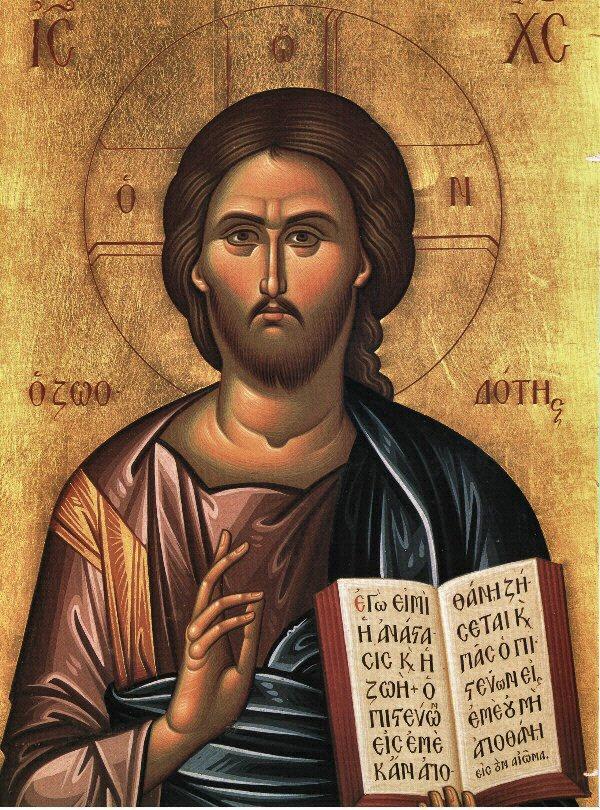
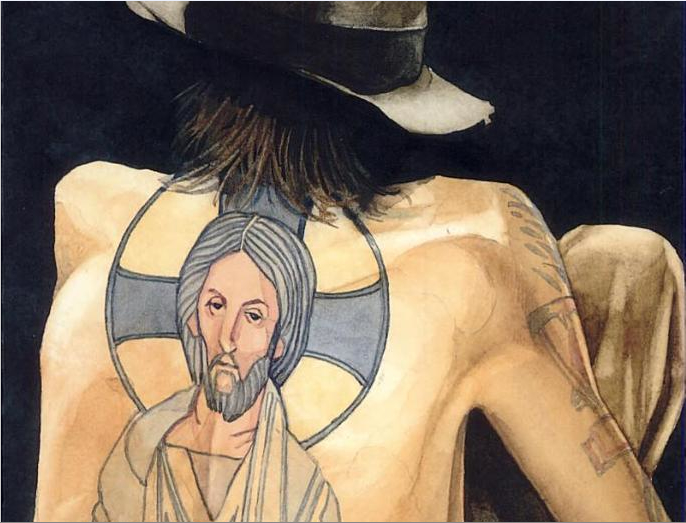
parker's back 2In Flannery O’Connor’s short story Parker’s Back, the main character, O.E. Parker sees a man at a carnival with tattoos at the age of 14 and somehow starts to question the meaning of his existence.  The man’s skin was “patterned in . . . a single intricate design of brilliant color.”  He grows up with this urge to always be on the go; to find that which will plug the hole in his soul.  Remembering the man at the carnival, he starts to get tattoos all over his body and finally gets one on his back of the Byzantine Christ.  Somehow the tattoos help O.E. have a sense of identity and temporarily appease his longing, but the urge to go off into the mountains is always there.

I can relate to this feeling of wanting to go west and start a new life far away from everything.  It’s an itch or a longing or something that I can’t describe and I’m sure I got it from my father.  Unlike my father, I would never leave my children and feed the desire to ride off into parts unknown, nor do I have any plans of getting a tattoo like O.E.  For the longest time, I resented my father’s willingness to abandon his kids and go where his whims led him.  On the other hand, I have a jealousy of his indifference.

The picture I have always painted of my father is one of an irresponsible jackass who was too selfish to consider anyone but himself.  He was easy to hate (although this is a strong word) and vilify when he was far away and unknown.  Even after meeting him again for the first time in 12 years, I felt anything but respect for him – probably something closer to contempt.

For reasons unknown, the poet Sylvia Plath also had issues with her “daddy”.  We do not know if he was abusive or uninvolved or what the case was.  We do know that, in her poem Daddy, she paints a picture of an evil Nazi who did his best to ruin her life.  In the poem, he tells her deceased father that she finally had to kill him, but he was already dead.  In reality, Otto Plath was not a Nazi, nor many of the things she purports him to be in the poem.  By making him other it seems that it was easier to hate for Sylvia to hate him.  Her tumultuous relationship with Ted Hughes bleeds into the narrative of her father and the two seem to become one – a man she detests whom she will no longer allow to have a hold on her.

As with O.E., I can also relate to Sylvia.  It’s much easier to hate someone who is other or unknown.  I have a father – I have never had a “Daddy”.  But I no longer see any reason to vilify him or hate him.  In my going to him and spending time with him, his leaving becomes an “unleaving”.  He becomes to me someone who is not merely known, but someone that I can sympathize with as I imagine the towering western peaks that await me.  I imagine the urge to pack up and leave is in within us all.  The thing that makes us different is that some of us decide to follow where the urge takes them and others stay while embracing the urge – thereby negating the necessity of an “unleaving”.


And Still I Rise

Posted in Uncategorized with tags , , , , on March 9, 2016 by thecrossingchicago
Being raped at the age of 8 did not stop her from rising.  Although the man who raped her (her mother’s boyfriend) only served a day in jail for his crime, still she rose.  Even though she felt guilty for telling her family about what happened and that the man was found dead the day after his release from jail, still she would rise.  While she became mute for five years out of shame, fearing that it was her spoken words that led to this man’s death, that’s right; she still rose and nothing could stop her.
Jogging home from the gym yesterday, I was listening to a writer’s podcast on which Brene Brown was being interviewed.  She told about when she was on Oprah and after the recording was over, Oprah turned to her and said, “Maya Angelou is in the green room, would you like to meet her?”  Little did Oprah know, that Brene used Maya’s poem, I Shall Not Be Moved at the end of the semester for her classes.  When she went in the back and met Angelou and told her how much she admired her, Angelou took her hand and recited in song a few lines from the poem: “Like a tree planted by the waters, I shall not be moved.”  When I heard this, I got goosebumps.
Naturally, I had to look the poem up and not only read it, but hear Angelou reciting it herself in her amazing musical voice.  Sitting and listening to her recitations of I Shall Not Be Moved and And Still I Rise with tears starting to well up in my eyes, I pondered what I should write about for this week’s e-blast.  I looked up at my book shelf across the room and saw it there through the salty warmth that both blurred and magnified my vision: a small yellow book of poetry sticking out because of its color, entitled And Still I Rise.
 
Enjoy this recitation of the breath-taking poem that only one who had been stepped on and pushed down could have conceived.  As you listen to the power and depth of Maya’s voice and the magic of her words, remember that we all rise.  People may try to create you in their own image.  Their perceptions may try to paint you in a certain way.  They may may hate and despise you for who you are.  You may be too sexy, happy, beautiful, amazing, caring, loving, or wise for their own good.  But remember, no matter how hard they may step or with however much force they push, there is a place inside that cannot be broken, “and so naturally, there [we] go rising.”
More on rising at Easter . . . .
 

Cinnamon

Posted in Uncategorized on December 28, 2015 by thecrossingchicago

Here is a tiny excerpt from a memoir I am working on.  It’s unedited and raw, but you get the drift.  Enjoy.

– – – – – – – – – – – – – – – – – – – – – – – – – – – – – – – – – – – – – – – –

My nose still burned as I sat on the counter trying to blow out as much of the powder as I could.  No, I wasn’t a four year-old coke addict, but apparently I had a cinnamon problem. 

Our neighbor, Joe, had brought over a small plastic margarine container full of cinnamon and sugar that he had mixed up.  This was a fairly common occurrence and I don’t recall if it was specifically for me this time, but I loved the taste of cinnamon and sugar on warm butter spread over toast.  The smell was almost as good as the taste.

I took the plastic tub down from the counter where my mom had left it and pried open the lid while she and Joe talked in the kitchen doorway that led outside our Irene Avenue apartment in Rochelle, IL.  The lid came off with a jerk and a little of the light brown mixture landed on the floor.  I looked up and made sure that nobody had noticed.  Mom and Joe were still deep in conversation.  I was safe to clean it up after I completed what I had set out to do.  I held the tub of delicious crystals up to my nose and took a deep whiff.

This time, not getting caught wasn’t an option.  The whole tub hit the floor sending its precious contents all over like a desert storm.  Brown and white granules mixed with the grey and gold flecks in the old faded linoleum.  I coughed and gagged and snorted and screamed as the cinnamon and sugar mixed with snot and got caked to the walls of my nasal passage.

My mom whipped around and took in the scene before her.  Joe ran from his spot in the doorway and picked me up setting me down on the counter.  He grabbed a tissue and my mom poured a glass of water while I tried to blow out the cinnamon-flavored snot balls.

After drinking some water and blowing out all that I could, I sat there on that countertop and cried.  My mom and Joe laughed at the cute little dummy who had snorted cinnamon.  I cried because my nose burned and so did something in my gut.  I cried because I remembered that the last time I had been on that countertop was when my dad set me there months before to look me in the eye and tell me that he was moving out.  Countertops were apparently where all the shit happened and I wanted to avoid them at all costs from there on out.

Autumn Leaves

Posted in Uncategorized on December 16, 2015 by thecrossingchicago

autumn leavesStrolling along the neighborhood streets with my dog or maybe with my daughter for a cake-pop run to Starbucks while taking in the Christmas lights adorning the surrounding houses, I notice the bright autumnal colors.  For some reason, I have come to think of ourselves, or at least how we should be, as the leaves of fall.  Deep within the leaves of the tree, there are vibrant colors that are covered up by the green chlorophyl feeding off of the sun’s warmth and light.  In the fall, as the warmth of summer gives way to sunny crisp days and cold dark nights, the chlorophyl is absorbed into the tree and the nutrients go to the roots to be stored for the winter.  The colder the nights and brighter the days, the more vibrant the colors of the leaves.

Eventually, the fiery red and gold fronds let go of their branches, or perhaps the branches let go of them, and they float peacefully to the ground.  They do not cling to the limbs that bore them, nor does the tree refuse to release them.  It is a cycle of necessity and when it is time to change and let go, it happens naturally.  We, on the other hand, have difficulty knowing when to be transformed and give up the ghost of our current iteration of life.

There are times in our own lives when we must evolve.  Knowing that it is time for change and that, like the leaves, we must let our attachments fall to become seeds that give birth to a life to come.  We are at once like the leaves and the branches.  We clutch desperately to that which, for a season, fed us with life and sustenance.  Being fully aware that there are things we are called to and selves to become, we dig in our talons as if sliding perilously to the edge of a cliff; our grip ever slipping as the raging waters swirl below.  And we are like the branches.  Seeing that the leaves must be allowed to change and reveal their true colors and die to their old selves to give way to the new, we refuse to free them from our clutches.

If the leaf could talk, perhaps it would say thank you to the branch.  Thank you for holding me up and preparing me for this time.  Thank you for helping me become who I am supposed to be and letting me go when it was needed.  And the branch would sing in reply, thank you for sheltering me from the elements.  Thank you for protecting me from the harsh rays of the sun and for absorbing for me their brilliance.  Thank you for changing what could have harmed me into that which gives me life.  Intoning their duet of gratitude and interdependence, their words rise up to the warm light of the sun as another leaf glides solemnly to its rest: I am me, you are you, we are.

Merton’s Ghost

Posted in Uncategorized with tags , , , , on November 23, 2015 by thecrossingchicago

In a cemetery behind Gethsemani Abbey, there is one grave that has a scarf laid across it.  It is also the only grave that contains a body in a casket.  The monastery owns one casket that is used for all monks as they lay in state. When the bodies are buried, they are lowered into the grave without a casket and a white cloth is placed over their faces.  This single grave was special, of course, not only because there was a casket in it, but because of who it contained.  unnamed (1)

You have heard me mention Thomas Merton and I have used his prayers in worship.  Merton was the author of more than 20 books and, in his later years, a champion of ecumenism.  It was this embrace of other religions and humans in general that indirectly (or directly) led to his death in Thailand while he attended a gathering for monks.  Some believe that his mysterious death (electrocution when touching a fan as he got out of the bath) was not an accident as he was a vociferous opponent of the Vietnam War and a vocal proponent of civil rights.  He was 53 when he died in 1958 and was transported back to Gethsemani in the casket that he would remain in.
As I encountered these enigmatic individuals in their white robes and black scapulars, I wondered what would drive them to leave the world and its materialistic trappings and commit to a life within those hallowed walls.  After a five-and-a-half year “trial period,” the monk has to give away all of his earthly possessions and make a solemn vow to live the rest of his days among these brethren.
Seven times a day, the monks and retreatants would make their way into the sanctuary and, after genuflecting and bowing toward the altar, sit silent awaiting the bell to begin the chanting of the liturgy.  The cantor starts off the praying of the psalms and the monks sing in response followed by a hymn to the Virgin Mary.  This happens these seven times plus mass all the way up to the last prayer of the day at 7:30.
The psalms being chanted reverberated off of the cavernous walls of the sanctuary that was dark except for a couple of candles.  As I made my way with the other retreatants and the monks toward the abbot who was sprinkling holy water on each bowed head, there was a certain sense of peace that washed over me.  We had chanted the portion of the liturgy of the divine hours known as Vespers and entreated God the same was way done at the end of each day: “Protect us O God from the darkness and awake us in the morn with the light of your new day.”
As two candles flickered in front of the icon of Mary and the baby Jesus, the spirits of Merton and of every monk who had arrived at Gethsemani since it’s beginning in 1848 were alive and well.  And for that moment, while I had a glimpse of why these monks would choose this life, there was the feeling of confidence that the words uttered so long ago by St. Julian of Norwich were true: “All shall be well, and all shall be well, and all manner of things shall be well.”