Beyond Belief

Posted in Uncategorized on April 3, 2016 by thecrossingchicago

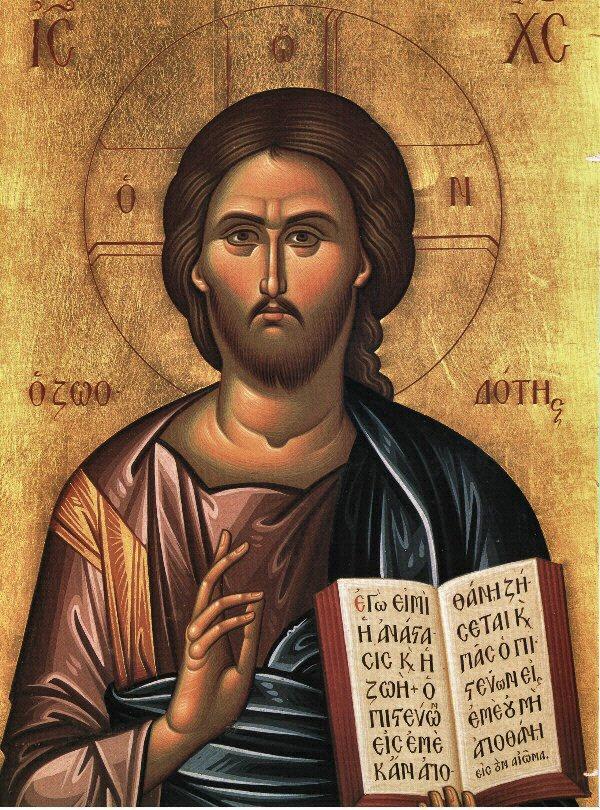
Christos0_medium3“Peace be with you,” Jesus said.  In Arabic, As Salaam Alaikum.  In Hebrew, Shalom.  In his own language, Aramaic/Assyrian, Shlama Lukh.  This was and is still a standard greeting of people from the Middle East.  Beyond this, however, Jesus was wishing peace to a people who were spiritually and emotionally distraught after running away to hide while their leader was crucified.  Finally, it was a wish of peace for a group of people who did not and would not get along very well.

Shortly after Jesus’s death, factions developed among the disciples.  Some people followed Matthew, some Luke, some Thomas, some John, etc.  Each group of followers, writing in their disciple’s name, recorded their version of the events of Jesus’s life, death, and resurrection.  Paul wrote in 1 Corinthians 1:11-13: “For it has been reported to me by Chloe’s people that there are quarrels among you, my brothers and sisters. What I mean is that each of you says, ‘I belong to Paul’, or ‘I belong to Apollos’, or ‘I belong to Cephas’, or ‘I belong to Christ.’ Has Christ been divided? Was Paul crucified for you? Or were you baptized in the name of Paul?”  This was his call for the disciples and those who chose to gather under their teaching to get along despite their different beliefs.

One particular rift existed between John and Thomas.  It is not likely that either John nor Thomas wrote their respective gospels, but rather their students.  Nonetheless, the writings reflect the teachings of their namesakes.  Thomas wrote his gospel shortly before John’s.  It came to be known as a gnostic gospel and some took this to mean that there was a secret knowledge to be attained from it because gnosis means “knowledge.”  The meaning, though, of gnostic goes even further than a simple understanding.  It reflects a “knowing” of God through experience rather than an intellectual assent to a certain set of beliefs.  Thomas stated that we are all made in the imago dei (image of God) and as such, contain the divine within us.  If we would but seek within, we would find the light of God and be transformed by it.

John strongly disagreed with this thinking.  John was the only disciple/gospel writer that expressly called Jesus God.  He firmly pushed the idea that a belief in Jesus as God was essential to individual salvation.  We can see this in John 3:16-18.  John (or John’s students) wrote his gospel as a response to Thomas’s gospel and intentionally painted Thomas as one without belief.  When Jesus said he was “the way, truth, and the life” in John’s gospel, this was in response to Thomas saying he didn’t understand how we could know the way.  In John 20, after Jesus’s resurrection and subsequent appearance to the disciples, John inserts his “doubting Thomas” story:

But Thomas (who was called the Twin), one of the twelve, was not with them when Jesus came. So the other disciples told him, ‘We have seen the Lord.’ But he said to them, ‘Unless I see the mark of the nails in his hands, and put my finger in the mark of the nails and my hand in his side, I will not believe.’

 A week later his disciples were again in the house, and Thomas was with them. Although the doors were shut, Jesus came and stood among them and said, ‘Peace be with you.’ Then he said to Thomas, ‘Put your finger here and see my hands. Reach out your hand and put it in my side. Do not doubt but believe.’ Thomas answered him, ‘My Lord and my God!’Jesus said to him, ‘Have you believed because you have seen me? Blessed are those who have not seen and yet have come to believe.’

The chapter finishes with another call to belief: “Now Jesus did many other signs in the presence of his disciples, which are not written in this book. But these are written so that you may come to believe that Jesus is the Messiah, the Son of God, and that through believing you may have life in his name.”

With many different beliefs about who and what Jesus was and what his crucifixion meant, early church fathers felt it was necessary to create an orthodox belief set.  Heterodoxy was unsettling to them as it allowed people to believe what they wanted and not have to subscribe to a single catholic (universal) understanding.  One church father who was most perturbed by this loose doctrinal cohesiveness was Irenaeus.  Since there were four directions, four corners of the universe, and four pillars of faith, he believed there should be four gospels.  So, he chose Matthew, Mark, Luke, and his favorite – John – for the gospel canon.  He encouraged other believers to draw their faith from this set of books and to destroy the other books that existed: The Gospel of Philip, The Acts of the Apostles, The Gospel of Mary, The Gospel of Judas, The Acts of John, The Secret Book of John, and many, many others.

While many obeyed and destroyed the books, some buried them to preserve them and keep them safe from destruction.  Among these were those found at Nag Hammadi in 1945.  Even going with four gospels that now exist in our Bible did not stop the wide divergence of beliefs in the early church as many interpreted the four gospels in their own ways.  It didn’t help that the four gospels say different things about the person of Jesus and record the narrative differently.  One example is how in the synoptic (same source) gospels, Matthew, Mark, and Luke, Jesus’s overturning the change table at the temple and upsetting the money changers is the straw that broke the camel’s back leading to his crucifixion.  In John, this event happens first in Jesus’s ministry and it is his raising of Lazarus that scares the Jews (John the most anti-Semitic gospel of the four) and leads them to demand Jesus’s crucifixion lest “the people believe him and come to realize he is God.”  Irenaeus encouraged church folk of the time to ignore the differences and difficult to understand passages and just focus on the clear and common aspects.

(I encourage you to do a comparative study of the four gospels and read them side-by-side.  Note that Luke and Matthew mention a virgin birth while the other two gospels do not.  Also note how the synoptic gospels start with Jesus’s birth as a human, while John starts “In the beginning” with the logos dwelling with and being God.)

The church today is no better, if not worse, than the church of early times.  Even within a single congregation, we all hold different beliefs around God and Jesus and myriad interpretations of the Bible.  For many denominations, these differences lead to a freeze on cooperation with other denominations or even congregations within their own denomination.  But do we really have this luxury?  I don’t think so.

As long as children are still dying of starvation and our youth are being gunned down in the streets and people are freezing to death in the cold because they have no home, I would opine that we don’t have the right to be deterred by our beliefs.  Beliefs are important.  They are our own.  We can embrace them and hold them dearly while still working together for the mission of God.  With so many churches in the U.S. alone, it is a travesty that these horrors still exist.  It’s time to put aside our differences and get to work together, and so experience God in the mission itself.  Then, when our work is done and the kin-dom of God is realized, let’s sit down with a pint of cold brew and have ourselves a friendly theology pub as we discuss belief in a light-hearted and civil manner.
Daddy/ The Unleaving

Posted in Uncategorized on April 1, 2016 by thecrossingchicago

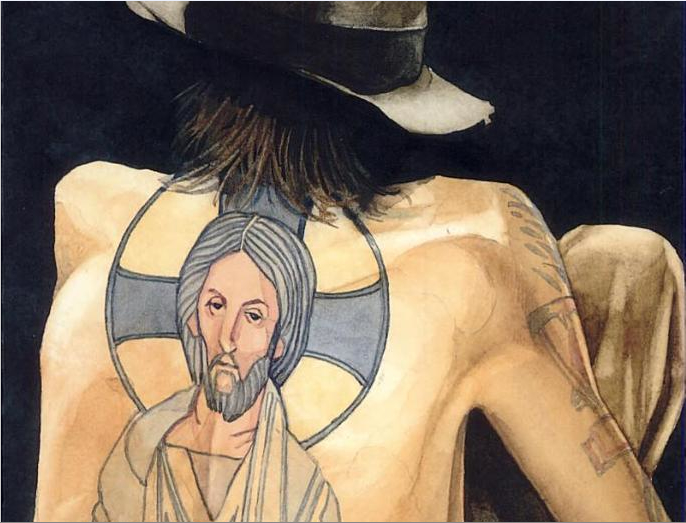
parker's back 2In Flannery O’Connor’s short story Parker’s Back, the main character, O.E. Parker sees a man at a carnival with tattoos at the age of 14 and somehow starts to question the meaning of his existence.  The man’s skin was “patterned in . . . a single intricate design of brilliant color.”  He grows up with this urge to always be on the go; to find that which will plug the hole in his soul.  Remembering the man at the carnival, he starts to get tattoos all over his body and finally gets one on his back of the Byzantine Christ.  Somehow the tattoos help O.E. have a sense of identity and temporarily appease his longing, but the urge to go off into the mountains is always there.

I can relate to this feeling of wanting to go west and start a new life far away from everything.  It’s an itch or a longing or something that I can’t describe and I’m sure I got it from my father.  Unlike my father, I would never leave my children and feed the desire to ride off into parts unknown, nor do I have any plans of getting a tattoo like O.E.  For the longest time, I resented my father’s willingness to abandon his kids and go where his whims led him.  On the other hand, I have a jealousy of his indifference.

The picture I have always painted of my father is one of an irresponsible jackass who was too selfish to consider anyone but himself.  He was easy to hate (although this is a strong word) and vilify when he was far away and unknown.  Even after meeting him again for the first time in 12 years, I felt anything but respect for him – probably something closer to contempt.

For reasons unknown, the poet Sylvia Plath also had issues with her “daddy”.  We do not know if he was abusive or uninvolved or what the case was.  We do know that, in her poem Daddy, she paints a picture of an evil Nazi who did his best to ruin her life.  In the poem, he tells her deceased father that she finally had to kill him, but he was already dead.  In reality, Otto Plath was not a Nazi, nor many of the things she purports him to be in the poem.  By making him other it seems that it was easier to hate for Sylvia to hate him.  Her tumultuous relationship with Ted Hughes bleeds into the narrative of her father and the two seem to become one – a man she detests whom she will no longer allow to have a hold on her.

As with O.E., I can also relate to Sylvia.  It’s much easier to hate someone who is other or unknown.  I have a father – I have never had a “Daddy”.  But I no longer see any reason to vilify him or hate him.  In my going to him and spending time with him, his leaving becomes an “unleaving”.  He becomes to me someone who is not merely known, but someone that I can sympathize with as I imagine the towering western peaks that await me.  I imagine the urge to pack up and leave is in within us all.  The thing that makes us different is that some of us decide to follow where the urge takes them and others stay while embracing the urge – thereby negating the necessity of an “unleaving”.


And Still I Rise

Posted in Uncategorized with tags , , , , on March 9, 2016 by thecrossingchicago
Being raped at the age of 8 did not stop her from rising.  Although the man who raped her (her mother’s boyfriend) only served a day in jail for his crime, still she rose.  Even though she felt guilty for telling her family about what happened and that the man was found dead the day after his release from jail, still she would rise.  While she became mute for five years out of shame, fearing that it was her spoken words that led to this man’s death, that’s right; she still rose and nothing could stop her.
Jogging home from the gym yesterday, I was listening to a writer’s podcast on which Brene Brown was being interviewed.  She told about when she was on Oprah and after the recording was over, Oprah turned to her and said, “Maya Angelou is in the green room, would you like to meet her?”  Little did Oprah know, that Brene used Maya’s poem, I Shall Not Be Moved at the end of the semester for her classes.  When she went in the back and met Angelou and told her how much she admired her, Angelou took her hand and recited in song a few lines from the poem: “Like a tree planted by the waters, I shall not be moved.”  When I heard this, I got goosebumps.
Naturally, I had to look the poem up and not only read it, but hear Angelou reciting it herself in her amazing musical voice.  Sitting and listening to her recitations of I Shall Not Be Moved and And Still I Rise with tears starting to well up in my eyes, I pondered what I should write about for this week’s e-blast.  I looked up at my book shelf across the room and saw it there through the salty warmth that both blurred and magnified my vision: a small yellow book of poetry sticking out because of its color, entitled And Still I Rise.
 
Enjoy this recitation of the breath-taking poem that only one who had been stepped on and pushed down could have conceived.  As you listen to the power and depth of Maya’s voice and the magic of her words, remember that we all rise.  People may try to create you in their own image.  Their perceptions may try to paint you in a certain way.  They may may hate and despise you for who you are.  You may be too sexy, happy, beautiful, amazing, caring, loving, or wise for their own good.  But remember, no matter how hard they may step or with however much force they push, there is a place inside that cannot be broken, “and so naturally, there [we] go rising.”
More on rising at Easter . . . .
 

Cinnamon

Posted in Uncategorized on December 28, 2015 by thecrossingchicago

Here is a tiny excerpt from a memoir I am working on.  It’s unedited and raw, but you get the drift.  Enjoy.

– – – – – – – – – – – – – – – – – – – – – – – – – – – – – – – – – – – – – – – –

My nose still burned as I sat on the counter trying to blow out as much of the powder as I could.  No, I wasn’t a four year-old coke addict, but apparently I had a cinnamon problem. 

Our neighbor, Joe, had brought over a small plastic margarine container full of cinnamon and sugar that he had mixed up.  This was a fairly common occurrence and I don’t recall if it was specifically for me this time, but I loved the taste of cinnamon and sugar on warm butter spread over toast.  The smell was almost as good as the taste.

I took the plastic tub down from the counter where my mom had left it and pried open the lid while she and Joe talked in the kitchen doorway that led outside our Irene Avenue apartment in Rochelle, IL.  The lid came off with a jerk and a little of the light brown mixture landed on the floor.  I looked up and made sure that nobody had noticed.  Mom and Joe were still deep in conversation.  I was safe to clean it up after I completed what I had set out to do.  I held the tub of delicious crystals up to my nose and took a deep whiff.

This time, not getting caught wasn’t an option.  The whole tub hit the floor sending its precious contents all over like a desert storm.  Brown and white granules mixed with the grey and gold flecks in the old faded linoleum.  I coughed and gagged and snorted and screamed as the cinnamon and sugar mixed with snot and got caked to the walls of my nasal passage.

My mom whipped around and took in the scene before her.  Joe ran from his spot in the doorway and picked me up setting me down on the counter.  He grabbed a tissue and my mom poured a glass of water while I tried to blow out the cinnamon-flavored snot balls.

After drinking some water and blowing out all that I could, I sat there on that countertop and cried.  My mom and Joe laughed at the cute little dummy who had snorted cinnamon.  I cried because my nose burned and so did something in my gut.  I cried because I remembered that the last time I had been on that countertop was when my dad set me there months before to look me in the eye and tell me that he was moving out.  Countertops were apparently where all the shit happened and I wanted to avoid them at all costs from there on out.

Autumn Leaves

Posted in Uncategorized on December 16, 2015 by thecrossingchicago

autumn leavesStrolling along the neighborhood streets with my dog or maybe with my daughter for a cake-pop run to Starbucks while taking in the Christmas lights adorning the surrounding houses, I notice the bright autumnal colors.  For some reason, I have come to think of ourselves, or at least how we should be, as the leaves of fall.  Deep within the leaves of the tree, there are vibrant colors that are covered up by the green chlorophyl feeding off of the sun’s warmth and light.  In the fall, as the warmth of summer gives way to sunny crisp days and cold dark nights, the chlorophyl is absorbed into the tree and the nutrients go to the roots to be stored for the winter.  The colder the nights and brighter the days, the more vibrant the colors of the leaves.

Eventually, the fiery red and gold fronds let go of their branches, or perhaps the branches let go of them, and they float peacefully to the ground.  They do not cling to the limbs that bore them, nor does the tree refuse to release them.  It is a cycle of necessity and when it is time to change and let go, it happens naturally.  We, on the other hand, have difficulty knowing when to be transformed and give up the ghost of our current iteration of life.

There are times in our own lives when we must evolve.  Knowing that it is time for change and that, like the leaves, we must let our attachments fall to become seeds that give birth to a life to come.  We are at once like the leaves and the branches.  We clutch desperately to that which, for a season, fed us with life and sustenance.  Being fully aware that there are things we are called to and selves to become, we dig in our talons as if sliding perilously to the edge of a cliff; our grip ever slipping as the raging waters swirl below.  And we are like the branches.  Seeing that the leaves must be allowed to change and reveal their true colors and die to their old selves to give way to the new, we refuse to free them from our clutches.

If the leaf could talk, perhaps it would say thank you to the branch.  Thank you for holding me up and preparing me for this time.  Thank you for helping me become who I am supposed to be and letting me go when it was needed.  And the branch would sing in reply, thank you for sheltering me from the elements.  Thank you for protecting me from the harsh rays of the sun and for absorbing for me their brilliance.  Thank you for changing what could have harmed me into that which gives me life.  Intoning their duet of gratitude and interdependence, their words rise up to the warm light of the sun as another leaf glides solemnly to its rest: I am me, you are you, we are.

Merton’s Ghost

Posted in Uncategorized with tags , , , , on November 23, 2015 by thecrossingchicago

In a cemetery behind Gethsemani Abbey, there is one grave that has a scarf laid across it.  It is also the only grave that contains a body in a casket.  The monastery owns one casket that is used for all monks as they lay in state. When the bodies are buried, they are lowered into the grave without a casket and a white cloth is placed over their faces.  This single grave was special, of course, not only because there was a casket in it, but because of who it contained.  unnamed (1)

You have heard me mention Thomas Merton and I have used his prayers in worship.  Merton was the author of more than 20 books and, in his later years, a champion of ecumenism.  It was this embrace of other religions and humans in general that indirectly (or directly) led to his death in Thailand while he attended a gathering for monks.  Some believe that his mysterious death (electrocution when touching a fan as he got out of the bath) was not an accident as he was a vociferous opponent of the Vietnam War and a vocal proponent of civil rights.  He was 53 when he died in 1958 and was transported back to Gethsemani in the casket that he would remain in.
As I encountered these enigmatic individuals in their white robes and black scapulars, I wondered what would drive them to leave the world and its materialistic trappings and commit to a life within those hallowed walls.  After a five-and-a-half year “trial period,” the monk has to give away all of his earthly possessions and make a solemn vow to live the rest of his days among these brethren.
Seven times a day, the monks and retreatants would make their way into the sanctuary and, after genuflecting and bowing toward the altar, sit silent awaiting the bell to begin the chanting of the liturgy.  The cantor starts off the praying of the psalms and the monks sing in response followed by a hymn to the Virgin Mary.  This happens these seven times plus mass all the way up to the last prayer of the day at 7:30.
The psalms being chanted reverberated off of the cavernous walls of the sanctuary that was dark except for a couple of candles.  As I made my way with the other retreatants and the monks toward the abbot who was sprinkling holy water on each bowed head, there was a certain sense of peace that washed over me.  We had chanted the portion of the liturgy of the divine hours known as Vespers and entreated God the same was way done at the end of each day: “Protect us O God from the darkness and awake us in the morn with the light of your new day.”
As two candles flickered in front of the icon of Mary and the baby Jesus, the spirits of Merton and of every monk who had arrived at Gethsemani since it’s beginning in 1848 were alive and well.  And for that moment, while I had a glimpse of why these monks would choose this life, there was the feeling of confidence that the words uttered so long ago by St. Julian of Norwich were true: “All shall be well, and all shall be well, and all manner of things shall be well.”

Prayers in the Grotto

Posted in Uncategorized with tags , , , , on November 23, 2015 by thecrossingchicago

IMG_1610IMG_1617

As I was hiking over the land at Gethsemani Abbey where Thomas Merton was a monk, I came across a small shed with prayers tacked to the wall and ceiling.  I obviously did not expect to find it in the middle of the woods, but I was deeply moved by the heartfelt longings that filled the space.

Prayers in the Grotto

They were not mere verses penned on a whim.

They were not the simple obligation to write something when presented with paper.

They were heartfelt pleas to the universe.  Legitimate questions to the essence and core

of all being.  Not rhetorical, but genuinely and desperately seeking an answer.

They were the same laments that had followed their authors

everywhere they went. 

The inescapable pleas for a sign, for hope, for healing that had not yet found their way home.

These were the cries that had been hurled into the wind that now hung heavily in that grotto

like a dark damp cloth wretchedly in need of sunlight and fresh air to dry and breathe and be.

Their words, our words.

The supplications of those whose God is so near as to seem absent.

The awareness of how a simple “I love you” or “You’re good enough” or “I affirm you” can be

the very voice of God to those who need it.

Curled up pieces of paper and freshly written ones hanging from the walls and ceiling with longing

and expectation that God will actually peer in and read them.

May those prayers find their way out through the cracks

and float freely in the light of a new morning;

finding their way back to the hearts from whose lips they were uttered.

May they be blessed by that light who turns sorrow into joy, sadness into laughter.

– Brandyn Simmons

Hymn of Faith

Posted in Uncategorized on October 19, 2015 by thecrossingchicago

images-of-jesus-with-children-1Lord, the Lord Almighty,

May those who hope in you

Not be disgraced because of me;

God of Israel,

May those who seek you

Not be put to shame because of me.

Psalm 69:6

This passage is a prayer for each of us to pray daily.  Not only clergy, but every person who professes to live into a call to uphold the grace and mercy of God should live this as a mantra.  It’s not always easy.  I am a pastor, but I am also a human.  I sin.  I make mistakes.  I fall flat on my face and occasionally need someone to pick me up and hand me a tissue for my bloody nose.  I am neither called to be nor capable of being perfect.  But at the very least, I have to act and speak so that my tainted ways do not spill over onto someone else and prevent him or her from experiencing the love of God.

Although all who have been called to the vocation of ordained ministry know this (or at least should), sometimes there are failures that have tragic consequences.  A young girl that I know had the faith in a loving and merciful God forcibly ripped from her thirteen year-old soul.  She believed that God protected her and kept her safe.  She had faith that God watched over her and kept the forces of evil and destroyers of innocence at bay.  She trusted that those who spoke for and represented the Almighty would use their God-given authority to heal and forgive and cast out demons to teach her and treat her well.  She was horribly mistaken.

After this young girl of African descent was repeatedly raped by her pastor, she was left with two seeds growing with in her: a child in her womb, and a welling anger at a God who could allow such things to happen.  The very person who was the hands and feet of the healer Himself, tore a wound in her mind, body, and spirit that may never be mended.  She teeters between justifiable anger in an all-powerful deity who chose to sit back and watch her be violated and the disbelief that such a God could possibly exist.  The rug has been ripped out from under her and she is left with the wind knocked out of her, gasping for air, feeling that everything she has believed in is a lie; and right now, nobody can convince her otherwise.

In their Artist’s Song, the band Lost in the Trees pined, “Sing out your hymn of faith ’cause I have none – your song is my fortress.”  For now, this is all we can do for this young lady and all who have had their hope in life taken from them.  For all those who believed that there really was a light in the darkness and that life isn’t just a cruel joke, but were left crying in the dark while those outside laughed in derision; for all of those who looked up to the ambassadors of a loving God just to be left feeling that God looked the other way while they robbed them of their faith like a thief in the night, we sing for them.  We sing our hymn of faith because they have none and hope that our words will become their fortress.

This wasn’t the first time, by far, nor will it be the last time that one of God’s children are harmed by the very ones that God called to defend them.  It would be better to have a millstone hung from their neck . . . .  While we can set up boundaries and a safe haven to prevent such things from happening in the future, we can’t be vigilantes for those who have already been wronged.  As even now my fists are clenched and I want to make this man pay for taking what wasn’t his and hope that the legal system does its job, I am reminded of my own ability to cause hurt for those around me.  To whom much is given, much is expected.

As our voices float into the night sky and fall like gentle rain upon those innocents who thirst for healing, let us keep on singing our hymn of faith for them: May those who seek you not be put to shame because of me.

Amen and Amen.

My Name Is . . . Bella

Posted in Uncategorized on September 29, 2015 by thecrossingchicago

Bella Bond was found in a bag along Boston’s shoreline.  It is apparent that the two year-old was beaten/suffocated to death by her mother’s boyfriend who thought she was a demon.  Bella’s mother is a prostitute and drug addict who had a history of having children taken away from her by the state.

Too many of our youth are in unhealthy home environments and a significant number of them have no voice to speak out with.  While we have systems in place to deal with abusive and unstable parents, there are still many who fall through the cracks and end up dead either physically or emotionally.  Those who are “lucky” enough to survive the hostile environment they have the misfortune of being born in to, often end up dealing with emotional wounds the rest of their lives that lead to the perpetuation of destructive behavior.  Few, however, find a constructive way to work through their healing – people such as Marshall Mathers.

Mathers, the rapper known as Eminem, was no stranger to an environment that led to a fractured soul.  An addict mother with Munchausen’s Syndrome, a father who pulled a disappearing act, an uncle who was his same age who committed suicide, and other unhealthy factors were a reality at their home on 8 Mile in Detroit.

Mathers could have easily turned to the things that so many troubled youth do.  Drugs, violence, gangs, all awaited him and he started down the path toward them.  But then he realized he had a talent.  He found that poetic expression through rap was healing.

If only more youth had a creative outlet to express themselves and find the healing they need.  Unfortunately, too many parents and teachers are telling kids to do something constructive and that they will never make it on artistic ability.  They need to get a real job and deal with the emotional wounds that fester inside on their own.  As parents, teachers, and mentors, we need to encourage our youth to express themselves.  We need to give them a voice and let them find peace in their words while they still have them.  Bella will never have a chance this side of the veil to heal, but there is still hope for so many others.  Hopefully through this expression they can clean out the skeletons in their closet and redeem the vision that still lingers in the headlights.

Cleaning Out My Closet is Eminem’s moving account of dealing with the emotions from his childhood.  Headlights is the sequel and apology to his mother for being so harsh.  Grab your tissues and enjoy.


Rosie-Colored Glasses

Posted in Uncategorized with tags , , , , on September 9, 2015 by thecrossingchicago

modern-houses-snow-country-house-designs-8It was a bright day as the sun glittered on the freshly fallen snow.  The roofs of the nice houses were covered as were the luxury vehicles that sat in their driveways.  It was a perfect scene from a Norman Rockwell painting or perhaps from Home Alone before everything went haywire.  Except for the suspicious looking man in the Lexus driving through the neighborhood.  When the officer noticed him, he could tell that he was clearly out of place.  After all, the man was African-American and not only did he not belong in this affluent neighborhood, but in all likelihood, the Lexus he was driving was stolen.  Black folk couldn’t afford such luxuries.

The officer pulled the man over and asked him if he knew why he’d been pulled over.  A lovely little trick that cops use when they clearly have no reason to be pulling someone over.  Perhaps he expected the man to flinch or even give a confession right on the spot.  It worked.  The man did confess to his crime. 

“Yes, officer.  DWOTW,” the man answered.

“What the hell does that mean?” the officer asked as he squinted his eyes suspiciously.  This boy was toying with him.

“Driving while other than white,” the man explained.

The officer was not remotely amused and asked the man to get out of the vehicle so that the officer could search it.  An African-American in a nice car in an affluent neighborhood could only be up to no good.  There had to be drugs or weapons in the car.  It didn’t matter that the officer had no cause for search nor seizure.  There wasn’t something that looked like a gun handle sticking up barely in sight in the glovebox.  There was no bag with white powder sticking out from under the seat.  No, the man’s crime was simply “driving while other than white.” 

The driver pointed out the officer’s folly and rubbed a little extra egg on his face as he pointed out that, not only was the Lexus he was driving his own, but that was his big house on the end of the street with his kids and wife waiting inside for him.  This particular driver was a graduate of Northwestern University where he played defensive back.  He was later drafted by the San Diego Chargers and after retirement from the NFL, finished his graduate work and is now employed as a nuclear physicist overseeing the 17 nuclear power plants east of the Mississippi.  This man is also one of Westyn’s football coaches.

Roosevelt Groves (or Rosie, as we call him), told me this story as we was taping up Westyn’s hand after blocking a PAT and taking a boot in the back of the hand.  When one of the coaches asked Rosie if he had a knife to cut the makeshift splint that they had created to fit Westyn’s hand, he replied jokingly, “Cops shoot black folks who carry knives so I don’t carry one anymore.”  I laughed along with him, but it wasn’t really funny.

Lest anyone think I am anti-police or even overly critical, I am pointing out something that does not merely exist within the police force, but within all of us.

What if Rosie had been an African-American teenager in a hoodie sitting down low in a beat up Chevy Monte Carlo blasting rap music when he cruised through this neighborhood?  Then would the officer have been justified in pulling him over?  As hard as it is to say out loud, must of us would say yes. 

All races have equal rights in the U.S.  Civil rights became a reality 50 years ago.  There’s nothing wrong with society.  We see our world through rose-colored glasses and things appear much better than they really are because we are the privileged.  We should know something is horribly wrong when even our prophet, Lord, and God incarnate uses racial slurs.  Maybe instead of looking at everything through rose-colored glasses, we need to start seeing it through Rosie-colored glasses.

When we read the Bible in snippets as given by the lectionary, we tend to lose the overall meaning.  The narrative is taken apart in chunks and we end up with a misinterpretation of the intended lesson.  One important aspect of this story is that Jesus choses to go to “the other side.”  He doesn’t merely go to the other side of the tracks, he goes where the people on the other side of the tracks came from

The Jews didn’t only look down on those who lived in the surrounding territories, they hated them.  These were the people whose ancestors tried to keep them from claiming their God-given land.  I don’t imagine the “foreigners” liked the Jews any more.  It took a lot of courage and a big swallow of pride for this Syrophoenician woman to go to Jesus and ask for help.  The love she had for her daughter compelled her to go to this Palestinian Jew who had a reputation for being a healer.  And what she received in return was a slap in the face.

I’m not sure what this woman expected Jesus would say when she went to him.  After all, she wasn’t only a foreigner, but she was a woman.  Jesus was supposed to be different, but he proved to be just like the rest. 

Go away dog, what I have to give is for the Jews only. 

Yes, but even the dogs get to collect the crumbs that fall at their master’s feet.

I imagine that Jesus was clapping in his heart when she said this.  She stood up for herself and didn’t allow even the Sophia of God to put her down when her daughter was suffering. 

Did Jesus use this opportunity to teach a lesson to the disciples?  He had just gotten done teaching that it was what came out of our mouths that defiled and now what went in.  Perhaps he was showing them how words could hurt.  Or maybe he just wanted to test the woman and see what she would do.  Then again, maybe Jesus was just a bigot like everyone else.   

This woman’s daughter was afflicted by a demon.  While the people of that area believed in the supernatural and demon possession was not out of the question in their worldview, it was also code for something that was torturing the mind.  Something was bringing this girl down and tormenting her.  Perhaps she was bullied by her peers.  Maybe somebody called her a dog.  We will never know.  What we do know is that Jesus taught this woman a valuable lesson – don’t ever let yourself be put down by others.

This was a moment much like when Jacob wrestled with the Angel of God until morning – I will not let go of you until you bless me.  Jesus threw some cruel words at her, but she did not back down.  She, in essence, said I will not go away until you do what I know only you can do.  The correlation surely was not lost on Jesus.

I have done what you asked for.  Go back to your daughter and teach her to do as you have done.  Don’t let her be pushed down by those who would seek to oppress her.  Teach her to have pride and never, ever, hang her head and believe that she is any less than anyone else.

This story would be powerful all by itself without a follow-up.  But Jesus wasn’t done.  When he was headed through Tyre on his way back, he came across a man who was deaf and mute.  It’s a little gross to think how Jesus basically spit in his mouth, but it’s very powerful to consider what the result was.  Was the man really deaf and mute?  Or was he doing what most of us do on a daily basis?  Hear no evil, see no evil, speak no evil. 

Before Jesus said ephphatha, or open, he looked up to heaven and sighed.  How long will these people keep on this way?  How long will those who have been created in your image continue to treat each other like dogs? 

Jesus opened the man’s mouth and ears and told him to stop being silent and start speaking up.  Don’t pretend you can’t hear injustices spoken.  Don’t act like everything is ok.  Jesus’s message was the same to him as it is to us: I have given you a voice, now use it.