Archive for the Uncategorized Category

Killing the Dogma

Posted in Uncategorized on December 7, 2012 by pastoralb

killing buddhaIn a Zen koan that is attributed to the 9th century Buddhist master Lin Chi, it is said if a Buddhist meets the Buddha on the road, he or she should kill him.  Other versions of this story take place with a conversation where the master is teaching the student a valuable lesson.  What lesson is it?  The master teaches his student that whatever conceptions one has of the Buddha, they are wrong and as a result they impede the path to enlightenment.  If the practitioner’s mind is wrapped around a particular view of Buddha and his teachings, then all other possibilities become impossibilities.  This is no different in the Christian church when we consider the person of Jesus.

In a church that is united under one central figure I am constantly baffled by how dividing Jesus is.  I obviously do not think that Jesus intentionally created division in what would become the Christian church, but the beliefs that we hold result in division.  If we view Jesus as the savior of the world who was God in human form and hold that any other view is condemnable, then we miss out on the possibility of Jesus being a mystic who was deeply in touch with God.  We say that it is our goal as Christians to be Christ-like, but when we attempt this by embodying the love and compassion that Jesus had, we are accused of turning Jesus in to a mere principle.  In doing so, we are accused of removing the hope that Jesus brought as “true God of true God”.  (Admittedly, if we make Jesus in to a simple revolutionary or a radical mystic, we miss out on the beauty and other possibilities of who Jesus was or could have been.)

Where though, I ask, is the hope for the common person if we lose sight of Jesus as a mystic deeply in touch with God?  If Jesus was God, then what was so exceptional about his relationship with God?  We are left then with only waiting in anticipation for this God-man to return and redeem the fallen world and save us from ourselves.  If, however, Jesus was a human who got so in touch with God so as to have divine knowledge revealed to him, then there is hope that we too can have such a connection with God.  If Jesus was a mystic who was awakened to the fact that God dwells within humankind and the possibility exists to be in touch with that God and embody the God-like, ultimate good traits of love, compassion, and respect, then the kingdom of God can be made real right here among us.  Jesus himself said that “the kingdom of God is within you” and “the kingdom of God is among you”.  How heretical is it, then, to think that Jesus was trying to tell us something quite profound here – namely that we, too, can commune with God and bring hope to reality as a result of this interaction with the divine?

Many have criticized those like H. Richard Niebuhr who opined that we cannot possibly know all truth and that truth is subjective.  Theologians such as John Howard Yoder accuse such people of not committing to the true meaning of the gospel.  But what if Jesus really was human and yet somehow divine?  Would that just be too much of an uncomfortable mystery that we feel the need to explain away?  Many of us do adhere to belief in the trinity, after all.  What can be more confusing than this age-old attempt at putting our intellectual tension at ease?  What would it look like to admit that none of us have all of the answers?  What might we be missing out on to state that Jesus must have been one particular “thing” and those who do not accept this are in grave danger?  Jesus?  A mystery?  Maybe we can get some more insight by doing what he did and exploring other views of who he was instead of arguing that we already have all the answers.  What a concept . . .  As we enter the Advent season, the time is ripe for such discussions.

To my atheist friends

Posted in Uncategorized on November 26, 2012 by pastoralb

I’m a Christian and unapologetically so.  But that doesn’t necessarily mean what you think it does.  I am showing all of my cards here, but I think it’s appropriate now.

I was listening to NPR as an author was explaining how she had left the Catholic church decades ago and considered herself an atheist, but still wished that she had faith.  I have had many conversations with atheists and have considered myself one at different points in my life.  After leaving the church for about five years when I was living in Japan and going to a Buddhist temple, I eventually came to realize that I didn’t have to throw away my faith and have nothing to do with the church.

Today, I would say that atheists have more faith than I do.  I often hear them rallying against God and saying what a jackass God is.  I find this ironic.  Doesn’t the very meaning of atheism point to the complete disbelief in a deity?  If this is the case, then how can an atheist think that God is a jerk?  I’m just sayin’ . . .  So, what do I mean by saying that atheists have more faith than I do?  I certainly do not mean to say that atheists are bad or wrong or to degrade them in any way.  In fact, I find that I have more in common with them when it comes to belief than I do many Christians.  Many atheists that I encounter though, are either very upset with God or are sure that there is no God.  If one is sure of anything then there is no need for faith.  I would rather call myself an agnostic because I do not know any answers or what is true or not, but I have faith.  This faith does not give me a sense of false confidence that I am correct in my beliefs, but rather lets me accept the fact that God is a mystery and that I can find peace amidst that tension.

To me, the matter of God or God’s existence or non-existence is an issue of semantics.  Many atheists have rallied more against the Church than they have against God.  Ironically, though, they have accepted the Church’s antiquated definition of God.  The God that many atheists rally against is the God the church created in its own image, not necessarily the real God.  Unfortunately, many people do not realize that not every Christian believes that there is a sadistic father-like deity that sits on a throne above the clouds and just waits for the chance to send someone to the fires of hell if they do not accept accept the son that he sent to save us from our terrible misdeeds.  Those who hold fast to this view of God are the loudest and therefore, the rest of us let them define who God is.

Take the Bible for example.  Some believe that it is a literal document that is the 100% inerrant word of God.  I don’t think so.  I do, however, still believe that the Bible is one of the most important documents ever written.  I see the Bible as a compilation of perceptions of God at different times in history for specific people and cultures for specific issues.  I think it is dangerous to apply the Bible literally to every situation.  Some churches have attempted to do this and warned that if we do not accept their interpretations then we are going to face God’s wrath.  I think we can still keep the Bible as a great book that contains great insight and great wisdom and even still call it a “divine” book without accepting it as literal.

One goal of the United Church of Christ in a recent vision statement is to become “theologically conversant”.  I like this idea.  I think if we start bringing theology to the lay level and not being afraid to discuss things without assuming that we have all the answers, we can learn a lot from one another.  Those who have left the church or thrown God away may come to realize that some of us believe that God is inside us, in nature, mysterious, mystical, inexplicable, and evolutionary and that the loudest voice is not necessarily the most representative of the belief of the masses.

So, what about the matter of semantics?  What the Buddhist calls nothingness and the great reality within that is the essence of the universe, I call God.  What the atheist calls forces of nature that create through evolution, I call God.  What the humanist calls the innate ability that is at the very core of our existence to know the difference between right and wrong, I call God.  Do we have to accept the picture of God that was painted by the Constantinian church millennia ago for a specific agenda?  I don’t think so.  I think we are free to discuss who and what we think God is and in doing so, the church just might become relevant again.  Maybe the church could be a place where we do what is right for one another and help each other when in need.  Maybe we can get to a point where we are not so vehement about defending what we believe, but can be more focused on doing what is right.  Ok, I’ll shut up now.  You can find more of my rants on “traditional” religion and the like at other places in this blog.

Want to get involved in that kind of discussion where nobody assumes they have all the “truth” and answers and isn’t out to convert anyone to a specific belief system?  Then join us at the Schaumburg Theology Pub or at The Crossing.

Letting Go to Hold On

Posted in Uncategorized on November 19, 2012 by pastoralb

A few days ago I was perusing the youth books at Target for a birthday gift.  I picked one up and and was thumbing through it when I found a tract inside the book.  The tract was a “friendly” reminder that, without Jesus, we are headed for eternal fire without a single drink of water.  Awww, it gives me the warm fuzzies.

It occurred to me, as it has many times, that we sometimes have a very unhealthy view of God.  We have created a God that is angry and vengeful that would just as soon send us to hell as to look at us.  Most of this is based on how we interpret the Bible.  We read it as if it were a transcribed account of God’s dictation.  I think it’s helpful to remember that the Bible was written by humans about God, not the other way around.  This is not to say that I don’t think that the Bible is inspired.  Just read some of the Psalms or other parts of the Bible and one can readily see where God has touched humans and inspired us to things that we could not have possibly conceived on our own.

So, what am I saying?  I am proposing that we learn from our Jewish antecedents and start wrestling with God again.  Jacob was blessed for wrestling with God.  Abraham bargained with God.  Moses called God out when God wanted to wipe out the Israelites.  What about us?  Christianity has taken the God of the Israelites and made God out to be a vengeful megalomaniac who is unconcerned with the welfare of the created order and those who struggle within it.  God conveniently only exists for some when needed to keep another in line as seen in the tract I mentioned.  How sad is this?

We have created a box for our angry God and placed this deity inside and put a pretty bow on it never to be let out.  What if we talked back to God and wrestled with our Creator to find out who this deity really is.  What if we quit relying on how others thousands of years ago have described God and actually started experiencing God.  Leonard Bernstein has some wonderful lyrics in his Third Symphony showing what such a spoken struggle might look like.  What’s the worst that can happen?  Is God going to get angry with us?  I don’t think so.  That would be hypocritical.  Instead, I would opine that it is in the struggling and wrestling with God that we really get to know and experience God.

Silence is Golden

Posted in Uncategorized on November 9, 2012 by pastoralb

When a person has Alzheimer’s Disease, it is generally believed that there is a lack of amylase, an enzyme that breaks down proteins in the brain.  The proteins therefore build up on the dendrites and cause what they cause plaques and tangles.  This results in a short circuiting of neurochemical transmission leaving the person confused and unable to recall memories.  Doctors try very hard with different medications to slow this process, if not reverse it.  Family and friends, however, are more focused on another task – namely, “getting through” to their loved one.  They look for some sign that the patient is hearing and understanding them.  I like to think of this as the God in me communicating with the God in you.  Here’s why:

When I was about 10 years old, my great-grandfather was in the nursing home in the end stages of Alzheimer’s.  He could not recognize anyone and the few words that he could say made no sense.  I would sit by his side and have “conversations” with him in whatever language he was using for the day.  We had given up on being able to communicate with him and were resigned to the fact that the man we knew and loved was no longer in there.  BUT . . .  One day, shortly before he died, he held up a picture of me as a baby, looked me straight in the eye, and said “This is you.”  I couldn’t control my crying or my wonderment at his ability to reach out from where ever he was in there.

I have heard other stories like this.  I met with some chaplains last week who were hospice chaplains and also worked with dementia patients.  These were patients who had been given up on for any possibility of meaningful communication.  There was no way that these people any longer understood what was being said to them or even comprehended who they were or what was going on around them.  That is, until a chaplain started playing the piano and singing old hymns and one of these patients started singing along.  Or the chaplain who was charting after seeing a patient.  She was holding a children’s book, The Giving Tree, and handed it to an end stage AD patient who hadn’t spoken in years and was assumed to be completely “gone” so that she could do her charting.  When she looked back it appeared that the patient was actually reading the book.  She said, “Are you reading that?”  The patient nodded.  “Ok, I’ll give it to you.”  The patient said nothing and appeared to keep reading.  Sarcastically, the chaplain said, without looking up from her computer, “You could at least thank me.”  The patient replied, “Thank you for the book.”  The chaplain wept.  When technical, medical, and rigorously tried methods did not work, the God in the patients were able to communicate with the God in the chaplains – right there in the silence and simplicity.

One of the most intriguing passages in the Bible, I think, is 1 Kings 19:11-18.  Elijah is on the mountain because God has sent him there telling him that God will pass by:

“Now there was a great wind, so strong that it was splitting mountains and breaking rocks in pieces before the Lord, but the Lord was not in the wind; and after the wind an earthquake, but theLord was not in the earthquake; and after the earthquake a fire, but theLord was not in the fire; and after the fire a sound of sheer silence.When Elijah heard it, he wrapped his face in his mantle and went out and stood at the entrance of the cave. Then there came a voice to him that said, ‘What are you doing here, Elijah?’ “

Wow.  There is something like Zen to this passage.  A “sound” of sheer silence.  This sounds like a koan.  God was not in the loud cacophony, or where God was sought, or expected to be.  God was right there in the silence.  We are constantly searching for something – assurance, peace, affirmation.  No matter what name we give to this particular sense or feeling that we are seeking, I think it’s safe to call it God.  We seek God daily and try to get some sense that God is present.  We get in the car and crank up the Christian radio station so that we can feel God.  Listen for the voice of God in the thunder to give us some proof that God is there.  Isn’t it ironic then, that if God is there in the silence speaking to us, that the very methods we use to find the Divine are the very things that prevent us from finding or hearing God?   Hmmm . . . .

Keep Your Eye on the Ball

Posted in Uncategorized on November 2, 2012 by pastoralb

Everyone has “that” guy in their class.  I say guy, because it usually is a male.  He is there in every single class.  He may be a different person, but he’s always there.  You know who I mean.  That guy who always has to make a comment about something.  It is as if he just likes to hear the sound of his own voice or has no filter to keep his mouth shut.  He will ask a question that he already knows (or thinks he knows) the answer to.  Then, when the teacher gives the answer, he will invariably commend the teacher for his or her answer and add his own opinion.  I’m tempted to insert a sample dialogue here, but just think of any class you have been in and you will remember “that” guy – unless you are that guy, that is . . . 🙂

Jesus encounters this guy in Mark 12:28-34 in the form of a scribe who is perhaps testing Jesus or just wanting to give himself an opportunity to show off his knowledge.  “Which commandment is the greatest of all?”  After Jesus explains that the greatest commandment to be trumped by no other is loving God and then loving your neighbor, the scribe fulfills his role nicely and commends Jesus for his astutely erudite answer.  But then, Jesus throws the curve ball.  Jesus very well could have been complimenting the scribe here, but I think he was making a point – “You are not far from the Kingdom of God.”  Well said grasshopper, but you’re still a little short.  Close, but no cigar.  Just like those who Jesus had encountered in the previous couple chapters in Mark, there was something lacking.  Something kept the inquirer from having it all figured out.

Before every season, that famed coach who used to lead some team up north, what’s his name again?  Oh yeah, Vince Lombardi would hold up a football and say to the team, “This is a football.”  That’s it.  Plain and simple.  He was talking to a team of players who had practically been born with a football in their hands.  These guys had played football since they were old enough to stand on their own two feet and Lombardi was telling them something so obvious that it could have been insulting.  But that is the point.  Lombardi wanted this team to understand that it is the obvious things that win games.  It is the simple fundamentals that get you to glory.  Head to the outside when you tackle.  When you block, it’s middle, inside, linebacker.  When you are playing corner, your responsibilities are to defend the receiver, then contain the outside, then go to the middle for the tackle.  And so on.

This same penchant for missing the obvious is what Jesus was talking about to the scribe.  He in essence stood in front of this man and pointed at himself and said, “This is love.”  It wasn’t good enough that the scribe understood intellectually what the commandments were.  He actually had to do them.  But Jesus was saying something even more profound than this.  He was saying that if you embody love to those around you, the kingdom of God will be right here!  We spend a lot of time with our heads tilted to the sky waiting for Jesus to come back and make everything better.  But we miss the obvious. When Jesus stood right here on this earth he told us, love one another and embody that love and the kingdom will already be here.

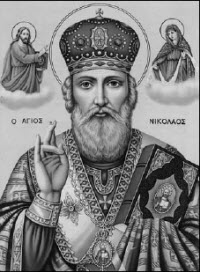
This Sunday we celebrate All Saint’s Day.  It is said that St. Nicholas was a great example of what it looked like to embody love.  In the time that St. Nicholas lived in the fourth and fifth centuries, it was common for the father of a daughter to pay a dowry to a suitor so that he would marry his daughter.  The higher the dowry, the more likely the daughter find a husband.  If a daughter did not find a husband, she would have to be sent in to slavery. One story says that there was a man who had three daughters.  The man was very distraught every day when the third daughter finally reached marrying age because none of his daughters were married and being a poor cobbler, he did not make enough money making and selling shoes to come up with a dowry for one daughter, let alone all three.  It is said that St. Nicholas, then the Bishop of this area of Turkey, secretly left three bags of gold in the shoes of this old cobbler so that his daughters would have a dowry and not be sent into slavery.  He placed these bags of gold anonymously expecting nothing in return.  He just did it because he had love for other people.

Is this story true?  Did it really happen?  I don’t think it matters.  We are smart enough to know that acts of selfless love can bring a little bit of heaven right here on earth.  The only problem is . . . where are the saints?  Who do we turn to as the world around us sometimes seems to be falling apart?  Where are these saints who will make the Kingdom of God appear before us?  See the reflection in your computer monitor as you read this?  See the face looking back at you?  Yep, you get my point.  Let’s go out and be saints to those around us because we have a love that is so deep and so strong that it oozes from our pores and we can’t contain it.  I guess there is still hope for this world . . .

Liturgy for the Modern Church

Posted in Uncategorized on October 30, 2012 by pastoralb

When growing up in the United Methodist Church, I heard numerous liturgies every Sunday.  I thought these liturgies were not only boring, but had nothing to do with me.  These were the antiquated words of long-dead patristic leaders who had no idea about what I needed or how my prayers should be worded.  After I left the church for a number of years, I came back with a new theology and a new appreciation for liturgy.  It was ironic that, although my theology had become more progressive, my appreciation for liturgy and ritual was heightened.  I had grown to see liturgy as the words of a community who had similar needs and an occasional common lack of words for prayer.

For me, liturgy has become a way of creating sacred space amidst the ordinary.  Since we do not know exactly what God is or what God’s essence is, we are left to our imaginative devices.  One image I have of God is a deep dark lake that sometimes engulfs us, sometimes fills us, and sometimes is near us.  Liturgy then, as I see it, is like blowing on the surface of that body of water with the hope that the ripples will spread and have a positive effect, all the way longing for even a single drop to come up and touch us.

God being the mystery that God is, it is sometimes difficult to know what to say to such a God.  It is hard to know how to craft a liturgy that speaks to such a God and experience that God.  Living in an age of post-Christendom where many people do not feel that going to church is a necessity and deny the trinitarian theology of their youth, how can we still help people experience God through liturgy?  I think that we have the need for a progressive liturgy that touches people even today.  Many churches, such as the large non-denominational evangelical churches, have done away with liturgy and come to see it as irrelevant for people today.  I disagree.  I think that we should write a liturgy that reflects our beliefs, therefore helping us to experience God in honesty and depth.  Stay tuned for some of those liturgies . . .

The New Ecumenism?

Posted in Uncategorized on October 23, 2012 by pastoralb

We have a theology pub that gets together once a month to enjoy good beer or tea (whichever the preference) and talk about theology.  Anyone who comes to the group must have the understanding that we are not proselytizing or criticizing others for their beliefs.  Rather, we are engaging in conversation as respectful people who genuinely want to learn from one another.  Unfortunately, there has been one who could not bring herself to do this and attacked the group for entertaining any other views than her theology.  For the most part though, we have been able to have great discussions with the understanding that we cannot always agree with one another, but we will always respect one another.

We do not have to look far to find areas where a little compassion could go a long way.  Fatherless children, families living on the street, kids without food to eat, and the list goes on.  Who is better equipped than the church to help these people and who has more of a directive to help these people than the church?  I seem to recall Jesus saying something about loving our neighbors, clothing the naked, freedom for the oppressed, and doing for the “least of these”.  Unfortunately, too many pastors are more focused on having the “right” theology than doing what Jesus did.  What would it look like if we just got over ourselves and face the fact that we will never agree on everything, but that’s ok?  What could we accomplish together if we set aside our pride and desire to be right for the sake of doing what Jesus did instead of asserting our ownership over who Jesus was?  Maybe I’m too much of an idealist . . .  What say you?

Leading from the Trenches

Posted in Uncategorized on October 19, 2012 by pastoralb

A few days ago, as my youngest son was heading in to the house after helping with some fall cleaning outside, he stopped and was staring at something. There was a dead bird lying on the ground in front of our neighbor’s house.  He asked my wife to bring him a pair of gloves.  She told him to just leave the bird alone because he had no idea how it died or what kind of diseases it may have.  He kept persisting and said that he really needed a pair of gloves so that he could give it a proper burial.  Great kid, right?  He’s got such a warm and caring heart.  She asked him why he was so insistent on burying the bird.  He proceeded to explain to her that, if he was kind enough to bury the bird and give it a small headstone and maybe say a few words over it that the bird might come back down the road as a person and give him something in return and make him rich.  This is a popular theme in Japanese fairy tales when a poor, usually older couple who can barely make ends meet, help an injured animal that eventually dies and later comes back to give them riches. When she started telling me this story I thought, “Awww, that’s my boy.”  By the time she was done, I was like, “Yep, that’s my boy.”

Everybody aspires to something.  I can’t imagine that there are many people who just go through life completely aimlessly with no particular rhyme nor reason.  Most of us grow up wanting to be great in our own way and the most common vision of greatness comes in the form of leadership.  CEO, president, general, whatever the organization, few people aspire to stay at the bottom of the totem pole.  But why is this?  What’s their motivation for wanting to get to the top?  Undoubtedly, some start with a noble vision of affecting change for the good of humanity, but I would venture to say that for the majority of folks aspiring for the C-suite, it is just a matter of pride.

The clergy/priesthood is no exception in this regard.  Priests ordained in great cathedrals likely aspire to be cardinals some day and even in many protestant churches, men and women dream of some day being bishop.  Even in some non-denominational churches pastors will plant a church with the goal of some day being the next Joel Osteen or Bill Hybels.  Oftentimes, while a few token efforts are made, there is a complete disregard for the needs of people.  At worst (and yes, this happens, too), pastors of some mega churches will feed on the needs of the hurting and oppressed to help them build their ecclesiastical empires.  There is a pervading mindset in any area or industry of, “What’s in it for me?” and unfortunately, the church is not above this.  Sometimes another’s pain or loss is used by people to their own advantage. Even Jesus’ own disciples are not above being overly concerned for numero uno.

In Mark 10, Jesus and the disciples are heading in to Jerusalem and I picture a sort of child-like excitement on the part of the disciples almost like going up the yellow brick road to Oz.  “We’re going to Jerusalem, woo hoo!”  But Jesus corrects them and says, “You do realize that this is no vacation.  When we get there I’m going to be handed over to the authorities, mocked, spit at, tortured, and killed, but on the third day I will rise.”  And then this is the best part, James and John say, “Wow, that’s a bummer.  Yeah, that’s really rough.  Oh hey, by the way, we want you to do something for us.”  “And what would that be?”  “Well, we were thinking, you know, you could do us a solid and let us sit on either side of you in your glory.”  The very people hand picked by Jesus shrug off the fact that he is about to be killed and focus instead on what they can get out of the situation.

Jesus of course has a comeback because throughout the gospels, people can’t seem to take the hint that you just don’t ask Jesus questions because he will never fail to be a buzzkill.  “Can you drink the cup that I drink?”  We can see the way Jesus evolves in the gospels by the way he asks the question.  In Matthew, when James and John’s mother ask Jesus to let them be at his right and left, he asks them if they can drink the cup that he is about to drink.  In Mark, it is the cup that Jesus already drinks.  It’s easy then to read the Matthew version and see this as Jesus talking about his crucifixion and death.  I think Mark is more accurate, however.  Jesus tells James and John that these seats at his right and left are reserved for those who deserve them and he cannot just give them away at random.  Those who occupy those seats will deserve them because they drink the cup that Jesus drinks – devoting themselves as servants for the good of other humans.  The rulers that they are used to – the Gentile Roman rulers – rub it in and treat their subordinates like dirt.  But you, if you want to be great, if you want to consider yourselves my people, you will serve others with no thought of praise or notoriety.

This is a great example of servant leadership.  Jesus shows the disciples that to be a great leader, you have to have something worth leading for.  Not personal fame.  Not your own prosperity.  Instead, to be a great leader, you have to be a servant who is willing to set your own ambitions and pride aside for the good of others.

In 1891 a young Indian man graduated law school in England and moved back to his home country.  Not being able to get work, he moved to South Africa and was on track to become a rather successful attorney.  During one of his cases he attempted to get it settled out of court and was successful in doing so.  This case would change the course of the young man’s life because he said he had learned the true practice of law because he had seen the better side of human nature and the good that lies within the human heart.  He decided to dedicate his life to solving major problems by appealing to the good side of human nature and bringing about peace amidst conflict without fighting in a practice that came to be known as non-violent resistance.

He moved back to India which was under British occupation and rule.  After many years, his servant-like leadership proved successful when the British finally gave up and  in 1947 left India.  This man chose to give up the fame and wealth that lay certain in front of him.  He could have pursued politics and potentially amassed an army to try driving out the British.  Instead, he chose to be like the least of these and led from the trenches.  The result was victory without bloodshed.  Well, almost.  This great servant leader was assassinated a year later when trying to use the same tactics to bring about peace between the Hindus and the Muslims.  On the day of his death, for the first time ever for a non-political figure, nations around the world lowered their flags to half mast for the man who was known as Mahatma, meaning “great soul.”  He had taught the world what it looked like to be a true leader.  Having never owned a great corporate empire nor governed a great nation, Mahatma Gandhi had found something worth leading for – the well-being of the human race.

I see that same spirit at IUCC.  This is why I’m proud to be here.  I am NOT in the business of putting down other churches and other denominations because beyond a doubt, there are some churches in all denominations that are doing wonderful things for the people in God’s great creation.  What I AM in the business of doing though is looking around at this congregation and smiling with pride because we are a church that serves God’s people, not because there is necessarily something in it for us, but because we live by the example that Jesus set and because it’s just the right thing to do.

Finding the Sacred in the Ordinary

Posted in Uncategorized on October 15, 2012 by pastoralb

Religion is a frustrating thing.  Sometimes it can be like Ground Hog Day when the day is really bad.  Sometimes, though, it can be a beautiful thing.  I think it is up to us which experience we take away from it.  At the apex of the Christian religion is a God that is taught about, learned about, read about, but not always experienced.  This God is placed within a particular intellectual framework depending upon the practitioner.  Events that transpire and objects that are encountered outside of the allowable realm of God’s work or character are perceived as ordinary, mundane, or at the extreme – cruel.  For example, if our theology holds that God rules the universe from a place above the clouds and has complete control over everything that happens in the temporal realm, then that God is responsible for even the “bad stuff” that happens to us and those around us.  If we see God as this amazing and magnificent personage that only works in big ways, then we will miss the Divine when it is in something ordinary like the sun shining through the trees or a towering mountain.

In Peter Rollins’ book, Orthodox Heretic, he has a familiar parable with an interesting twist.  In The Prodigal Father, one late night, the sons realize that their father is gone.  They live in a great mansion and the father is a very rich man.  Much like the original parable, the oldest son remains on the estate and is a very bitter man.  The youngest son leaves with his inheritance to spend and drown away his sorrows for his missing father and comes back empty handed to find that his father is still gone.  As I read that story, it occurred to me that father may very well have been nearby and never in fact have left.  What if the father changed from his Armani suit, Burberry cufflinks, Fendi necktie, and Ferragamo shoes into overalls and worked the property as a hired hand? This would mean that the father was right there with them all the while, but because they perceived their rich powerful father to be one certain way, they could not even recognize him when he was in a different form.  This is not to paint God as a father figure, but merely to say that we do the same with God.  I believe that God appears to us every day, but we fail to see God because we cannot conceive of the Divine being in the ordinary.

A friend of mine who we’ll call Dave was leaving his church where he is a pastoral intern when a homeless man walked in the door and asked if there were any funds available.  The man explained that he had to take a train to the nearest naval base.  It did not occur to Dave that the man may have been speaking of the Great Lakes Naval Base, but the man’s story sounded fishy to him, so he sent the man on his way explaining that he did not have any money to give and did not have access any church money.  Dave got in his car and headed for home when the car stalled out at the stop light around the corner from the church.  He panicked because he was in the middle of traffic in downtown Oak Park and had people honking at him to get out of the way.  He opened the hood and not being able to find the cause of the problem was highly anxious when he saw a hand from the corner of his eye reach under the hood and make an adjustment to one of the spark plugs.  Dave looked up and saw the homeless man that he had just turned away.  The man gave him a nod and then proceeded to get into the driver’s seat of my friend’s car.  Dave was thinking that his car was being stolen when the man turned the ignition and the car started right up.  The man got out of the car and walked away.  Dumbstruck, Dave got in his car and drove home.  Did God from his perch on high pull some divine strings and make this happen?  I am not convinced that this is the case.  I think, rather, that God was in the event.  I think the event was not the result of God doing something, but instead a manifestation of Godself.

We spend so much time seeking God, but fail to see God in the ordinary humdrum of daily life because these experiences do not fit our concept of God and how the Divine works.  What if we could see God in a baby’s touch, or in the stars in the sky, or a ray of sunlight through the trees?  Think of great composers who hear music in their heads and then pen that music later to be performed.  Where does this music come from?  Is the performance of this music not a manifestation of the Divine?  If this is hard to imagine, listen to this, or this, or this.  Have you ever seen the sun rise over the Rockies or Mount Moran reflected in Lake Bradley?  Have you ever seen a baby smile up at its father or mother and grasp their finger in its tiny hand?  If we can start seeing God in these seemingly ordinary and mundane things, God will not seem so far away, but will fill the space around us and in us like having a shade lifted from our eyes revealing the sacred world around us.

Personal Exodus

Posted in Uncategorized on September 28, 2012 by pastoralb

In his book Telling Secrets, Frederick Buechner talks about his father’s suicide and how under no circumstances was it to be talked about.  Mentioning that his father even existed was verboten not only with “outsiders”, but also within the family.  When he finally did mention it in a book that he wrote, his mother read him the riot act and refused to speak with him for telling the family secrets.  Many families have painful stories, but as Buechner opines, I also think it is healthy to talk about them, or at the very least, acknowledge that they exist.

Each of us is the culmination of all of our stories.  All of the people who have had an impact on our lives contribute in some way to who we are as their stories intersect with ours.  This narrative of existence forms us and whether we admit it or not, shapes the way we see the world.  These stories may be negative or positive, but if we acknowledge them and realize the role the play in our lives, then we can harness the power in them for our own good.

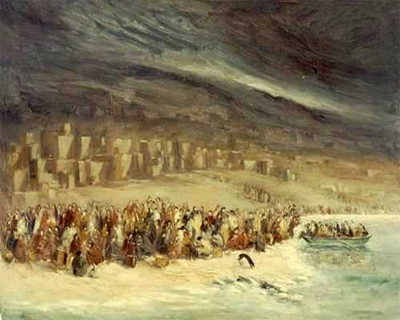
These stories do not just happen at the individual level, but also at the community or cultural level.  One great example is the Exodus story.  Scholars argue over whether or not the Exodus even as recorded in the Bible actually happened or if it did, when it happened.  To me, the facticity of the event does not have any bearing on whether or not it is real.  Even if we are to call the Exodus a myth, I believe it is as a wise person once said – a myth is not something that is untrue, it is something that is so true that it happens every day.  Let’s explore the Exodus story and see.

Do you remember when the Israelites were taken into slavery into Egypt?  If you said “yes”, then you’re thinking of perhaps the Babylonians or the Assyrians because it never happened.  The Israelites under Joseph’s direction went willingly to Egypt because of a famine in the land in which they were living.  After Joseph died, the Israelites were taken as slaves and they ended up being in Egypt for 430 years.  Eventually, Moses was called by God to free the Israelites from their bonds of slavery and lead them in to the promised land.  Negotiation with the pharaoh didn’t go so well and so, after the plagues, the Israelites high-tailed it across the Red Sea (or the Sea of Reeds) and in to the desert.  Then, the went happily ever after in to the promised land, right?  Nope.  They wandered in the desert for 40 years and Moses never did see the promised land.  The Israelites grumbled and moaned about their food and their lodging and argued with God at every chance they got.  They even complained that they would rather be back in Egypt where they could eat.  Finally, because Moses had disobeyed God (remember the whole staff and water from the rock thing?), Joshua was chosen as Moses’ successor.  Things didn’t get much better after that for another 400 years or so, but we’ll leave that for another day.

So, what’s this got to do with us?  Well, isn’t this the story of our lives?  Regardless of whether or not this story actually happened, it still happens and is happening right now.  Have we ever willingly “left home”, so to speak because we thought the grass was greener on the other side and then become enslaved when we realized it wasn’t?  Have we ever, after a difficult battle, tried to go home but just spun our wheels in the same situation or habits?   I’m pretty sure that the answer is “yes” in one way or another.  Some of us are still in the desert.

So, how do we find our ways back home?  For some of us it is as easy as realizing that we are home and embracing the stories in our lives instead of running from them – even the ugly ones.  For others, it begins with trusting that the stories are good and at the very least truly are a part of who we are.  Regardless of where we are at – still in Egypt, wandering in the desert, or back home – there is much to be gained from acknowledging our stories and accepting them as a part of our lives.  Just a thought . . .