Lazarus

Posted in Uncategorized on April 4, 2014 by thecrossingchicago

tombOh, Lazarus.  You never even existed, but yet you are so real.  You are merely a figment of the Jews’ collective imagination, but yet you are an archetype for all of us.  Dives couldn’t convince Abraham to send you out to him to give him a drop of water for the chasm was too wide.  He couldn’t convince the old patriarch to send you to his family to warn them of their impending doom and so you rested peacefully in the bosom of he whose descendants were as numerous as the stars in the sky.  So quiet and comfortable without a worry in the world.  No concern over where your next meal would come from.  No care about how the townspeople would treat you.  No more to fret over your sisters’ drama.  And then it happened.  The Nazarene looked toward where your body lie at rest in the cool dark tomb and with with a breath that carried into your lifeless ears called you back to this world.

What was it like for you?  Were you one minute listening to Dives beg for mercy and the next gasping for air under your burial mask?  Were you resting contently in the old man’s bosom one moment in perfect comfort and the next could feel your stiff back aching and pressed against the cold stone?  He called you and you came.  How the light must have hurt as it struck your dilated pupils like an insolent child when you walked out into the sun at noonday.  

You stumbled out, your funeral bands still clinging to your reeking flesh.  Four days in a damp tomb will do that to you.  Were you glad when sensation came back, though painfully to your body?  Did your lungs burn when air was thrust back into them expanding them like old wine sacks dry and cracked from disuse? Were you elated to be able to feel again or were you mad at the intruder who yanked you unwillingly from your slumber?  Did you despise this prophet for bringing you back from sheol?  Did you count it as selfishness that this man wanted you back by his side when he could have prevented you from dying in the first place?  What killed you anyway?  Was it despair or just ennui at being alive? 

I wonder what happened to you after that.  I wonder if you went on to do great things and make the world better for those around you.  Or was it that you crawled back into the tomb and curled into the fetal position in your bed of complacency?  It was your choice, after all.  Had you rotted so much as to preclude you from living with any semblance of normalcy?  Did it seem like an undue curse that was imprinted on you forcing you to carry it every where you went?  Or did you  have a new hope that made your heart soar as you were able to see and appreciate beauty for the first time?  Well?  

Why did that prophet weep for you?  Why did he feel like you had to be brought back, even it if was kicking and screaming?  Maybe he did it just to show the rest of us that we have that kind of power – the power to call the dead back to life with a single utterance of hope.  Maybe he wanted us to realize that such a force lived within us, too – a force that could propel even us out of the grave and into the light when it seemed that darkness was the only choice.  I don’t know either, but I guess it’s up to me to find out.   

The Lenten Journey

Posted in Uncategorized on March 5, 2014 by thecrossingchicago

ash-wednesdayToday is Ash Wednesday.  Many of us will go and get ashes placed on our forehead as a mark of something we perhaps haven’t given much thought to.  It marks the beginning of Lent, the season where we give something up, but aren’t really sure why.  Over the past couple of years I have given Lent a lot of thought.  Why do we give things up?  What’s with the ashes?  Why 40 days?  It is important to note that the word “Lent” is found nowhere in the Bible.  There are models for it, however, in Jesus’ temptation and 40 days in the desert, Moses and the Israelites’ 40 years of wandering in the desert waiting to enter the promised land, and Elijah’s 40 days of wondering and worrying about what Jezebel is going to do with him while he is attended by angels and finally meets God on the mountain.  It’s no wonder then that the passage about Jesus’ temptation appears in Mark after Jesus is on the mountain with Elijah and Moses – two guys who wandered and met God on a mountain.  Starting to see a pattern?

Jesus is in the desert when Satan comes to him and tempts him with meeting his own needs by turning rocks into bread.  He is offered a kingdom of his own and to use his special abilities to test his mortality.  THIS, I think, is the essence of Lent: to embrace our humanity and relish everything that it includes – even our own mortality.  I would guess that Jesus did not spend a literal 40 day period of time in a literal desert with a malevolent personage who was constantly tempting him.  I don’t think this is the point.  It seems to me that the point is that we are most tempted in our loneliness.  It is the idle time alone when we can work up the most mischief, but it can also be the best time.  The desert fathers and mothers intentionally sought solace in the farthest reaches of the desert so as to shed distractions and get closer to God and to themselves.

The biggest mark of our humanity is our mortality.  From ashes we have come and to ashes we will return.  Ashes to ashes, dust to dust.  The ashes we have imposed on our foreheads is a symbol and a reminder that sometimes we need to just be.  We don’t need to be this or be that.  We simply need to be mindful of our existence and embrace our humanity and every single breath that reminds us we are alive.  We are also reminded that the breath will not always be there and a time will come when we will return to the dust from which we came.  We have to be able to embrace that, too, because it is an essential part of being human.  We give things up, then, so that we can get rid of our attachments – even for just 40 days – and concentrate on being.  The things that we think will make us happy are usually a barrier to our peace and mindfulness.  After all, Jesus didn’t turn rocks into bread, instead he embraced the hunger as it reminded him of his humanity.

So, what am I giving up for Lent?  I think I’ll give up laziness and complacency.  Hopefully this will mean that I’ll get up a little earlier each day and get a little more done.  Hopefully it means that I will do more writing and embrace those things that make me human a little more deeply.

Is God Dead?

Posted in Uncategorized on March 3, 2014 by thecrossingchicago

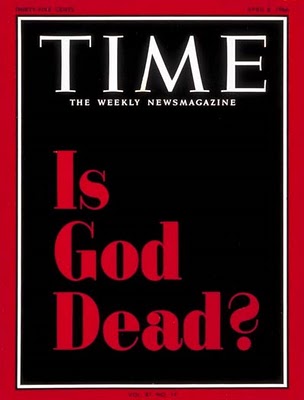
time-is-god-deadTime magazine said it in the interrogatory.  In his Thus Spoke Zarathustra and in an article in The Gay ScienceNietzsche said it in the affirmative – God is dead.  Period.  Here is a quote from his article:

God is dead. God remains dead. And we have killed him. Yet his shadow still looms. How shall we comfort ourselves, the murderers of all murderers? What was holiest and mightiest of all that the world has yet owned has bled to death under our knives: who will wipe this blood off us? What water is there for us to clean ourselves? What festivals of atonement, what sacred games shall we have to invent? Is not the greatness of this deed too great for us? Must we ourselves not become gods simply to appear worthy of it?

—Nietzsche, The Gay Science, Section 125

Nietzsche is accused by many who have never actually read him as being a nihilist.  Quite to the contrary, he did not gloat about the human act of deicide, rather he lamented it.  He did not believe that humans had literally murdered God, but he felt that they were replacing God with less important things and, in the process, making God inconsequential in their lives.  In fact, Nietzsche warned against nihilism and said that it was a dangerous thing to not have a supreme being as a moral guide.

To the question, Is God Dead? I say – we can only hope so.  Much as Nietzsche has been misunderstood, I could easily be hung upside down from the church rafters for making such a statement too loudly.  So, lest the doctrinal SWAT team show up at my door with Bibles drawn and my excommunication papers in hand, let me clarify that statement.

Since humans have been capable of cognition and certainly since the advent of Roman systematic theology, we have been seeking, hoping for even a mere glimpse of who and or what God is.  In our search, we walk away with more questions than answers.  “If God is in control, then how can evil exist?”  “If God is omnipotent, then how can bad things happen or does God just not care?”  “If God created everything and God is good, then how is it possible for Satan to exist?”  “If God has a plan for everything, where is the good in suffering?”  “If we are ultimately responsible for the evil in the world, what about natural disasters?  We couldn’t possibly cause earthquakes and tsunamis.”  “If God is capable of anything, then why did he have to kill his son so that we can be ‘saved’?”

Such questions are quite valid within the framework in which this God exists, yet lead only to more questions and even worse answers.  How about some of these: “God gave us free will, so we are ultimately responsible for evil.  Our evil acts caused God to curse the world and that is why the earth is imperfect and sometimes has natural disasters.”  “God allows Satan to exist to test us and see if we truly will obey him.”  “God allows suffering so that we can be molded by it.”  “God  has a plan and sometimes works in ways so mysterious that we cannot comprehend them, therefore we should not even try.”

Ok, you get the point.  I could go on forever, but such thinking can only lead to circular reasoning.  So what’s our problem?  Personally, I think it is that we have created one version of God who is imperfect and irrational and therefore requires much explanation and futile attempts at logic so as to reconcile the complete inanity of it all.  Ironically, we call this God perfect and blame our own feeble minds for their inability to comprehend such a being when it is those feeble minds that created this deity in the first place.  If we are going to ever make any existential progress, I think we would do well by letting this God die the same slow and painful death that “He” purportedly lets others withstand.  On second thought, it’s probably best that we “kill” this senseless deity as quickly as possible so that we can get on with our lives.

I can recall as a young boy even into high school I would spend the night with my great-grandmother at her home.  We would go through the same routine of watching Murder, She Wrote, Empty Nest, The Golden Girls, and Wheel of Fortune.  When it was time for bed, I would say the prayers that she taught me: The Lord’s Prayer and The Serenity Prayer.  I would also say a prayer that, as much as I tried to mix it up, always came out about the same – “Dear God, please let grandma be alive and well in the morning.”  I always felt that if I did not pray with just the exact words that God would find a loophole and I would wake up to find her having died in her sleep.  In order to close up these loopholes lest a certain wily deity sneak one through, I would pray the same thing in as many ways as I could think to verbalize it.  It doesn’t take a PhD in theology to realize that this is not a healthy view of God, but nonetheless it’s the one that we usually pray to in the dead of night.  I killed this God long ago, but in the darkest hours when the lightning is flashing outside and finger-like branches are tapping on the window, I sometimes catch myself resurrecting him.

I realize that this all sounds rather cynical and perhaps it is.  Rest assured, though, that my intention is not to be sacrilegious, but rather just the opposite.  I would love nothing more than to have folks encounter God for the first time because they were finally willing to let go of the God they created.  The God that Nietzsche claimed that humans had killed was imagined at a particular time for a particular reason.  “He” no longer serves a purpose, so how about a discussion about what God might be if we let God be God?  To be continued . . . .

Get a Life

Posted in Uncategorized on February 25, 2014 by thecrossingchicago

jburkmanIt’s pretty sad.  You may have already heard the news that lobbyist Jack Burkman is drafting legislation that, if passed, will ban gays from the NFL.  We all know that there is no way that it will pass, but it is still disconcerting that someone would use his or her intellect (if there is any) and other resources to get involved in something that is frankly none of their business.

According to Burkman, “We are losing our decency as a nation.”  I couldn’t agree more.  How much indecency does it take to take it upon one’s self to legislate the sexuality or any other facet of a person’s private life?  Burkman says that it is an unthinkable horror to mothers across the nation to have to imagine their sons being forced to shower with gays.  Nice.  How about putting your mouth to better use and teach people to be more accepting of one another.  Then again, you wouldn’t know anything about that – would you?  I’m not generally one to get cynical, but this guy represents exactly what he’s talking about – the loss of our decency as a country.  Let’s start worrying about ourselves before we go out attacking others.


Knowing it All

Posted in Uncategorized on February 3, 2014 by thecrossingchicago

absolute-truthDuring this time of year when we want to escape the cold midwestern winter it only makes sense to go where it is warmer.  Unfortunately, I’m not that bright and went up north to spend a weekend with my “brothers-from-another-mother” up in Wisconsin.  As always tends to happen around the breakfast, lunch, or dinner table, political “discussions” break out usually in the form of one person espousing what are no more than his own opinions, but are presented as though they are the only option a sane person with an IQ higher than his shoe size could arrive at.  It is later in the evening after dinner and some wine that the religious discussions begin.

I always go away and do the dishes when the political rhetoric is heating up, but I will usually stay and banter for a short while during the religious ones.   Ultimately, though, people will try to razz me by saying that they are atheists and are thrown off when I tell them that I have no agenda to prove them wrong.  I have no need to convince folks of a particular faith system or even to believe that there is a God – however one defines this term.  Rather, I will say that absolute truth is a hard thing to come by and those who have it really don’t have it.  I don’t opine that we should be relativists, but I certainly don’t think that we can stand for very long on absolutes when it comes to defining God.

It is extremely difficult, likely impossible in fact, to “prove” that one is right in either of these discussions.  This is why I don’t waste my breath on political discussions.  When it comes to theology, however, I have to ask myself what we are really studying in this academic subject.  Are we studying God?  I would opine that we are not.  To “do” theology is to explore the various ideas that humankind has developed over the years about the Divine.  But, they are just these – our own ideas.  Theology is not the study of God-self.  I don’t think that God can be known outside of experience, but regardless, it troubles me when self-professed theologians purport that they own absolute truth and have evidence to back it.  It’s even worse when folks base their ideologies on these truths “because the Bible says so.”  More often than not such truth claims are based upon biblical texts taken egregiously out of context and used in a way that the original authors likely never intended.

Despite my reticence to embrace absolute truth claims, I do not propose that we all become relativists.  I think what we run a risk of losing the opportunity to experience the Divine if we merely say that all religions are the same  because they are clearly not.  Each religion grows out of a particular cultural context and history for specific reasons and it would be irresponsible to push those reasons aside.  To say that they are all the same is to come to a conclusion and I would say that, when it comes to God, there are no conclusions.  It is as Catherine Keller said in her book, On the Mystery: Discerning Divinity in Process: “When we think we’ve finally got it, have we already lost it?”  I would say yes.

Our search for God is just that – a search.  It is a journey that takes us places that we could have never imagined and could never have seen were we to have our minds hardened by the pretty little bow we have placed around our own version of absolute truth – forever dooming it from being transformed by God.  Keller says that, “Abstracted from it’s living relationships, even a proposition about divine love can be cited ‘in bad faith.’  It can be turned into a terrorizing absolute.  Such abstraction from text and context, whereby a proposition can then be reinserted unilaterally into any life situation, is the temptation of all forms of truth-language, but above all of theology.  It is the fertilizer of every atheism.” (emphasis mine)  

When people are busy creating their own form of God and imposing it upon others “for their own good,” it has the same effect as the framing that happens on either side of the political aisle.  People define things in their own chosen words leaving others to agree or disagree with no middle ground.  When we describe God and “think we’ve finally got it” we force a necessary atheism for those who have not experienced that God.  If what you describe is God and I cannot bring myself to believe in this God, then I do not believe in God and am therefore an atheist.  Instead of trying to make sense of the Divine, why can’t we just embrace the mystery that God is and enjoy the journey of new and breath-taking experiences?  Why do we have to hold the keys to the truth?  Perhaps we would be better served by NOT giving up on thinking, or on the search for God, but instead embracing that which we discover rather than setting it aside because it doesn’t match our pre-defined notions.  This would be to allow a very large God in process remain in process with the ability to work wherever that God may be found.

I wouldn’t say that I agree with Augustine on everything or even remotely so, but I think he was dead on when he said, Si comprehendis, non est Deus – “If you have understood it, then that what you have understood is not God.”  When it comes to God, let’s stop worrying about being right and start being real.

The God of the Gaps and Unified Theory

Posted in Uncategorized on January 23, 2014 by thecrossingchicago

I was recently listening to an interview on On Being with Marilynne Robinson (fiction writer) and Marcelo Gleiser (astrophysicist) when it occurred to me that, while we keep science and faith at opposite poles and often in great tension with one another, there are a lot of similarities.  In fact, religion could stand to learn a few things from science and visa versa.  Indeed, contrary to the beliefs of those like Dawkins and Hawking, science and religion need not be antithetically at odds with one another.

We have heard of the God of the gaps – the idea that those things which are explicable remain within the realm of science and logic while those things that we cannot explain are attributed to God.  For example, Newton realized that the Earth and the other planets in the solar system were revolving around the sun in an elliptical pattern due to a force called gravity.  This was pure science.  However, neither he nor anyone else could explain what force started the planets in motion in the first place.  This was believed to be the work of a divine being because nobody could come up with a viable reason.  Humans are on a search to find God in a way that doesn’t merely fill the gaps of the unknown, but to grasp that which is incomprehensible.

In science, there is a search for what Dr. Gleiser calls “beautiful perfection.”  That is, the way in which bodies act upon one another is a result of forces that exist between them and within those forces there is a symmetry that explains the effects of those forces upon the objects.  I’m not a scientist and I won’t pretend to be one, but the basic gist is that there is a symmetry that lies at the core of existence that wraps science up with a nice bow and “explains it all.”  This is called Unified Theory and its discovery is the quest of many scientists.

It always intrigues me, that such ideas as this within the scientific world are called “theories,” which by their very nature mean that there is significant evidence via the proof and disproof of hypotheses and null hypotheses as to their being correct, but they are not proven per se which would make them a “law.”  In religion, however, (especially Christianity) we have “absolute truth.”   Void of any data or evidence we who adhere to a particular religion believe that there is something that is absolute and true without a willingness to budge despite the lack of benefit or tangible proof.  In science, however, if a theory is disproven, there is great rejoicing amidst the scientific community because it means that advances have been made in that particular field.  The feelings of the scientist(s) (if still alive) who introduced the existing theory may be hurt temporarily, but over all they will be pleased because their goal was likely not for self-notoriety, but rather for the advancement of knowledge in their field.  In religion, it seems, we are more concerned about being right.

Believers attribute the inexplicable to a Divine being who has all the answers where our own run out.  Scientists search for a grand design to the structure of the universe all the way down to subatomic particles to make sense of how it all works.  In the end, we’re not all that different.  We’re all on a search for something that we can’t quite get our minds wrapped around.  The difference is, when believers discover something that potentially advances our relationship with the “mysterious Other,” even when it means needing to let go of old dogma, it is deemed as heresy and disallowed because it doesn’t match up against the “absolute truths that we hold to be self-evident.”  I think it would be nice if we could get over ourselves (because after all, it’s really just our own egotistical need to be right and fear of being wrong that keeps us holding on) and rejoice when we make advances in connecting with God.  Yep, we’ve got a lot to learn from each other, those scientists and us who own the truth.

Taking Risks

Posted in Uncategorized on January 16, 2014 by thecrossingchicago

Fr Alec ReidFather Alec Reid was a voice for peace in a time when it was best to keep your mouth shut.  During the fighting between the Catholic Irish Republican Army of Northern Ireland and the Protestant British Forces, Father Reid worked going back between the parties and trying to bring peace in a conflict that would claim over 3500 lives.  It would have been much safer if he would have kept to himself and just stayed in the monastery that he lived in for 40 years, but he chose to risk his life for what he believed in.

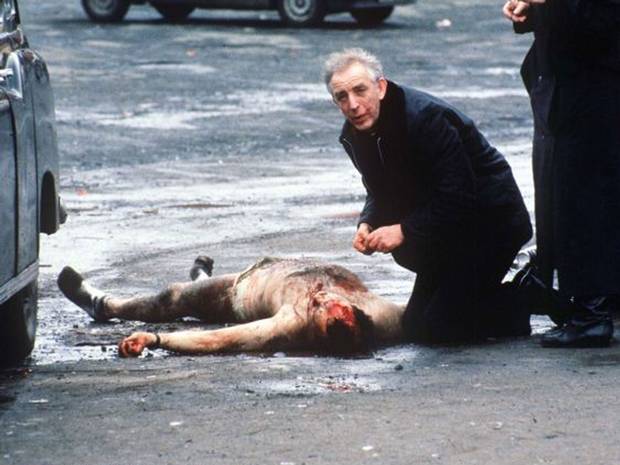
One time, in fact, during a funeral for an IRA soldier in Northern Ireland, father Reid was walking by with documents that were being exchanged between Sinn Fein and the British government to broker a peace deal when two British undercover officers were discovered by IRA security people.  Although Father Reid pleaded for the IRA to stop, they dragged the officers from their car, stripped them, and beat them.  One of the security people pulled out a gun and Father Reid laid on the ground with the two men who were lying face down on the street and put his arms over them.  The IRA member said, “Get up, or I’ll f@#%ing shoot you as well.”  They grabbed Father Reid and pulled him away and then shot the two British officers.  Father Reid ran back to the men, turned them over, and tried to do CPR on them.  It was too late.  Father Reid got down on one knee, administered last rites, and then picked up his bloodied envelope to take back to the monastery and exchange it for a clean one.  Lucky for him he wasn’t killed, but he risked his life regardless of the possible danger to him so that humans would be able to live together at peace.

John the Baptist was a social prophet and revolutionary in a time and place when, again, it was much better to keep your mouth shut.  Anyone associated with him was marked by the Roman government and deemed an outcast by the temple Jews.  The Jews and the Roman government had a deal.  As long as the Jews behaved themselves and paid their taxes on time, the Romans would let them conducted their religious business.  As often happens under such a system, the Jewish leaders took extra liberties in exercising power and turned the purity system into a money-making, power grabbing exercise.

It was this system and denigration of his religion that John came to speak out against.  He called for people to repent – meaning to change their minds and ways – and go back to seeking righteousness for the sake of one another.  Needless to say, the Jewish authorities had a good thing going and didn’t appreciate John flapping his jaws.  Being associated with him was extremely dangerous.  To be baptized by John was akin to making a public announcement that you were joining the cause and joining the resistance.  In Judaism, baptism was a purification ritual that occurred when one committed to living a life of righteousness for the sake of oneself and those around you.

It was on to just such a scene that Jesus entered.  Jesus goes to John and says, “I’m in.  I’m joining this movement.”  John gave him an out.  He said that it should be Jesus that was baptizing John and not the other way around.  We often hear this as a theological statement, but we could also hear this as John saying, “You don’t have to do this.  I’m already a marked man but they’re not after you yet.”  Jesus knew what he was getting himself into and he insisted that John go through with the ritual.  And so he did.  It was then that it is said that a dove descended upon Jesus as a sign that God “was well pleased” that Jesus had made the decision to stand up for what was right, even if it meant that his life would be in danger.

If we were baptized, what were we baptized into?  A specific belief system?  I don’t think so.  I think our baptisms are supposed to be an outward and visible commitment to a new way of life rooted in that which is the essence of all being.  I think baptism is a commitment to the things that Jesus taught and lived by – namely, justice, freedom, love, and peace.  We were baptized into a revolution with risks.  How are we doing on that?  Are we sticking our proverbial necks out for someone in need or are we just playing it safe?  Just wondering.

The Three Wise Guys

Posted in Uncategorized with tags , , , on January 3, 2014 by thecrossingchicago

ImageThe three wise men.  That’s what we call them, although it says nowhere in Matthew that there were actually three.  Perhaps they would be better labeled as the “the three wise guys.”  Herod was the Kim Jong Un of his time.  This was Herod Antipas, not to be confused with his father, Herod the Great.  He was paranoid and realized that he was no more than a puppet at the hands of those more powerful than he.  He killed his own family members out of paranoia that they would try to dethrone him and even divorced his own wife to marry his brother’s.  When John the Baptist spoke out against this marriage arrangement, Herod had John’s head served up on a silver platter – literally.

It must have been a great slap in the face then, for these three wise guys to show up at Herod’s doorstep saying, “We understand that a new king has been born.  Someone who will be greater than you.  We want to go pay him homage, so can you tell us where he might be?”  That would be like going to Kim Jong Un and saying, “We hear that a new leader over all of unified Korea has been born, can you show us where he is?”  You can imagine how Herod would have flown into a rage and ordered every child two and under to be killed.

The question that has to nag at us though, is, who were these wise men and why did they go to Jesus?  It might be helpful to take a look at who they likely were.  The magi were called wise men, but they were also mystics and astrologers.   Magi is the plural of magus which was the name for a Zoroastrian practitioner.   Looking back on history and connecting the dots, we can determine that these Zoroastrians were from either Persia or Babylon.  A good number of Jews never came back from the exile to Babylon and it is a distinct possibility that, if these Zoroastrians were Babylonian, they could be familiar with the Jewish concept of a messiah.  Likewise, if they were Persians, they would be very familiar with the Jews as it was Cyrus, the founder of Persia, that defeated the Babylonians and allowed the Jews to return home and even helped them rebuild their temple.  From 1500 BCE, Zoroastrianism was the primary religion in that area in terms of monotheistic religions.  In fact, it is said to have been the first monotheistic religion followed soon thereafter by Judaism.

Zoroaster, or Zarathustra was a religious figure who got tired of the class/purity systems of his area in what is today northeast Iran.  There was a pantheon of deities and people were expected to please the Gods or face the consequences leading to strict purity rules that developed into a caste system.  Zoroaster found this to be very oppressive and was reported to, during one of the purification rituals, had an experience in which he encountered Mazda – the one true God.  This God, Zoroaster said, is all good and is the creator of the universe.  Mazda dwells within humans and every bit of good in people is a manifestation of Mazda, where all evil is from Angra Mainyu.  It was supposedly revealed to Zoroaster that Mazda wanted for humans to focus on practicing good words, good thoughts, and good deeds.  In doing so, the goodness would be spread to others and eventually evil would be defeated and a new kingdom would be established here on the earth while those who embraced evil ended up in hell with Angra.  Sound familiar?  Yeah, I thought it might.  It was into such a system of Jewish purity laws and class division between the pure and the untouchables that Jesus was born into.

King Cyrus had been a Zoroastrian and proselytizing was against the core of the religion.  More important than converting people to certain beliefs was teaching people to show compassion and love to one another, thereby bringing about heaven on earth.  It is no wonder then that King Cyrus has a special place in the hearts of many Jews, especially since he sent Sheshbazzar along with Zerubbabel back to Jerusalem to rebuild the temple and then commissioned Ezra to go back and teach God’s law to the newly returned Jews.

Fast forward about 500 years and here we find a group of Zoroastrian mystics, those who believe fully in the immanence of God within human beings, going to pay homage to one who was to be the ultimate incarnation of God.  These men were signifying the end of the old order and the beginning of the new.  This was not to replace Judaism, but to embrace it while casting off the man-made oppressive aspects of it that only served to make God seem farther away.  We humans are good at building systems and structures that are supposed to get us closer to God that only serve as barriers that prevent us from seeing God.

If God indwells all humans, and those who are open to the awareness of the presence of God can experience that connectivity, then it should be no surprise that these Zoroastrian mystics would have experienced something like a cosmic earthquake at the core of their being when a God-man like Jesus entered the scene.  Someone who wanted exactly what they wanted – the redemption of all creation – had come and they just had to meet him.  It’s not known how long these men stayed and who knows, could they have even had some influence on Jesus’ spiritual development?

We can learn from these men that it’s not always wise to turn to the powers that be for wisdom and direction.  Just because it’s “The way we’ve always done it” doesn’t mean it’s the best way.  Herod and the religious leaders represented the old ways that just led to death.  Fear leads to an irrational and dangerous attempt at grasping and holding on to save some semblance of familiarity.  Let’s be open to new revelation no matter where it comes from.  Let’s see that God is still speaking, and in this New Year, let’s put the fear, complacency, trepidation aside and dare to do something different.

Make Them Hear You

Posted in Uncategorized on November 30, 2013 by thecrossingchicago

make them hear youAdvent.  The season of longing and hope for a brighter tomorrow.  The celebration of the light of the world entering creation to save humankind from itself.  At the same time that we experience this glimmer of anticipation, we are also hit with a healthy dose of reality.  We realize that things don’t seem to change very much and that the world is in this constant cycle as history repeats itself again and again never really coming to redemption.  I wonder why.  Einstein said that the definition of insanity was to do something over and over again expecting different results.

Let’s take economics for instance.  This is a perfect time to talk about it with Black Friday just behind us.  The financial sector says spend, spend, spend.  Let’s spend as much as we can and show that consumer confidence is up.  Let’s maximize revenues and do what we need to in order to make sure the bottom line is as fat as possible.  This way companies will be able to hire more people and unemployment will drop and the economy will improve.  The social sectors says, “Are you kidding me?”  This mentality is what has been costing us all along.  You’re telling me that it’s good for the economy for people to go out and buy things that they don’t need at prices that defy logic and have them go deeper in debt as they put it on their credit cards?  So now they will have to pay the interest on those cards on top of the debt they already had and will decrease their disposable income.  Yeah, that makes sense.  As long as nobody reverses this cycle, it will continue to repeat itself from generation to generation as it always has.  Somebody has to take a stand and start teaching a better way.

What about foreign policy?  If the leader(s) of a nation or people group do something that we disagree with, we should threaten force and the taking of lives.  If they do not obey us, we have to carry through with our threats lest we be deemed as weak.  It doesn’t matter what the ideology is behind their actions, either way they are wrong and we are right and such should be asserted.  What the heck?  If we spend some dough on these campaigns it will just improve the economy anyway.  This cycle has been in place ever since humans discovered fire.  2500 years ago Isaiah said that a day would come when war is taught no more.  He said that nations “shall beat their swords into ploughshares and their spears into pruning hooks.”  I guess we just keep waiting.  Or is there another way?

Jesus entered the world as our hope.  He was the one that came to teach a better way.  We Christians want him to hurry up and do something to make the world a better pace.  We want him to eradicate all of the foolishness and bring peace, but unfortunately we keep waiting.  In the meantime, we need to tell the world that there is a better way than the one that we have been following.  We need to bring to fruition this idea of teaching war no more.  How do we make them hear us?  How can we get them to listen?  If actions speak louder than words . . . .  Perhaps we have missed the point and Jesus didn’t come to do things for us, but instead came to show us how we were supposed to do them.  If that’s the case, then let’s start living out what we have been taught.  Make your actions speak loudly and make them hear you.

Because They Said So

Posted in Uncategorized on August 23, 2013 by thecrossingchicago

oppression-fists“They.”  The purveyors of great wisdom to the masses.  What would we ever do without them?  A good portion of what we know we got from them, so I guess I shouldn’t be too hard on them.  They say that this will be a hot summer in the first half and cool in the latter half.  They say that the Bears only have a four percent chance of going to the Super Bowl.  (They’re probably right on this one.)  They said that the world is flat and that you can tell a person’s personality by the shape of their head and that sheep grow out of the ground and that rats are spontaneously generated in dirty areas and that the sun is a habitable planet.  Yep, these are all things that “they” really said and that people have actually believed over the years.  Well, on Tuesday, “they” broke my heart.


It was almost the end of football practice and the boys were coming back to our side of the field after practicing field goals.  Right next to me I could see two boys bantering – one black and the other white – and I thought they were just playing around.  I realized they were quite serious, however, when the African-American one got on top of the Caucasian one and started punching him.  Lucky for him he still had his helmet and gear on so he just took a few shots to the side.  I was standing right there so I grabbed the one on top and pulled him off.  He ran back and went at it again.  I pulled him off again and he threw his helmet across the field and with tears streaming down his face yelled, “F*%# football!”  My initial reaction was that this kid had no right to get violent and I still think as much, but now I have the rest of the story to go with it.

The day before at practice, the Caucasian had apparently been taunting the African-American player and spitting at him.  He went to his mother and she told the coach.  When the proverbial schtuff hit the fan, the Caucasian was apparently spitting at the African-American again as they were practicing field goals and then began to call him a nigger.  The one being pestered told him to stop and so he did it more.  By the time they got back over to us, he just kept saying it over and over again, “Nigger, nigger, nigger.”  And so the boy snapped and yelled something to the effect of “I’ve had enough of this bullshit!” and laid into the one making the remarks.

So who is the victim here?  Sadly, some would think that it’s the white boy who got punched by a black boy.  Those darn black folk and their violent ways.  Others would think that the victim is the one who was taunted by racial slurs and spit at.  The reality, though, is that they are BOTH victims.  They are victims of “they” and their diabolically vociferous claims that it’s ok to oppress people and as a result of that oppression, violence is a natural outcome.  As human beings we have been led to believe by the ancient wisdom of “they” who have oppressed people throughout the ages that it is acceptable to assign one people to inferiority and another as their superiors.  “They” only have a voice if WE listen and give them credence!  Without someone to listen and act like what they say is true, they can never subvert justice and make the world believe that it is normal to oppress people.  In like manner, “they” will have no say in things when we start realizing that violence only breeds violence and that the cycle is systemically perpetual.  As long as we continue this way, we will ALL be guilty of giving the oppressors their swords and of simultaneously being the oppressors ourselves.

I am reminded of a great man, who, 50 years ago stood at the Mall in Washington D.C. and told the world that he had “been to the mountaintop.”  Being an African-American in those days, he could have very well said that on that mountaintop he saw whites finally inferior to blacks or that blacks had come to power over the whites.  But he didn’t.  He said he saw a dream.  A dream where children “will not be judged by the color of their skin, but by the content of their character.”  He said,

We must forever conduct our struggle on the high plane of dignity and discipline. We must not allow our creative protest to degenerate into physical violence. Again and again we must rise to the majestic heights of meeting physical force with soul force. The marvelous new militancy which has engulfed the Negro community must not lead us to distrust of all white people, for many of our white brothers, as evidenced by their presence here today, have come to realize that their destiny is tied up with our destiny and their freedom is inextricably bound to our freedom. We cannot walk alone.

He practiced a method of non-violent resistance and taught, like Jesus did, that violence will never solve anything.  I say “they” can go to hell because God knows we have all spent enough self-imposed time there.  On this 50th anniversary of his famous speech, I would encourage us all to read all of Dr. King’s speech here.  Let’s not just read it, let’s live it.  Jesus himself said that the “gospel” is to “proclaim freedom for the prisoners, recovery of sight for the blind, and to set the oppressed free” (Luke 4:18-19).  I don’t think it was any accident that Jesus chose to recite this text at the inauguration of his ministry.

In Luke 13:10-17, Jesus touches a woman who had been arched at the back for 18 years.  She couldn’t have the dignity of standing up straight and looking people in the eye like she was somebody.  For 18 years she looked at the ground in some sort of ashamed stature as if she had done something wrong by being born as a woman.  Then Jesus touched her.  He didn’t have to.  He could have healed her with a simple word, but he reached out his hand and touched her as if to say “You matter!  Now stand up straight and be proud of who you are.”  Dr. King gave this message to young black men so many years ago and we would do well to reiterate the message today.  Let’s encourage everyone to stand up proud for who God made them to be and to never feel like they have to resort to violence to prove it.  Likewise, let’s teach our children of any race that it’s never ok to treat another person like anything less than what they are – someone who has been fearfully and wonderfully made by the very hand of God.

Sometimes our dreams are God’s realities.  I long for the day when this dream becomes a reality and when we all can sit together in peace from every race, tribe, nation, and tongue and say “I remember when we used to listen to ‘them’.  How foolish we were back then.”