Archive for the Uncategorized Category

Prayers in the Grotto

Posted in Uncategorized with tags , , , , on November 23, 2015 by thecrossingchicago

IMG_1610IMG_1617

As I was hiking over the land at Gethsemani Abbey where Thomas Merton was a monk, I came across a small shed with prayers tacked to the wall and ceiling.  I obviously did not expect to find it in the middle of the woods, but I was deeply moved by the heartfelt longings that filled the space.

Prayers in the Grotto

They were not mere verses penned on a whim.

They were not the simple obligation to write something when presented with paper.

They were heartfelt pleas to the universe.  Legitimate questions to the essence and core

of all being.  Not rhetorical, but genuinely and desperately seeking an answer.

They were the same laments that had followed their authors

everywhere they went. 

The inescapable pleas for a sign, for hope, for healing that had not yet found their way home.

These were the cries that had been hurled into the wind that now hung heavily in that grotto

like a dark damp cloth wretchedly in need of sunlight and fresh air to dry and breathe and be.

Their words, our words.

The supplications of those whose God is so near as to seem absent.

The awareness of how a simple “I love you” or “You’re good enough” or “I affirm you” can be

the very voice of God to those who need it.

Curled up pieces of paper and freshly written ones hanging from the walls and ceiling with longing

and expectation that God will actually peer in and read them.

May those prayers find their way out through the cracks

and float freely in the light of a new morning;

finding their way back to the hearts from whose lips they were uttered.

May they be blessed by that light who turns sorrow into joy, sadness into laughter.

– Brandyn Simmons

Hymn of Faith

Posted in Uncategorized on October 19, 2015 by thecrossingchicago

images-of-jesus-with-children-1Lord, the Lord Almighty,

May those who hope in you

Not be disgraced because of me;

God of Israel,

May those who seek you

Not be put to shame because of me.

Psalm 69:6

This passage is a prayer for each of us to pray daily.  Not only clergy, but every person who professes to live into a call to uphold the grace and mercy of God should live this as a mantra.  It’s not always easy.  I am a pastor, but I am also a human.  I sin.  I make mistakes.  I fall flat on my face and occasionally need someone to pick me up and hand me a tissue for my bloody nose.  I am neither called to be nor capable of being perfect.  But at the very least, I have to act and speak so that my tainted ways do not spill over onto someone else and prevent him or her from experiencing the love of God.

Although all who have been called to the vocation of ordained ministry know this (or at least should), sometimes there are failures that have tragic consequences.  A young girl that I know had the faith in a loving and merciful God forcibly ripped from her thirteen year-old soul.  She believed that God protected her and kept her safe.  She had faith that God watched over her and kept the forces of evil and destroyers of innocence at bay.  She trusted that those who spoke for and represented the Almighty would use their God-given authority to heal and forgive and cast out demons to teach her and treat her well.  She was horribly mistaken.

After this young girl of African descent was repeatedly raped by her pastor, she was left with two seeds growing with in her: a child in her womb, and a welling anger at a God who could allow such things to happen.  The very person who was the hands and feet of the healer Himself, tore a wound in her mind, body, and spirit that may never be mended.  She teeters between justifiable anger in an all-powerful deity who chose to sit back and watch her be violated and the disbelief that such a God could possibly exist.  The rug has been ripped out from under her and she is left with the wind knocked out of her, gasping for air, feeling that everything she has believed in is a lie; and right now, nobody can convince her otherwise.

In their Artist’s Song, the band Lost in the Trees pined, “Sing out your hymn of faith ’cause I have none – your song is my fortress.”  For now, this is all we can do for this young lady and all who have had their hope in life taken from them.  For all those who believed that there really was a light in the darkness and that life isn’t just a cruel joke, but were left crying in the dark while those outside laughed in derision; for all of those who looked up to the ambassadors of a loving God just to be left feeling that God looked the other way while they robbed them of their faith like a thief in the night, we sing for them.  We sing our hymn of faith because they have none and hope that our words will become their fortress.

This wasn’t the first time, by far, nor will it be the last time that one of God’s children are harmed by the very ones that God called to defend them.  It would be better to have a millstone hung from their neck . . . .  While we can set up boundaries and a safe haven to prevent such things from happening in the future, we can’t be vigilantes for those who have already been wronged.  As even now my fists are clenched and I want to make this man pay for taking what wasn’t his and hope that the legal system does its job, I am reminded of my own ability to cause hurt for those around me.  To whom much is given, much is expected.

As our voices float into the night sky and fall like gentle rain upon those innocents who thirst for healing, let us keep on singing our hymn of faith for them: May those who seek you not be put to shame because of me.

Amen and Amen.

My Name Is . . . Bella

Posted in Uncategorized on September 29, 2015 by thecrossingchicago

Bella Bond was found in a bag along Boston’s shoreline.  It is apparent that the two year-old was beaten/suffocated to death by her mother’s boyfriend who thought she was a demon.  Bella’s mother is a prostitute and drug addict who had a history of having children taken away from her by the state.

Too many of our youth are in unhealthy home environments and a significant number of them have no voice to speak out with.  While we have systems in place to deal with abusive and unstable parents, there are still many who fall through the cracks and end up dead either physically or emotionally.  Those who are “lucky” enough to survive the hostile environment they have the misfortune of being born in to, often end up dealing with emotional wounds the rest of their lives that lead to the perpetuation of destructive behavior.  Few, however, find a constructive way to work through their healing – people such as Marshall Mathers.

Mathers, the rapper known as Eminem, was no stranger to an environment that led to a fractured soul.  An addict mother with Munchausen’s Syndrome, a father who pulled a disappearing act, an uncle who was his same age who committed suicide, and other unhealthy factors were a reality at their home on 8 Mile in Detroit.

Mathers could have easily turned to the things that so many troubled youth do.  Drugs, violence, gangs, all awaited him and he started down the path toward them.  But then he realized he had a talent.  He found that poetic expression through rap was healing.

If only more youth had a creative outlet to express themselves and find the healing they need.  Unfortunately, too many parents and teachers are telling kids to do something constructive and that they will never make it on artistic ability.  They need to get a real job and deal with the emotional wounds that fester inside on their own.  As parents, teachers, and mentors, we need to encourage our youth to express themselves.  We need to give them a voice and let them find peace in their words while they still have them.  Bella will never have a chance this side of the veil to heal, but there is still hope for so many others.  Hopefully through this expression they can clean out the skeletons in their closet and redeem the vision that still lingers in the headlights.

Cleaning Out My Closet is Eminem’s moving account of dealing with the emotions from his childhood.  Headlights is the sequel and apology to his mother for being so harsh.  Grab your tissues and enjoy.


Rosie-Colored Glasses

Posted in Uncategorized with tags , , , , on September 9, 2015 by thecrossingchicago

modern-houses-snow-country-house-designs-8It was a bright day as the sun glittered on the freshly fallen snow.  The roofs of the nice houses were covered as were the luxury vehicles that sat in their driveways.  It was a perfect scene from a Norman Rockwell painting or perhaps from Home Alone before everything went haywire.  Except for the suspicious looking man in the Lexus driving through the neighborhood.  When the officer noticed him, he could tell that he was clearly out of place.  After all, the man was African-American and not only did he not belong in this affluent neighborhood, but in all likelihood, the Lexus he was driving was stolen.  Black folk couldn’t afford such luxuries.

The officer pulled the man over and asked him if he knew why he’d been pulled over.  A lovely little trick that cops use when they clearly have no reason to be pulling someone over.  Perhaps he expected the man to flinch or even give a confession right on the spot.  It worked.  The man did confess to his crime. 

“Yes, officer.  DWOTW,” the man answered.

“What the hell does that mean?” the officer asked as he squinted his eyes suspiciously.  This boy was toying with him.

“Driving while other than white,” the man explained.

The officer was not remotely amused and asked the man to get out of the vehicle so that the officer could search it.  An African-American in a nice car in an affluent neighborhood could only be up to no good.  There had to be drugs or weapons in the car.  It didn’t matter that the officer had no cause for search nor seizure.  There wasn’t something that looked like a gun handle sticking up barely in sight in the glovebox.  There was no bag with white powder sticking out from under the seat.  No, the man’s crime was simply “driving while other than white.” 

The driver pointed out the officer’s folly and rubbed a little extra egg on his face as he pointed out that, not only was the Lexus he was driving his own, but that was his big house on the end of the street with his kids and wife waiting inside for him.  This particular driver was a graduate of Northwestern University where he played defensive back.  He was later drafted by the San Diego Chargers and after retirement from the NFL, finished his graduate work and is now employed as a nuclear physicist overseeing the 17 nuclear power plants east of the Mississippi.  This man is also one of Westyn’s football coaches.

Roosevelt Groves (or Rosie, as we call him), told me this story as we was taping up Westyn’s hand after blocking a PAT and taking a boot in the back of the hand.  When one of the coaches asked Rosie if he had a knife to cut the makeshift splint that they had created to fit Westyn’s hand, he replied jokingly, “Cops shoot black folks who carry knives so I don’t carry one anymore.”  I laughed along with him, but it wasn’t really funny.

Lest anyone think I am anti-police or even overly critical, I am pointing out something that does not merely exist within the police force, but within all of us.

What if Rosie had been an African-American teenager in a hoodie sitting down low in a beat up Chevy Monte Carlo blasting rap music when he cruised through this neighborhood?  Then would the officer have been justified in pulling him over?  As hard as it is to say out loud, must of us would say yes. 

All races have equal rights in the U.S.  Civil rights became a reality 50 years ago.  There’s nothing wrong with society.  We see our world through rose-colored glasses and things appear much better than they really are because we are the privileged.  We should know something is horribly wrong when even our prophet, Lord, and God incarnate uses racial slurs.  Maybe instead of looking at everything through rose-colored glasses, we need to start seeing it through Rosie-colored glasses.

When we read the Bible in snippets as given by the lectionary, we tend to lose the overall meaning.  The narrative is taken apart in chunks and we end up with a misinterpretation of the intended lesson.  One important aspect of this story is that Jesus choses to go to “the other side.”  He doesn’t merely go to the other side of the tracks, he goes where the people on the other side of the tracks came from

The Jews didn’t only look down on those who lived in the surrounding territories, they hated them.  These were the people whose ancestors tried to keep them from claiming their God-given land.  I don’t imagine the “foreigners” liked the Jews any more.  It took a lot of courage and a big swallow of pride for this Syrophoenician woman to go to Jesus and ask for help.  The love she had for her daughter compelled her to go to this Palestinian Jew who had a reputation for being a healer.  And what she received in return was a slap in the face.

I’m not sure what this woman expected Jesus would say when she went to him.  After all, she wasn’t only a foreigner, but she was a woman.  Jesus was supposed to be different, but he proved to be just like the rest. 

Go away dog, what I have to give is for the Jews only. 

Yes, but even the dogs get to collect the crumbs that fall at their master’s feet.

I imagine that Jesus was clapping in his heart when she said this.  She stood up for herself and didn’t allow even the Sophia of God to put her down when her daughter was suffering. 

Did Jesus use this opportunity to teach a lesson to the disciples?  He had just gotten done teaching that it was what came out of our mouths that defiled and now what went in.  Perhaps he was showing them how words could hurt.  Or maybe he just wanted to test the woman and see what she would do.  Then again, maybe Jesus was just a bigot like everyone else.   

This woman’s daughter was afflicted by a demon.  While the people of that area believed in the supernatural and demon possession was not out of the question in their worldview, it was also code for something that was torturing the mind.  Something was bringing this girl down and tormenting her.  Perhaps she was bullied by her peers.  Maybe somebody called her a dog.  We will never know.  What we do know is that Jesus taught this woman a valuable lesson – don’t ever let yourself be put down by others.

This was a moment much like when Jacob wrestled with the Angel of God until morning – I will not let go of you until you bless me.  Jesus threw some cruel words at her, but she did not back down.  She, in essence, said I will not go away until you do what I know only you can do.  The correlation surely was not lost on Jesus.

I have done what you asked for.  Go back to your daughter and teach her to do as you have done.  Don’t let her be pushed down by those who would seek to oppress her.  Teach her to have pride and never, ever, hang her head and believe that she is any less than anyone else.

This story would be powerful all by itself without a follow-up.  But Jesus wasn’t done.  When he was headed through Tyre on his way back, he came across a man who was deaf and mute.  It’s a little gross to think how Jesus basically spit in his mouth, but it’s very powerful to consider what the result was.  Was the man really deaf and mute?  Or was he doing what most of us do on a daily basis?  Hear no evil, see no evil, speak no evil. 

Before Jesus said ephphatha, or open, he looked up to heaven and sighed.  How long will these people keep on this way?  How long will those who have been created in your image continue to treat each other like dogs? 

Jesus opened the man’s mouth and ears and told him to stop being silent and start speaking up.  Don’t pretend you can’t hear injustices spoken.  Don’t act like everything is ok.  Jesus’s message was the same to him as it is to us: I have given you a voice, now use it.

Hard Life in a Small Town

Posted in Uncategorized on August 31, 2015 by thecrossingchicago

graveWhen my brother, Trent, was in kindergarten, he was completely smitten over an adorable little girl named Katie Milligan.  She was always full of energy and was the kind of kid that everyone always doted over because of her infectious smile and endless curiosity. You couldn’t help but like her and, in our small school, she was everyone’s little sister.

I can’t honestly say that I remember the day clearly or how I found out, but I can recall Trent being sad about something and my mom explaining that one of his classmates had died.  The only thing I can recall thinking at the time was, how is it possible for someone so young to die?  Only old people are supposed to die.  Unfortunately, the cosmos didn’t operate the way I thought it should.

Katie’s dad, Mack, was a farmer and they lived out on a country road that ran between Holcomb and Kings right across from the cemetery where my grandparents would later be buried.  Perhaps Mack had nobody else to keep an eye on Katie and perhaps he just wanted some special daddy/daughter time as he shared with her what his work was like.  I can only imagine the panic Mack must have felt when he glanced over and noticed Katie was no longer sitting next to him on his tractor, nor the horror that rattled him to the core of his soul when he looked back and saw her tiny body that had been crushed by the rear tire.

There was a flurry of talk as is common for a small town and everyone developed their own opinion about the horrific tragedy as if they were somehow entitled to one.  Ultimately, there were two camps of thought: those who thought Mack was irresponsible for letting his daughter ride unrestrained in the tractor with him, and those whose hearts ached for him.  Most people had a leg in each camp. 

I can’t recall if people ran to the side of Mack and his wife to support them during this crisis.  I don’t know if anyone attempted to console or comfort them where no words could undo what had been done.  It seems to me that most avoided Mack and his family altogether.  Maybe this is just the faulty memory of a then eight year-old, but I think there is some truth to it.  Most were probably uncomfortable because they didn’t know what to say.  Others maybe were afraid that what ever bad karma Mack had summoned would rub off on them and the Angel of Death would come for their young, too.  Maybe they were uncomfortable around Katie’s mom who, with a history of mental illness, snapped with the death of her daughter.  It’s hard to say what the reason was, but my recollection is that they were alone as they lowered the little casket into the same ground that my ancestors reposed in.

—–

I’m sure there were other tragedies that rattled the small school’s teacher and student body, but most involved those who had moved on and made it at least into early adulthood.  People like my second cousin Karl who died at 22 when he crashed his homemade Ultralite airplane or when my aunt’s best friend, Greg, was killed in a car crash at 25.  Mostly, though I just remember fighting a lot and spending what seemed like the majority of my time in the principal’s office as a result of those fights.

Bullies were in great supply at Kings School.  With a student body of only about 250, there seemed to be a particularly high ratio of bullies.  I liked to think of myself as a bully-slayer (admittedly falsely altruistic and self-aggrandizing thinking indeed) and, as I continued to grow and become physically stronger, I would find myself toe to toe with them on a regular basis.  One such person was Justin Anders.

Justin and I could never seem to see eye to eye.  He was at least a year older than I was (I believe he was held back) and was an eighth grader when I was in seventh.  He was “dating” a friend of mine who had a certain affinity for bad boys and I was a bit envious.  A fair dose of jealousy combined with a misguided hunger for revenge led me to a fight at recess that left Justin with a fractured eye socket and orders from his doctor not to watch TV all summer lest the ultraviolet rays blind him in that eye.  As we sat outside the principal’s office glaring at each other – me with a venomous stare and him with a swollen eye – I honestly can’t say that I felt any pity for him.

As I ponder the enmity that I had for Justin for being a bully, a loser, and a down-right mean person, I am fully aware that I was far from innocent and that the lens I viewed him through was severely tainted.  Memory flatters the rememberer, but reality holds no judgment. 

Justin didn’t have a life that was any easier than mine.  It most ways, circumstance had dealt him a rather shitty hand.  His parents were divorced, his dad didn’t have much, if anything, to do with him, his mother was mentally unstable, and his step-dad had run over and killed his sister, Katie, with a tractor four years before.  There’s no question about it – life was rough for Justin Anders.

There are a lot of things in my life that, if granted the chance, I would do over.  Unfortunately, we don’t get do-overs.  As the rapper Eminem says, “We only got one shot.”  We merely get to do better the next time, God forbid, such a chance presents itself.  I was far too young to do things right when my life’s path intersected that of Mack and Justin.  I would like to think, though, that if I come across another Mack Milligan that I will put my hand on his shoulder and weep with him for all of the hopes and dreams that would never be.  For the brokenness that only a father can know at the loss of his little girl and that I would say nothing, just letting sighs too deep for words intercede where there is nothing that can be said. 

If I ever come across another Justin Anders, as much as I may be quick to judgment and anger at first, I hope that I will do things better.  I hope that I will extend an open hand of peace toward him instead of a clenched fist of hate.  I hope that I will take his hand in mind, look him in the eye, and say, “Yeah.  Life sucks sometimes, brother.  But it gets better when we face it together.”  Let it be so.  Amen.

Yeah, But . . .

Posted in Uncategorized with tags , , , , , on August 25, 2015 by thecrossingchicago

what i talk aboutOne of the great things about being a pastor (and there are many), is the opportunity to do a lot of writing.  I enjoy writing and the places that it takes me, but I am constantly wanting to take it to the next level.  I want to publish the non-fiction book I just wrote. I want to write novels. I want to publish more short stories. I want to develop a unique voice that moves people, etc.  I do ok and I realize the only way to become a good writer is to write.  There are other factors such as reading the works of good writers and setting aside a number of hours a day to write, even if I just end up staring at a blank page the whole time.  As much as I know all this and realize that I can probably become a fairly capable writer, there is always this nagging, “Yeah, but . . . “ going on in my head.  In the end, I am my own biggest critic and hurdle to overcoming mediocrity. 

“Yeah, but I have nothing important to say.”

“Yeah, but I can’t write like the great or even good authors.”

“Yeah, but I just don’t have the natural talent.”

“Yeah, but I will never be able to write anything worth reading.”

“Yeah, but I don’t even know where to start.”

You get the point.  Despite reading that a writer’s first draft is hardly “worth a damn” (Hemingway) and that it takes lots of practice, that nagging voice is still there.  Knowing that a disciplined writing regimen would elicit results that I can’t even yet fathom still sometimes leaves me paralyzed. Hearing writers like Stephen King say that even an average writer can get good merely by writing frequently (but a bad writer doesn’t have a snowball’s chance in hell – thanks a lot, Stephen), I am still plagued by a lack of confidence.  Even when folks are kind enough to tell me that I’ve got a gift for writing, I usually figure they’re just being kind.

On occasion, though, I hear something that gives me a burst of confidence or at least a glimmer of hope.  I hope these little nuggets will reach you, too, wherever you are and in whatever struggle you are plodding through.

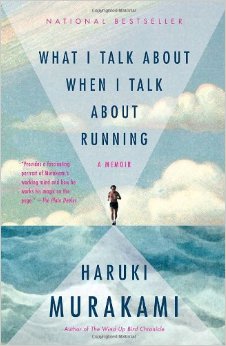
I just finished a book by one of my favorite authors, Haruki Murakami.  He is not only a good writer, but he has an imagination that is second to none.  Whenever I pick up one of his books, I can be sure that I won’t be disappointed.  The book was called What I Talk About When I Talk About Running.  It was a memoir of sorts of his dozens of marathons and triathlons and a little bit about how he got into writing. 

The book has energized me not only for writing, but I’ve also increased my running as a part of my daily workout.  I am amazed by the fact that, by tuning out my negative mind with music or podcasts on my iPod, I am able to run a lot farther without thinking about how my legs hurt or telling myself that I’m not a runner.  Instead of thinking about running, I just run.

According to Murakami, he was sitting watching a professional baseball game in Tokyo when he caught a foul ball and at that moment had the epiphany that he could write a novel (I don’t see the correlation either, and neither did he). He had no experience writing whatsoever and was running a small jazz bar with his wife at the time.  On his way home from the game, he bought a fountain pen and some writing paper and got to work.  Over the course of many months of writing from 3 am when he got home from the bar until the sun came up, he completed his first novel.  He submitted it for a contest and won.  The next year he released his second novel that was also written in the wee hours of the morning.  He sold his bar and convinced his wife to move out of the city so he could embark on a full-time career as a novelist.

What struck me the most was that a man who had no writing experience whatsoever put his mind to writing and got to it.  He stumbled along the way and had plenty of excuses not to write, but he was determined.  So determined, in fact, that he did his writing after a full day’s work when most of us are dead to the world.  He honed his craft and, through perseverance, became a very good writer.  His mindset about hard work paid off in his career as a novelist.  Having completed over 40 marathons and two ultra marathons (62 miles) as well as being strict about his allotted time for writing, translated into some very fabulous books that have brought joy to many readers.  It wasn’t so much that he had a savant for writing (although he obviously had to start off with some aptitude), but rather his mindset and discipline that helped him live his dreams.

The other part of the encouraging equation is something that my son’s coaches say at almost every practice.  It has been attributed to a number of motivational speakers and athletes, but rings true regardless of who first uttered it.  “The two things in life you are in total control over are your attitude and your effort.”  Here, here.

I may or may not have an aptitude for writing that is any better than anyone else’s.  But I am quite sure that, with a good and positive attitude (meaning kicking the yeah, but right in the yeah, butt) and giving all the effort I can (I will reap in direct proportion to what I sow), then I will succeed at making my dream a reality.

This is not only true for me, but it is true for YOU!  Is there something that you’re aspiring to do?  Is your mind trying to tell you that you’re any less than you really are?  Do you feel like life is dragging you down and keeping you from being who you know you were made to be?  Then don’t take it lying down!  If you’re reading this now and saying “Yeah, but . . . “ then I’m saying right back at you, “Yeah, but it’s who you were made to be!”  So don’t settle for anything less.

Angels and Demons

Posted in Uncategorized on August 19, 2015 by thecrossingchicago

holcomb railroad tracksThe railroad tracks felt like they divided us from the rest of the world.  Running north-south along the eastern edge of town, they were the border between our tiny town and No Man’s Land.  Even one step beyond those tracks and you were no longer in Holcomb.  The Doan’s, who lived not even 500 yards beyond the tracks toward highway 251, seemed like foreigners to me. 

A few times a day, freight trains would roll from their stop at the intermodal hub in Rochelle carrying who knows what up north to farms and factories.  The trains rolled along behind the grain elevator that spewed out corn dust that would cover our house across the street and create a living hell for anyone with asthma. 

There were no crossing arms or lights because everyone was used to the trains.  They were as much a part of our small-town existence as the tiny post office and the sea of corn and soy beans that came up to the other side of the unmarked road that ran alongside the tracks.  Life was simple and there was no sense of urgency as folks walked from one end of town to the other.  Only the old and infirm bothered with cars to get around unless you were crossing the tracks and going out of town. 

It wasn’t necessarily a friendly town.  You wouldn’t find folks sitting on their front porch drinking sweat tea and waving at neighbors strolling by, but most everyone knew each other and would lend a helping hand when needed. 

There was no need for a crossing arm or lights and bells at the three crossings because, even though nobody could tell you what time the two or three trains would roll by each day, their schedule was as much a part of our circadian rhythms as going to bed and waking up.  It wasn’t even that people felt the need to be careful of the trains because there wasn’t really anything to be careful of.  There was no way that anyone would be in the path of one of these trains because such things just didn’t happen.  Except for when it did.

Sandy Stumpf was heading to work via the middle crossing that was next to Doris and Charlie Vogel’s red and white house.  Perhaps she was focused on what she had to do at work and perhaps she wasn’t completely awake yet, but although she noticed the train near the crossing and that the train was moving, she thought the train had already passed and was moving in the other direction.  Unfortunately, she was wrong. 

As a 10 year old boy, I was three miles south in a classroom in Kings when the driver’s side of Sandy Stumpf’s car was crushed by the reversing train.  The train dragged her car off of the road and deposited it in the Vogel’s back yard near the basketball court that they erected for the town’s youth.  Miraculously, Sandy wasn’t fatally injured, but she was pinned inside her car by the crushed driver’s side door leaving her mostly immobile.  More than the pain of being hit, the fear and panic of being trapped overwhelmed her. 

My grandfather, Jim Hilliard, had been chief of our modest volunteer fire department, but was since retired when he saw what had happened and went to Sandy’s aid.  My grandpa had an uncanny knack for finding the scene of the accident as it was ironically him who found his best friend’s truck in a ditch near a country road after his friend had suffered a fatal heart attack.

Sandy needed to be extricated from her car, so there was nothing in that sense that my grandpa could do.  As they waited for emergency vehicles and as the paramedics sawed into her car to get her out, my grandpa knelt next to her and held her hand through the process.  He couldn’t physically get her out and back on her feet, but he provided support and encouragement in a way that gave her the strength to get through her potentially tragic ordeal.  When Sandy was finally free of her car and received the treatment she needed and in the days to follow, both Sandy and other townsfolk called Grandpa Jim a guardian angel.  Many said, “If I ever have an emergency, I want Jim Hilliard to be there with me.”

Sandy would outlive my grandpa by a number of years as he died about two years later at the age of 57.  Many gathered at his funeral and remembered his strong spirit as another angel was taken home.  It wasn’t many years later after his funeral that Sandy would also find herself in a casket – the victim of murder by poisoning at the hand of her husband.  She wasn’t his first wife that had mysteriously turned up dead.  Such is life in a small town where angels and demons play on the same field and eat of what has been reaped from the same soil, but it is the angels that give us strength, even long after they have returned to that hallowed ground.

Go Set A Watchman

Posted in Uncategorized with tags , , , , on August 6, 2015 by thecrossingchicago

harper-lee-go-set-a-watchman-cover-leadYeah, yeah, yeah.  I know.  It’s been a while.  I hope to get the mojo going here and what better place to start than with the much-anticipated novel by Harper Lee, Go Set A Watchman?  I will try to avoid too many spoilers here, but there will inevitably be a few.

I recently heard on NPR that there are bookstores actually giving refunds for this book.  Some demanded their money back because the book wasn’t as good as they thought it would/should be.  Others said they wanted a refund because of their disappointment in the characters in the book.  I fail to understand either of these claims.  I read the book and not only thought that it was good, but I saw it as a faithful depiction of reality.

I can understand that many had their hearts broken when the Great American Literary Hero of civil rights, Atticus Finch, turns out to be less than affirming in his advanced age.  It turns out that Atticus didn’t defend Tom Robinson so much for the sake of social justice as to reestablish order in the town that had gone crazy over the alleged rape of a white girl by a black boy.  Unlike Harper Lee’s father who was a segregationist who became more inclusive in his old age, Atticus joins the Citizen’s Council (White response to the NAACP) to slow down change in Maycomb Junction after SCOTUS had declared segregation to be unconstitutional.  When his daughter, Scout, who revered her father as a champion for equal rights, realizes that he is a member of this council, she lashes out at him in what results in the most moving parts of the book.

Scout eventually musters up the courage to speak to her father about his membership in the council.  She goes into his office and pulls no punches with the man she has never had the courage nor inclination to say a cross word to.

I remember that rape case you defended, but I missed the point.  You loved justice, all right.  Abstract justice written down item by item on a brief – nothing to do with that black boy, you just like a neat brief.  His cause interfered with your orderly mind, and you had to work order out of disorder.  It’s a compulsion with you, and now it’s coming home to you – “

It obviously pains her to say these harsh words to the man that she has revered, but she has her heart set upon rebuking him for letting her down the way he has.  She damns him for ruining the image that she had of him.

I believed in you.  I looked up to you, Atticus, like I never looked up to anybody in my life and never will again.  If you had only given me some hint, if you had only broken your word with me a couple of times, if you had been bad-tempered or impatient with me – if you had been a lesser man, maybe I could have taken what I saw you doing.  If once or twice you’d let me catch you doing something vile, then I would have understood today.  Then I’d have said that’s just His Way, that’s My Old Man, because I’d been prepared for it somewhere along the line – “

Atticus doesn’t argue with Scout.  When she says that she’s leaving and not coming back, he merely tells her to have it her way.

It’s never easy when our heroes betray us.  We put them on a pedestal and almost worship them with our undying fidelity and feel utterly lost when they fail to return the favor.  This is the danger of worshiping people and this, I believe, is the point of the book.  Atticus’s learned brother, Dr. Jack Finch, who has heard of the tongue lashing Scout has given Atticus paints a clearer picture for us.

Every man’s island, Jean Louise (Scout), every man’s watchman, is his conscience.  There is no such thing as a collective conscience. . . . now you, Miss, born with your own conscience, somewhere along the line fastened it like a barnacle onto your father’s.  As you grew up, when you were grown, totally unknown to yourself, you confused your father with God.  You never saw him as a man with a man’s heart, and a man’s failings – I’ll grant you it may have been hard to see, he makes so few mistakes, but he makes ’em  like all of us.  You were an emotional cripple, leaning on him, getting the answers from him, assuming that your answers would always be his answers . . . . When you happened along and saw him doing something that seemed to you to be the very antithesis of his conscience – your conscience – you literally could not stand it.  It made you physically ill.  Life became hell on earth for you.  You had to kill yourself, or he had to kill you to get you functioning as a separate entity.

And here, as they say, is the rest of the story.  I won’t spoil the ending, but I would be remiss to not mention the real point.  Those who would demand their money back because they felt betrayed by Atticus or Harper Lee in her depiction of him fail to see the reality of the situation.  Hemingway, Tolstoy, and others have said that the great stories have something in common – they are all in some way true.  This is why Hemingway would get over apparent writer’s block by “writing one true sentence.  The truest sentence [he] knew.”  Harper Lee did the same.  She knew that race relations were far from perfect in the real world.  She knew that our greatest heroes would always disappoint us in the end if we continue to worship them as Gods and not respect them despite being the flawed humans they are.

Lee was prophetic when she first presented this work in 1957 that would change and eventually become To Kill a Mockingbird.  Instead of seeing Atticus as a bigoted dream-slayer and faulting Lee for making him this way, perhaps we should appreciate the work as it is – literary fiction and Atticus for who he is – an archetype for all of the heroes we have and ever will worship.

The Dogma Files: Adam and Eve

Posted in Uncategorized with tags , , , , , , , , , , , on April 22, 2015 by thecrossingchicago

adam and eveGod is a liar.  The fact that we exist is proof of this reality.  In Genesis 2:16-17 God tells Adam that he can eat from any tree in the Garden of Eden, except for the fruit of the tree of knowledge of good and evil.  God warned Adam that if he ate of that fruit, he would die on that same day.  Guess not.  Maybe God was just kidding.

There are a lot of aspects to Christianity that are really hard to swallow.  There are a lot of stories that just don’t add up and the story of Adam and Eve is probably at the top of this list of untenable narratives.  Can we safely disregard this story then?  Should we just pull a Thomas Jefferson and cut that part out of the Bible?  Shame on the writers of this story for recording lies that would cause us to stumble some 2500 years later.  Or should I say shame on us for reading metaphorical narratives as though they were literal history?

It sounds awfully sacrilegious to call God a liar.  If the Bible is recorded as the exact, inspired, historical, factual Word of God, then God has been caught in a number of lies.  This makes it extremely difficult to follow such an untrustworthy deity.  We don’t have to worry about ditching God though, because God never said the words written in the Bible – not verbatim anyway.  As I’ve said here and elsewhere numerous times, the Bible is compilation of historiographical narratives.  It is the story of a people who are trying to make sense of their existence by recording true myths about existential problems and the plight of humanity.  This is the story of the Jews as seen through human eyes peering into the world of the sacred.

To call something a true myth is not an oxymoron.  Mythologist Joseph Campbell said, “All religions are true but none of them are literal.”  It’s also been said that a myth is something so true that is happens every day.  The stories in the Bible, Adam and Eve being no exception, are myths that help us see into the true nature of God and humanity, if only we have the eyes to see.  With this in mind, what would it look like to view the story of Adam and Eve through this lens and not as a literal event?  Let’s find out.

Although Adam is a proper name today, it wasn’t when this story was recorded.  Adam merely means “human.”  It is a play on words using the Hebrew word adamah which means “earth” from which Adam was formed.  The word for form or make in Akkadian is adamu and the word for red (the color of the clay from which Adam was made) is adam.  Those scripture writers were some witty fellers, weren’t they?

The Jews were in captivity in Babylon in the 6th century BC.  By that time, Akkadian was replacing Sumerian where most in the ancient Akkadian empire spoke both languages.  When the Jews were in captivity, they were influenced by the Akkadian, Babylonian, and Sumerian religions and this is where the creation accounts of Genesis come from.  The Jews’ language was also influenced by these other Ancient Near Eastern cultures.  Ironically, the story of King Sargon who led Akkad to prominence sounded much like the story of Moses.  Sargon was said to be placed in a reed basket as a baby and placed in the river to be left to the mercy of nature.

Now that we’ve freed our minds from the absolute necessity that the story of Adam and Eve must be literal, let’s take a look at the story and see what meaning it holds.  There is a lot of meat here (pun intended) around Eve being formed from Adam and the dominion of humans over animals, but I’ll save the gender roles and ecological discourse for another time.  For now, I want to focus on “The Fall” of humankind.

Adam and Eve had their pick of any food in paradise.  Assumedly, there were numerous types of vegetation and fruit to choose from.  It may be worth noting that there is no account of Adam explaining the rules around the tree of the knowledge of good and evil, but although God laid down the law before Eve was even created, she is aware of what was said.  This shows that Adam and Eve are not to be taken separately.  They represent all of humankind and are given two names so as to represent both genders.

Despite the fact that Eve knew better, she is tricked by the wily serpent (supposedly not yet a “snake” because it hasn’t yet been condemned to slithering on its belly) to eat the fruit of the tree (note again that nowhere in this text does it say “apple” although that’s how the legend has morphed) and have the same knowledge as God.  Adam also ate of it and many misogynists would claim that Adam gets a bad wrap because it was all really Eve’s fault.  It also makes us wonder why the story is told as the Fall of Adam and not the Fall of Eve.  God warned that death would happen on the same day, but we are told that the two went on to have children who would populate the region.  Of course we run into the age-old problem of incest if the offspring of Adam and Eve were having children together, but this is only problematic when the story is taken literally.

Adam and Eve did not physically die from eating the fruit, but as an archetype for humanity, humans do begin an existential death when we try to play God.  When we create false realities about ourselves, others, and cosmology and then try to impose those realities upon others, we die a little every day.  Adam and Eve were completely innocent in every sense of the word.  Not only had they done no wrong, but they were naive.  They had no idea they were naked.  They had no needs nor anxieties.  But when they tried to have knowledge (versus wisdom) they became aware of their lack and ineptitude.  They were no longer “good enough” and felt the need to hide themselves from the essence of all being.

Knowledge is good.  Knowledge is, as they say, power.  But when we seek knowledge as an alternative to wisdom, we begin to climb up out of the well of our depths and into the world of logic.  We lose all sense of mystery and sacredness and begin to see a need for a logical explanation for everything.  Facticity becomes more important than wonder and we lose the ability to experience God.  We leave our hearts behind and live in our heads.  This was the downfall of humankind as brilliantly painted into the tapestry of the myth of Adam and Eve.

When knowledge rules over wisdom dualism is born.  The need for exact reasoning for everything leads to a necessary determination whether something is good or bad.  The realm of wisdom tells us that there is no dualism and that good and bad are different sides of the same coin.  The realm of knowledge tells us that we have to put everything in its logical place to make sense of the universe.  This is why the forbidden fruit grew on the tree of the knowledge of good and evil.  When humankind decided to replace contentment and an awareness for the sacred we began to die.  The very essence of our meaning and purpose, our very existence in fact, and that existence in God became cloudy and we made a self-imposed exodus from paradise to our own Babylon where suffering awaited being born out of our delusions.  Humans are incapable of knowing everything.  When we try to give everything an explanation, we will inevitably be wrong some, if not most, of the time.  The false realities that we create are mere delusions that become attachments, for we are incapable of letting go of our finitude.  Perhaps this is why we have such a problem with mortality and need assurance of eternal life.

The story of Adam and Eve is not the history of our earthly mother and father who brought the wrath of God upon themselves for eating a forbidden fruit.  It is the story of humanity’s struggle to make sense of its own existence.  It is a myth that is so true that it happens every day.  It’s a warning against giving up wisdom for knowledge.  It isn’t an explanation for why bad things happen in the world and why Jesus needed to come as “the new Adam” and save us from ourselves.  But, in a sense it is exactly that, because Jesus pointed the way back to paradise.  He taught the way back to godly wisdom and giving up worrying and competing over resources.  He showed us that we need merely to turn our gaze inward to find that the Garden of Eden not only still exists, but is flourishing with more than we can ever need.  Now that’s a story worth telling.

Just Be Yourself

Posted in Uncategorized on April 19, 2015 by thecrossingchicago

be-yourselfThere are many kinds of prophets.  Some are real, actual prophets.  Some are false prophets who lie to achieve their own ends.  Some are delusional and believe that they are sent by God or that they are some sort of messiah.  Others are somewhere in between.  Vernon Howell was on that spectrum. 

Vernon had a rough childhood and some of the psychological effects showed.  He turned to his mother’s fundamentalist Seventh Day Adventist church, but was kicked out when he told the pastor that he had a revelation that he was supposed to marry the pastor’s daughter.  He then joined a reformist group that had splintered off from the Adventists and soon claimed that he had a vision that he was supposed to lead the group.  It was believed that he was having an affair with the 77 year-old widow of the founder of this sect and he gained support from her to take over the group. Understandably, her son, George Roden, felt that he was the rightful heir and challenged Vernon to a resurrection contest.  Roden exhumed a body to make it look like he had resurrected someone and Vernon told police about the incident.  When a third person came along and claimed to be the messiah and leader of the group, Roden killed him with an axe and was sent to a mental hospital.

Vernon finally took control of the group and engaged in many questionable practices including spiritual marriages, statutory rape of his “spiritual brides,” and child abuse.  Vernon had another vision that he was the incarnation of Cyrus the Great, the Persian king who freed the Jews from Babylonian captivity and sent them back to Israel.  He felt that it was his duty to reestablish the Davidic monarchy in Jerusalem and so, adopting the Persian name for king Cyrus as his last name, he changed his name to David Koresh.  After a 51 day seige, Koresh and 80 of his followers were killed 22 years ago today (April 19th).

This was a very sad and unfortunate example of a psychologically troubled person with a messiah complex leading vulnerable people to their doom.  I won’t get into how well or poorly the FBI handled the situation or why those people were so easily manipulated, but it just goes to show how dangerous a false prophet can be.  Likewise, a real prophet can be conversely as healthy.

So what is a prophet anyway?  From the Old Testament, we tend to see them as a person with a message from God.  It was typically a message of doom and gloom and warning for a people who had chosen to go against the will of an almighty God.  Are there still prophets today or has their function changed?  I would venture to say that they do and it has.  Peter exemplified what a modern-day prophet looks like in the book of Acts.

In Acts 3, Peter and John come across a man who is carried daily on a mat to the temple steps where he can beg for money.  Instead of giving them money, Peter did what a true prophet does, he empowered the man so that he can have a good life of his own volition instead of based on what others provide.  The man was lame from birth.  We know that we have to be careful about reading these stories literally, because we lose the true meaning.  So, the man was not factually and physically unable to walk.  Instead, he was unwilling to hold himself up and face life with dignity.  In essence, he took it all lying down.

The man’s friends enabled him over the years and carried him on his mat so that he could continue to receive reinforcement for his complacency.  Perhaps his parents had taught him in a way that furthered his enablement and then his friends took over that role.  When Peter and John saw this, they knew what was going on.  Peter got down to his level, looked him in the eye, and empowered the man.  In essence, he told the man that he had worth and that his life mattered.  He put out his hand and helped him up.  Nobody had ever done this for him.  Imagine the feeling of dignity that he must have had when he realized that what everyone else had been doing for him out of pity, he could do himself because he mattered.  From that moment, he saw that he didn’t exist to have things done to him, but that he could affect change with his own life.

At first, the man clung to Peter, but he eventually stood up straight and let go.  How many times have we heard in the New Testament Jesus telling people to let go of him and to “go and do likewise.”  Through his prophetic words, Peter had not only empowered a man back to life, but he had also made a prophet out of this man.  Who better to spread a message of empowerment than one who was raised from the “dead” himself?

Understandably, the people were shocked at what had happened.  This man who for decades had been laying on his mat begging others to do for him, was full of life and vigor and determined to live his own life.  Peter asked them, “Why are you so surprised?”  Then he launched into a discourse about sin.  He challenged those who had witnessed this transformation to repent.  As individualistic westerners, we hear words like sin and repentance as something to do with the terrible things we do against God and how we need to seek forgiveness from them lest we be punished by a blood-thirsty God who is insatiable.  This isn’t what sin and repentance meant in the 1st century and it’s not what they mean now.

To sin, as you have likely heard in others’ sermons, is to miss the mark.  This is not a good/bad dualistic “X” in the sand that God has put down daring us to undershoot it.  To sin is to live a life other than that which is truly us.  It is to be anything other than ourselves.  We all have a meaning that lies at the depth of our being that we are meant to be true to.  Anything that is done contrary to who we really are is “missing the mark” and makes us suffer.  Sin is corporate as well as individual.  When we repent (literally, change our minds) we get a new mindset for ourselves that spreads in encouragement to others.  This is what empowerment is all about.  It’s encouraging others to live lives that are true to themselves and reassuring them that they will experience great peace and joy when they do so.  It’s reminding them that they matter and that they, too, have the power to change the world.

Some people are hurting.  Most of us are.  This is part of being human.  Some feel hurt more deeply than others and have a hard time seeing past it to where there is hope, dignity, and strength.  There is a Japanese saying for when a child gets hurt that goes “ittai, ittai, tondekke!”  This means, “pain, pain, fly away!”  When the man who couldn’t see beyond his own hurt came face to face with Peter, Peter said, “ittai, ittai, tondekke!” and the man was empowered and saw his worth.  That’s what we have to do as modern day prophets.  Sometimes we have to kneel down with someone who is hurting or feels conquered by life and show them that they matter.  Sometimes we even have to look in the mirror and do that for ourselves.  Enablement will only create a life of suffering and encouragement to live a life other than that which is true to ourselves, but empowerment will bring people back from the dead and let them live fulfilled lives for the first time.

On April 19th, a “prophet” died.  But on April 19th another prophet was born.  And on the 20th, 21st, etc.  All of us have the potential to be prophets if we merely chose to empower instead of enable.  If we choose to live lives that are true to ourselves and encourage others to do the same, we speak the very words of God and bring life into existence in co-creation with our Creator.  It takes a spiritual journey within to know who you really are, but ultimately, all you have to do to kindle hope in the world while having an enriched life is just be yourself.