Hard Life in a Small Town

Posted in Uncategorized on August 31, 2015 by thecrossingchicago

graveWhen my brother, Trent, was in kindergarten, he was completely smitten over an adorable little girl named Katie Milligan.  She was always full of energy and was the kind of kid that everyone always doted over because of her infectious smile and endless curiosity. You couldn’t help but like her and, in our small school, she was everyone’s little sister.

I can’t honestly say that I remember the day clearly or how I found out, but I can recall Trent being sad about something and my mom explaining that one of his classmates had died.  The only thing I can recall thinking at the time was, how is it possible for someone so young to die?  Only old people are supposed to die.  Unfortunately, the cosmos didn’t operate the way I thought it should.

Katie’s dad, Mack, was a farmer and they lived out on a country road that ran between Holcomb and Kings right across from the cemetery where my grandparents would later be buried.  Perhaps Mack had nobody else to keep an eye on Katie and perhaps he just wanted some special daddy/daughter time as he shared with her what his work was like.  I can only imagine the panic Mack must have felt when he glanced over and noticed Katie was no longer sitting next to him on his tractor, nor the horror that rattled him to the core of his soul when he looked back and saw her tiny body that had been crushed by the rear tire.

There was a flurry of talk as is common for a small town and everyone developed their own opinion about the horrific tragedy as if they were somehow entitled to one.  Ultimately, there were two camps of thought: those who thought Mack was irresponsible for letting his daughter ride unrestrained in the tractor with him, and those whose hearts ached for him.  Most people had a leg in each camp. 

I can’t recall if people ran to the side of Mack and his wife to support them during this crisis.  I don’t know if anyone attempted to console or comfort them where no words could undo what had been done.  It seems to me that most avoided Mack and his family altogether.  Maybe this is just the faulty memory of a then eight year-old, but I think there is some truth to it.  Most were probably uncomfortable because they didn’t know what to say.  Others maybe were afraid that what ever bad karma Mack had summoned would rub off on them and the Angel of Death would come for their young, too.  Maybe they were uncomfortable around Katie’s mom who, with a history of mental illness, snapped with the death of her daughter.  It’s hard to say what the reason was, but my recollection is that they were alone as they lowered the little casket into the same ground that my ancestors reposed in.

—–

I’m sure there were other tragedies that rattled the small school’s teacher and student body, but most involved those who had moved on and made it at least into early adulthood.  People like my second cousin Karl who died at 22 when he crashed his homemade Ultralite airplane or when my aunt’s best friend, Greg, was killed in a car crash at 25.  Mostly, though I just remember fighting a lot and spending what seemed like the majority of my time in the principal’s office as a result of those fights.

Bullies were in great supply at Kings School.  With a student body of only about 250, there seemed to be a particularly high ratio of bullies.  I liked to think of myself as a bully-slayer (admittedly falsely altruistic and self-aggrandizing thinking indeed) and, as I continued to grow and become physically stronger, I would find myself toe to toe with them on a regular basis.  One such person was Justin Anders.

Justin and I could never seem to see eye to eye.  He was at least a year older than I was (I believe he was held back) and was an eighth grader when I was in seventh.  He was “dating” a friend of mine who had a certain affinity for bad boys and I was a bit envious.  A fair dose of jealousy combined with a misguided hunger for revenge led me to a fight at recess that left Justin with a fractured eye socket and orders from his doctor not to watch TV all summer lest the ultraviolet rays blind him in that eye.  As we sat outside the principal’s office glaring at each other – me with a venomous stare and him with a swollen eye – I honestly can’t say that I felt any pity for him.

As I ponder the enmity that I had for Justin for being a bully, a loser, and a down-right mean person, I am fully aware that I was far from innocent and that the lens I viewed him through was severely tainted.  Memory flatters the rememberer, but reality holds no judgment. 

Justin didn’t have a life that was any easier than mine.  It most ways, circumstance had dealt him a rather shitty hand.  His parents were divorced, his dad didn’t have much, if anything, to do with him, his mother was mentally unstable, and his step-dad had run over and killed his sister, Katie, with a tractor four years before.  There’s no question about it – life was rough for Justin Anders.

There are a lot of things in my life that, if granted the chance, I would do over.  Unfortunately, we don’t get do-overs.  As the rapper Eminem says, “We only got one shot.”  We merely get to do better the next time, God forbid, such a chance presents itself.  I was far too young to do things right when my life’s path intersected that of Mack and Justin.  I would like to think, though, that if I come across another Mack Milligan that I will put my hand on his shoulder and weep with him for all of the hopes and dreams that would never be.  For the brokenness that only a father can know at the loss of his little girl and that I would say nothing, just letting sighs too deep for words intercede where there is nothing that can be said. 

If I ever come across another Justin Anders, as much as I may be quick to judgment and anger at first, I hope that I will do things better.  I hope that I will extend an open hand of peace toward him instead of a clenched fist of hate.  I hope that I will take his hand in mind, look him in the eye, and say, “Yeah.  Life sucks sometimes, brother.  But it gets better when we face it together.”  Let it be so.  Amen.
Yeah, But . . .

Posted in Uncategorized with tags , , , , , on August 25, 2015 by thecrossingchicago

what i talk aboutOne of the great things about being a pastor (and there are many), is the opportunity to do a lot of writing.  I enjoy writing and the places that it takes me, but I am constantly wanting to take it to the next level.  I want to publish the non-fiction book I just wrote. I want to write novels. I want to publish more short stories. I want to develop a unique voice that moves people, etc.  I do ok and I realize the only way to become a good writer is to write.  There are other factors such as reading the works of good writers and setting aside a number of hours a day to write, even if I just end up staring at a blank page the whole time.  As much as I know all this and realize that I can probably become a fairly capable writer, there is always this nagging, “Yeah, but . . . “ going on in my head.  In the end, I am my own biggest critic and hurdle to overcoming mediocrity. 

“Yeah, but I have nothing important to say.”

“Yeah, but I can’t write like the great or even good authors.”

“Yeah, but I just don’t have the natural talent.”

“Yeah, but I will never be able to write anything worth reading.”

“Yeah, but I don’t even know where to start.”

You get the point.  Despite reading that a writer’s first draft is hardly “worth a damn” (Hemingway) and that it takes lots of practice, that nagging voice is still there.  Knowing that a disciplined writing regimen would elicit results that I can’t even yet fathom still sometimes leaves me paralyzed. Hearing writers like Stephen King say that even an average writer can get good merely by writing frequently (but a bad writer doesn’t have a snowball’s chance in hell – thanks a lot, Stephen), I am still plagued by a lack of confidence.  Even when folks are kind enough to tell me that I’ve got a gift for writing, I usually figure they’re just being kind.

On occasion, though, I hear something that gives me a burst of confidence or at least a glimmer of hope.  I hope these little nuggets will reach you, too, wherever you are and in whatever struggle you are plodding through.

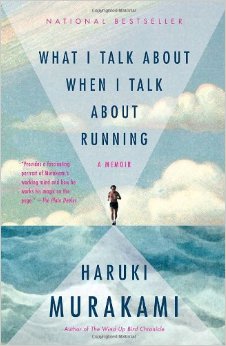
I just finished a book by one of my favorite authors, Haruki Murakami.  He is not only a good writer, but he has an imagination that is second to none.  Whenever I pick up one of his books, I can be sure that I won’t be disappointed.  The book was called What I Talk About When I Talk About Running.  It was a memoir of sorts of his dozens of marathons and triathlons and a little bit about how he got into writing. 

The book has energized me not only for writing, but I’ve also increased my running as a part of my daily workout.  I am amazed by the fact that, by tuning out my negative mind with music or podcasts on my iPod, I am able to run a lot farther without thinking about how my legs hurt or telling myself that I’m not a runner.  Instead of thinking about running, I just run.

According to Murakami, he was sitting watching a professional baseball game in Tokyo when he caught a foul ball and at that moment had the epiphany that he could write a novel (I don’t see the correlation either, and neither did he). He had no experience writing whatsoever and was running a small jazz bar with his wife at the time.  On his way home from the game, he bought a fountain pen and some writing paper and got to work.  Over the course of many months of writing from 3 am when he got home from the bar until the sun came up, he completed his first novel.  He submitted it for a contest and won.  The next year he released his second novel that was also written in the wee hours of the morning.  He sold his bar and convinced his wife to move out of the city so he could embark on a full-time career as a novelist.

What struck me the most was that a man who had no writing experience whatsoever put his mind to writing and got to it.  He stumbled along the way and had plenty of excuses not to write, but he was determined.  So determined, in fact, that he did his writing after a full day’s work when most of us are dead to the world.  He honed his craft and, through perseverance, became a very good writer.  His mindset about hard work paid off in his career as a novelist.  Having completed over 40 marathons and two ultra marathons (62 miles) as well as being strict about his allotted time for writing, translated into some very fabulous books that have brought joy to many readers.  It wasn’t so much that he had a savant for writing (although he obviously had to start off with some aptitude), but rather his mindset and discipline that helped him live his dreams.

The other part of the encouraging equation is something that my son’s coaches say at almost every practice.  It has been attributed to a number of motivational speakers and athletes, but rings true regardless of who first uttered it.  “The two things in life you are in total control over are your attitude and your effort.”  Here, here.

I may or may not have an aptitude for writing that is any better than anyone else’s.  But I am quite sure that, with a good and positive attitude (meaning kicking the yeah, but right in the yeah, butt) and giving all the effort I can (I will reap in direct proportion to what I sow), then I will succeed at making my dream a reality.

This is not only true for me, but it is true for YOU!  Is there something that you’re aspiring to do?  Is your mind trying to tell you that you’re any less than you really are?  Do you feel like life is dragging you down and keeping you from being who you know you were made to be?  Then don’t take it lying down!  If you’re reading this now and saying “Yeah, but . . . “ then I’m saying right back at you, “Yeah, but it’s who you were made to be!”  So don’t settle for anything less.

Angels and Demons

Posted in Uncategorized on August 19, 2015 by thecrossingchicago

holcomb railroad tracksThe railroad tracks felt like they divided us from the rest of the world.  Running north-south along the eastern edge of town, they were the border between our tiny town and No Man’s Land.  Even one step beyond those tracks and you were no longer in Holcomb.  The Doan’s, who lived not even 500 yards beyond the tracks toward highway 251, seemed like foreigners to me. 

A few times a day, freight trains would roll from their stop at the intermodal hub in Rochelle carrying who knows what up north to farms and factories.  The trains rolled along behind the grain elevator that spewed out corn dust that would cover our house across the street and create a living hell for anyone with asthma. 

There were no crossing arms or lights because everyone was used to the trains.  They were as much a part of our small-town existence as the tiny post office and the sea of corn and soy beans that came up to the other side of the unmarked road that ran alongside the tracks.  Life was simple and there was no sense of urgency as folks walked from one end of town to the other.  Only the old and infirm bothered with cars to get around unless you were crossing the tracks and going out of town. 

It wasn’t necessarily a friendly town.  You wouldn’t find folks sitting on their front porch drinking sweat tea and waving at neighbors strolling by, but most everyone knew each other and would lend a helping hand when needed. 

There was no need for a crossing arm or lights and bells at the three crossings because, even though nobody could tell you what time the two or three trains would roll by each day, their schedule was as much a part of our circadian rhythms as going to bed and waking up.  It wasn’t even that people felt the need to be careful of the trains because there wasn’t really anything to be careful of.  There was no way that anyone would be in the path of one of these trains because such things just didn’t happen.  Except for when it did.

Sandy Stumpf was heading to work via the middle crossing that was next to Doris and Charlie Vogel’s red and white house.  Perhaps she was focused on what she had to do at work and perhaps she wasn’t completely awake yet, but although she noticed the train near the crossing and that the train was moving, she thought the train had already passed and was moving in the other direction.  Unfortunately, she was wrong. 

As a 10 year old boy, I was three miles south in a classroom in Kings when the driver’s side of Sandy Stumpf’s car was crushed by the reversing train.  The train dragged her car off of the road and deposited it in the Vogel’s back yard near the basketball court that they erected for the town’s youth.  Miraculously, Sandy wasn’t fatally injured, but she was pinned inside her car by the crushed driver’s side door leaving her mostly immobile.  More than the pain of being hit, the fear and panic of being trapped overwhelmed her. 

My grandfather, Jim Hilliard, had been chief of our modest volunteer fire department, but was since retired when he saw what had happened and went to Sandy’s aid.  My grandpa had an uncanny knack for finding the scene of the accident as it was ironically him who found his best friend’s truck in a ditch near a country road after his friend had suffered a fatal heart attack.

Sandy needed to be extricated from her car, so there was nothing in that sense that my grandpa could do.  As they waited for emergency vehicles and as the paramedics sawed into her car to get her out, my grandpa knelt next to her and held her hand through the process.  He couldn’t physically get her out and back on her feet, but he provided support and encouragement in a way that gave her the strength to get through her potentially tragic ordeal.  When Sandy was finally free of her car and received the treatment she needed and in the days to follow, both Sandy and other townsfolk called Grandpa Jim a guardian angel.  Many said, “If I ever have an emergency, I want Jim Hilliard to be there with me.”

Sandy would outlive my grandpa by a number of years as he died about two years later at the age of 57.  Many gathered at his funeral and remembered his strong spirit as another angel was taken home.  It wasn’t many years later after his funeral that Sandy would also find herself in a casket – the victim of murder by poisoning at the hand of her husband.  She wasn’t his first wife that had mysteriously turned up dead.  Such is life in a small town where angels and demons play on the same field and eat of what has been reaped from the same soil, but it is the angels that give us strength, even long after they have returned to that hallowed ground.

Go Set A Watchman

Posted in Uncategorized with tags , , , , on August 6, 2015 by thecrossingchicago

harper-lee-go-set-a-watchman-cover-leadYeah, yeah, yeah.  I know.  It’s been a while.  I hope to get the mojo going here and what better place to start than with the much-anticipated novel by Harper Lee, Go Set A Watchman?  I will try to avoid too many spoilers here, but there will inevitably be a few.

I recently heard on NPR that there are bookstores actually giving refunds for this book.  Some demanded their money back because the book wasn’t as good as they thought it would/should be.  Others said they wanted a refund because of their disappointment in the characters in the book.  I fail to understand either of these claims.  I read the book and not only thought that it was good, but I saw it as a faithful depiction of reality.

I can understand that many had their hearts broken when the Great American Literary Hero of civil rights, Atticus Finch, turns out to be less than affirming in his advanced age.  It turns out that Atticus didn’t defend Tom Robinson so much for the sake of social justice as to reestablish order in the town that had gone crazy over the alleged rape of a white girl by a black boy.  Unlike Harper Lee’s father who was a segregationist who became more inclusive in his old age, Atticus joins the Citizen’s Council (White response to the NAACP) to slow down change in Maycomb Junction after SCOTUS had declared segregation to be unconstitutional.  When his daughter, Scout, who revered her father as a champion for equal rights, realizes that he is a member of this council, she lashes out at him in what results in the most moving parts of the book.

Scout eventually musters up the courage to speak to her father about his membership in the council.  She goes into his office and pulls no punches with the man she has never had the courage nor inclination to say a cross word to.

I remember that rape case you defended, but I missed the point.  You loved justice, all right.  Abstract justice written down item by item on a brief – nothing to do with that black boy, you just like a neat brief.  His cause interfered with your orderly mind, and you had to work order out of disorder.  It’s a compulsion with you, and now it’s coming home to you – “

It obviously pains her to say these harsh words to the man that she has revered, but she has her heart set upon rebuking him for letting her down the way he has.  She damns him for ruining the image that she had of him.

I believed in you.  I looked up to you, Atticus, like I never looked up to anybody in my life and never will again.  If you had only given me some hint, if you had only broken your word with me a couple of times, if you had been bad-tempered or impatient with me – if you had been a lesser man, maybe I could have taken what I saw you doing.  If once or twice you’d let me catch you doing something vile, then I would have understood today.  Then I’d have said that’s just His Way, that’s My Old Man, because I’d been prepared for it somewhere along the line – “

Atticus doesn’t argue with Scout.  When she says that she’s leaving and not coming back, he merely tells her to have it her way.

It’s never easy when our heroes betray us.  We put them on a pedestal and almost worship them with our undying fidelity and feel utterly lost when they fail to return the favor.  This is the danger of worshiping people and this, I believe, is the point of the book.  Atticus’s learned brother, Dr. Jack Finch, who has heard of the tongue lashing Scout has given Atticus paints a clearer picture for us.

Every man’s island, Jean Louise (Scout), every man’s watchman, is his conscience.  There is no such thing as a collective conscience. . . . now you, Miss, born with your own conscience, somewhere along the line fastened it like a barnacle onto your father’s.  As you grew up, when you were grown, totally unknown to yourself, you confused your father with God.  You never saw him as a man with a man’s heart, and a man’s failings – I’ll grant you it may have been hard to see, he makes so few mistakes, but he makes ’em  like all of us.  You were an emotional cripple, leaning on him, getting the answers from him, assuming that your answers would always be his answers . . . . When you happened along and saw him doing something that seemed to you to be the very antithesis of his conscience – your conscience – you literally could not stand it.  It made you physically ill.  Life became hell on earth for you.  You had to kill yourself, or he had to kill you to get you functioning as a separate entity.

And here, as they say, is the rest of the story.  I won’t spoil the ending, but I would be remiss to not mention the real point.  Those who would demand their money back because they felt betrayed by Atticus or Harper Lee in her depiction of him fail to see the reality of the situation.  Hemingway, Tolstoy, and others have said that the great stories have something in common – they are all in some way true.  This is why Hemingway would get over apparent writer’s block by “writing one true sentence.  The truest sentence [he] knew.”  Harper Lee did the same.  She knew that race relations were far from perfect in the real world.  She knew that our greatest heroes would always disappoint us in the end if we continue to worship them as Gods and not respect them despite being the flawed humans they are.

Lee was prophetic when she first presented this work in 1957 that would change and eventually become To Kill a Mockingbird.  Instead of seeing Atticus as a bigoted dream-slayer and faulting Lee for making him this way, perhaps we should appreciate the work as it is – literary fiction and Atticus for who he is – an archetype for all of the heroes we have and ever will worship.

The Dogma Files: Adam and Eve

Posted in Uncategorized with tags , , , , , , , , , , , on April 22, 2015 by thecrossingchicago

adam and eveGod is a liar.  The fact that we exist is proof of this reality.  In Genesis 2:16-17 God tells Adam that he can eat from any tree in the Garden of Eden, except for the fruit of the tree of knowledge of good and evil.  God warned Adam that if he ate of that fruit, he would die on that same day.  Guess not.  Maybe God was just kidding.

There are a lot of aspects to Christianity that are really hard to swallow.  There are a lot of stories that just don’t add up and the story of Adam and Eve is probably at the top of this list of untenable narratives.  Can we safely disregard this story then?  Should we just pull a Thomas Jefferson and cut that part out of the Bible?  Shame on the writers of this story for recording lies that would cause us to stumble some 2500 years later.  Or should I say shame on us for reading metaphorical narratives as though they were literal history?

It sounds awfully sacrilegious to call God a liar.  If the Bible is recorded as the exact, inspired, historical, factual Word of God, then God has been caught in a number of lies.  This makes it extremely difficult to follow such an untrustworthy deity.  We don’t have to worry about ditching God though, because God never said the words written in the Bible – not verbatim anyway.  As I’ve said here and elsewhere numerous times, the Bible is compilation of historiographical narratives.  It is the story of a people who are trying to make sense of their existence by recording true myths about existential problems and the plight of humanity.  This is the story of the Jews as seen through human eyes peering into the world of the sacred.

To call something a true myth is not an oxymoron.  Mythologist Joseph Campbell said, “All religions are true but none of them are literal.”  It’s also been said that a myth is something so true that is happens every day.  The stories in the Bible, Adam and Eve being no exception, are myths that help us see into the true nature of God and humanity, if only we have the eyes to see.  With this in mind, what would it look like to view the story of Adam and Eve through this lens and not as a literal event?  Let’s find out.

Although Adam is a proper name today, it wasn’t when this story was recorded.  Adam merely means “human.”  It is a play on words using the Hebrew word adamah which means “earth” from which Adam was formed.  The word for form or make in Akkadian is adamu and the word for red (the color of the clay from which Adam was made) is adam.  Those scripture writers were some witty fellers, weren’t they?

The Jews were in captivity in Babylon in the 6th century BC.  By that time, Akkadian was replacing Sumerian where most in the ancient Akkadian empire spoke both languages.  When the Jews were in captivity, they were influenced by the Akkadian, Babylonian, and Sumerian religions and this is where the creation accounts of Genesis come from.  The Jews’ language was also influenced by these other Ancient Near Eastern cultures.  Ironically, the story of King Sargon who led Akkad to prominence sounded much like the story of Moses.  Sargon was said to be placed in a reed basket as a baby and placed in the river to be left to the mercy of nature.

Now that we’ve freed our minds from the absolute necessity that the story of Adam and Eve must be literal, let’s take a look at the story and see what meaning it holds.  There is a lot of meat here (pun intended) around Eve being formed from Adam and the dominion of humans over animals, but I’ll save the gender roles and ecological discourse for another time.  For now, I want to focus on “The Fall” of humankind.

Adam and Eve had their pick of any food in paradise.  Assumedly, there were numerous types of vegetation and fruit to choose from.  It may be worth noting that there is no account of Adam explaining the rules around the tree of the knowledge of good and evil, but although God laid down the law before Eve was even created, she is aware of what was said.  This shows that Adam and Eve are not to be taken separately.  They represent all of humankind and are given two names so as to represent both genders.

Despite the fact that Eve knew better, she is tricked by the wily serpent (supposedly not yet a “snake” because it hasn’t yet been condemned to slithering on its belly) to eat the fruit of the tree (note again that nowhere in this text does it say “apple” although that’s how the legend has morphed) and have the same knowledge as God.  Adam also ate of it and many misogynists would claim that Adam gets a bad wrap because it was all really Eve’s fault.  It also makes us wonder why the story is told as the Fall of Adam and not the Fall of Eve.  God warned that death would happen on the same day, but we are told that the two went on to have children who would populate the region.  Of course we run into the age-old problem of incest if the offspring of Adam and Eve were having children together, but this is only problematic when the story is taken literally.

Adam and Eve did not physically die from eating the fruit, but as an archetype for humanity, humans do begin an existential death when we try to play God.  When we create false realities about ourselves, others, and cosmology and then try to impose those realities upon others, we die a little every day.  Adam and Eve were completely innocent in every sense of the word.  Not only had they done no wrong, but they were naive.  They had no idea they were naked.  They had no needs nor anxieties.  But when they tried to have knowledge (versus wisdom) they became aware of their lack and ineptitude.  They were no longer “good enough” and felt the need to hide themselves from the essence of all being.

Knowledge is good.  Knowledge is, as they say, power.  But when we seek knowledge as an alternative to wisdom, we begin to climb up out of the well of our depths and into the world of logic.  We lose all sense of mystery and sacredness and begin to see a need for a logical explanation for everything.  Facticity becomes more important than wonder and we lose the ability to experience God.  We leave our hearts behind and live in our heads.  This was the downfall of humankind as brilliantly painted into the tapestry of the myth of Adam and Eve.

When knowledge rules over wisdom dualism is born.  The need for exact reasoning for everything leads to a necessary determination whether something is good or bad.  The realm of wisdom tells us that there is no dualism and that good and bad are different sides of the same coin.  The realm of knowledge tells us that we have to put everything in its logical place to make sense of the universe.  This is why the forbidden fruit grew on the tree of the knowledge of good and evil.  When humankind decided to replace contentment and an awareness for the sacred we began to die.  The very essence of our meaning and purpose, our very existence in fact, and that existence in God became cloudy and we made a self-imposed exodus from paradise to our own Babylon where suffering awaited being born out of our delusions.  Humans are incapable of knowing everything.  When we try to give everything an explanation, we will inevitably be wrong some, if not most, of the time.  The false realities that we create are mere delusions that become attachments, for we are incapable of letting go of our finitude.  Perhaps this is why we have such a problem with mortality and need assurance of eternal life.

The story of Adam and Eve is not the history of our earthly mother and father who brought the wrath of God upon themselves for eating a forbidden fruit.  It is the story of humanity’s struggle to make sense of its own existence.  It is a myth that is so true that it happens every day.  It’s a warning against giving up wisdom for knowledge.  It isn’t an explanation for why bad things happen in the world and why Jesus needed to come as “the new Adam” and save us from ourselves.  But, in a sense it is exactly that, because Jesus pointed the way back to paradise.  He taught the way back to godly wisdom and giving up worrying and competing over resources.  He showed us that we need merely to turn our gaze inward to find that the Garden of Eden not only still exists, but is flourishing with more than we can ever need.  Now that’s a story worth telling.

Just Be Yourself

Posted in Uncategorized on April 19, 2015 by thecrossingchicago

be-yourselfThere are many kinds of prophets.  Some are real, actual prophets.  Some are false prophets who lie to achieve their own ends.  Some are delusional and believe that they are sent by God or that they are some sort of messiah.  Others are somewhere in between.  Vernon Howell was on that spectrum. 

Vernon had a rough childhood and some of the psychological effects showed.  He turned to his mother’s fundamentalist Seventh Day Adventist church, but was kicked out when he told the pastor that he had a revelation that he was supposed to marry the pastor’s daughter.  He then joined a reformist group that had splintered off from the Adventists and soon claimed that he had a vision that he was supposed to lead the group.  It was believed that he was having an affair with the 77 year-old widow of the founder of this sect and he gained support from her to take over the group. Understandably, her son, George Roden, felt that he was the rightful heir and challenged Vernon to a resurrection contest.  Roden exhumed a body to make it look like he had resurrected someone and Vernon told police about the incident.  When a third person came along and claimed to be the messiah and leader of the group, Roden killed him with an axe and was sent to a mental hospital.

Vernon finally took control of the group and engaged in many questionable practices including spiritual marriages, statutory rape of his “spiritual brides,” and child abuse.  Vernon had another vision that he was the incarnation of Cyrus the Great, the Persian king who freed the Jews from Babylonian captivity and sent them back to Israel.  He felt that it was his duty to reestablish the Davidic monarchy in Jerusalem and so, adopting the Persian name for king Cyrus as his last name, he changed his name to David Koresh.  After a 51 day seige, Koresh and 80 of his followers were killed 22 years ago today (April 19th).

This was a very sad and unfortunate example of a psychologically troubled person with a messiah complex leading vulnerable people to their doom.  I won’t get into how well or poorly the FBI handled the situation or why those people were so easily manipulated, but it just goes to show how dangerous a false prophet can be.  Likewise, a real prophet can be conversely as healthy.

So what is a prophet anyway?  From the Old Testament, we tend to see them as a person with a message from God.  It was typically a message of doom and gloom and warning for a people who had chosen to go against the will of an almighty God.  Are there still prophets today or has their function changed?  I would venture to say that they do and it has.  Peter exemplified what a modern-day prophet looks like in the book of Acts.

In Acts 3, Peter and John come across a man who is carried daily on a mat to the temple steps where he can beg for money.  Instead of giving them money, Peter did what a true prophet does, he empowered the man so that he can have a good life of his own volition instead of based on what others provide.  The man was lame from birth.  We know that we have to be careful about reading these stories literally, because we lose the true meaning.  So, the man was not factually and physically unable to walk.  Instead, he was unwilling to hold himself up and face life with dignity.  In essence, he took it all lying down.

The man’s friends enabled him over the years and carried him on his mat so that he could continue to receive reinforcement for his complacency.  Perhaps his parents had taught him in a way that furthered his enablement and then his friends took over that role.  When Peter and John saw this, they knew what was going on.  Peter got down to his level, looked him in the eye, and empowered the man.  In essence, he told the man that he had worth and that his life mattered.  He put out his hand and helped him up.  Nobody had ever done this for him.  Imagine the feeling of dignity that he must have had when he realized that what everyone else had been doing for him out of pity, he could do himself because he mattered.  From that moment, he saw that he didn’t exist to have things done to him, but that he could affect change with his own life.

At first, the man clung to Peter, but he eventually stood up straight and let go.  How many times have we heard in the New Testament Jesus telling people to let go of him and to “go and do likewise.”  Through his prophetic words, Peter had not only empowered a man back to life, but he had also made a prophet out of this man.  Who better to spread a message of empowerment than one who was raised from the “dead” himself?

Understandably, the people were shocked at what had happened.  This man who for decades had been laying on his mat begging others to do for him, was full of life and vigor and determined to live his own life.  Peter asked them, “Why are you so surprised?”  Then he launched into a discourse about sin.  He challenged those who had witnessed this transformation to repent.  As individualistic westerners, we hear words like sin and repentance as something to do with the terrible things we do against God and how we need to seek forgiveness from them lest we be punished by a blood-thirsty God who is insatiable.  This isn’t what sin and repentance meant in the 1st century and it’s not what they mean now.

To sin, as you have likely heard in others’ sermons, is to miss the mark.  This is not a good/bad dualistic “X” in the sand that God has put down daring us to undershoot it.  To sin is to live a life other than that which is truly us.  It is to be anything other than ourselves.  We all have a meaning that lies at the depth of our being that we are meant to be true to.  Anything that is done contrary to who we really are is “missing the mark” and makes us suffer.  Sin is corporate as well as individual.  When we repent (literally, change our minds) we get a new mindset for ourselves that spreads in encouragement to others.  This is what empowerment is all about.  It’s encouraging others to live lives that are true to themselves and reassuring them that they will experience great peace and joy when they do so.  It’s reminding them that they matter and that they, too, have the power to change the world.

Some people are hurting.  Most of us are.  This is part of being human.  Some feel hurt more deeply than others and have a hard time seeing past it to where there is hope, dignity, and strength.  There is a Japanese saying for when a child gets hurt that goes “ittai, ittai, tondekke!”  This means, “pain, pain, fly away!”  When the man who couldn’t see beyond his own hurt came face to face with Peter, Peter said, “ittai, ittai, tondekke!” and the man was empowered and saw his worth.  That’s what we have to do as modern day prophets.  Sometimes we have to kneel down with someone who is hurting or feels conquered by life and show them that they matter.  Sometimes we even have to look in the mirror and do that for ourselves.  Enablement will only create a life of suffering and encouragement to live a life other than that which is true to ourselves, but empowerment will bring people back from the dead and let them live fulfilled lives for the first time.

On April 19th, a “prophet” died.  But on April 19th another prophet was born.  And on the 20th, 21st, etc.  All of us have the potential to be prophets if we merely chose to empower instead of enable.  If we choose to live lives that are true to ourselves and encourage others to do the same, we speak the very words of God and bring life into existence in co-creation with our Creator.  It takes a spiritual journey within to know who you really are, but ultimately, all you have to do to kindle hope in the world while having an enriched life is just be yourself.

Dear Owen Strachan

Posted in Uncategorized on March 10, 2015 by thecrossingchicago

excommunicationI hereby excommunicate you, Owen Strachan, from the universal church of Jesus Christ.  There will be no surrender on progress and spreading the extravagant love of Jesus.  We will not give an inch to those who would look their fellow human beings in the eye and be haughty enough to assume that they can tell them that they are not good enough or somehow more of a sinner than themselves.  You have misrepresented what the gospel stands for and impeded the liberation that Jesus spoke of.  Instead of freeing the oppressed, you have proven only to add to the weight of their shackles.  Instead of giving sight, you have managed to continue blinding the masses from your pulpit of judgment.  Therefore, by the power vested in me by the church, your license to preach the gospel and membership in the church universal is hereby revoked.

What!?  What do you mean I don’t have the authority to tell you that you can no longer share your opinionated message within the church?  Is this not what you did to Rob Bell?  You speak for yourself Rev. Dr. Strachan.  You may very well represent the majority of your denomination within the Southern Baptist Conference, but you do not represent the entire church, so please do not speak as if you do.  There are many issues that you and I will never agree on.  Yet, we are both (as is Rob Bell) ordained to preach the gospel of Jesus Christ.  It is indeed troubling when we are claiming to preach the gospel, but are preaching different messages.  Is it an unsettling truth, but true nonetheless.

Neither you nor I can claim to represent the hundreds of thousands of congregations and millions of Christians here in the U.S. alone.  As much as we both have strong convictions that we wish everyone else would open their eyes and see, in the end we can only speak for ourselves.  The church is big, diverse, beautiful, and very broken just like the people that it is comprised of.  We serve the same God from different perspectives.  As much as I disagree with your position, I respect you as a human being who is fearfully and wonderfully made in the image of a very big and very loving God.  May we all serve that God well from our different positions and despite those differences, may God redeem the simple words that come from our human mouths and use them as God wishes.  When all is said and done, may our words edify and encourage those whom God has called us to serve and not make them any more broken than they already are.  After all, it is God’s church and may God’s will be done – not ours.

The God Beyond God

Posted in Uncategorized with tags , , , , , , on March 6, 2015 by thecrossingchicago

constellationsApparently the childhood home of Jesus has been found according to the Biblical Archaeology Review.  The home carved into the wall of a large stone matches the description in a 7th century text.  Archaeologists do admit, however, that the house may not have been occupied by Jesus, nor a Jewish family, nor are they sure that it even existed when Jesus walked the earth, but they say that there’s no reason to believe that it’s not the home of Jesus.  So, we can assume that it is.

Why are we always in search of facts when it comes to faith?  Isn’t that what faith is – trusting even though there’s no tangible evidence to support that which we have faith in?  We are constantly in need of a “because.”  We want truth to be clear and self-evident, but it rarely is.  The devil is in the details, as they say.

If you are a Japanese-American, your ancestors committed atrocities and set a shameful legacy for you.  There’s no question about it.  They snuck in and attacked Pearl Harbor, raped Nanking, took the entire counties of Korea and the Philippines prisoner.  Bad, bad, bad plain and simple. 

In 1905, Teddy Roosevelt sent the largest U.S. delegation to ever go overseas on a ship to Asia.  He looked at Japan and decided that they were the “whitest” Asian race and would be the perfect people to start a veritable Monroe Doctrine for the Pacific.  Roosevelt’s daughter, the Secretary of War who would become president Taft, his future son-in-law and Speaker of the House Nicholas Longworth, and many other congressman were on this ship.  Through his emissaries, Roosevelt convinced Japan to start a rapid expansion plan throughout Asia starting with Korea as a launching point to China and then to the Philippines.  Roosevelt said the Filipinos were barbarians that needed to be cultured and he paraded them in grass skirts at the World’s Fair in St. Louis.  Before all this, though, Roosevelt felt that Russia should be targeted first so as to weaken the power of the Tsar so that the expansion plan would go more smoothly.  This was convenient because Japan was already in a war with Russia. 

Japan took well to this plan.  After all, Emperor Hirohito was, according to Japanese mythology, a descendent of the Sun Goddess Amaterasu who created Japan along with Izanami and Izanagi from the swirling chaos and who gave birth to the first emperor, Jinmu.  Japan devised an eight point plan to take over Asia and got to work right away.  Roosevelt praised Japan’s sneak attack on Russia before the delegation set sail and later brokered the peace treaty that would end the war and earn him the Nobel Peace Prize.  Japan set its sights on Korea next.  This was historically fated because it was from Korea that the Mongols launched their stolen ships in an attempt to expand their empire into Japan in the 1200s.  Two different fleets of ships were destroyed by typhoons which Japan called the kamikaze, or Divine Wind.  So, it was in a reversal of events that Japan would go the opposite direction and use Korea to launch into mainland Asia.  As Japan rapidly expanded, they came to disagreements with future U.S. administrations and eventually that of Theodore’s cousin, Franklin Delano Roosevelt.  In order to keep the Japanese in check, FDR issued an oil embargo which Japan protested with a sneak attack on Pearl Harbor.  Needless to say, this sneak attack was not smiled upon by the sitting U.S. president.  So, which is the truth?  Was the U.S. to blame for the events that led to WWII, the Korean War, and even the Cold War or was Japan really just bad and sneaky?  Well, the victors write history, so who knows?

Even when things are set right before our eyes, the truth that surrounds them is usually buried somewhere between the shallow and the deep.  Symbols abound around us that represent greater realities, but they are not always the realities themselves.  As Paul Knitter has reiterated from others, the finger pointing at the moon is not the moon.  Our quest should not be for absolute truth, but instead to embrace the symbols so that we may better experience that which they point to.  In our attempt to define God with realistic terms, we have set the symbols aside and created our own version of God.  In so doing, we have lost what Paul Tillich called the God beyond God.  In trying to get all the facts and no reality in its fullness, we have lost our sense of wonder.

The Psalmist wrote in Psalm 19 this perplexing truth about the wonders of creation:

The heavens are telling the glory of God;

and the firmament proclaims God’s handiwork.

Day to day pours forth speech,

and night to night declares knowledge.

There is no speech, nor are there words;

their voice is not heard;

yet their voice goes out through all the earth,

and their words to the end of the world.

We rely too much on our own understanding to experience the cosmos.  We are listening for the clear speech that hasn’t been uttered.  We look at the lights of tall buildings in wonder of what our hands have made, but are blinded by those lights to the radiance of the stars that shine unseen above us.  But we have experienced wonder.  Perhaps in the majestic Rockies, the towering sequoias, the sweet trill of a violin harmonizing with a cello, or maybe even in the cry of a newborn child.  When our hearts were filled with awe, there was no “because,” there was only wonder.  We did not say to ourselves, “I am filled with such a strong feeling because . . . .”  We experienced the view or the sound for what it was, God’s handiwork that is not fully explicable with human words or wisdom.

If we were to get away from the unnatural lights of the city and go where we could really see the innumerable stars in the firmament we would be amazed.  If we were to hold up one grain of sand at arm’s length, that grain of sand would cover 10,000 galaxies that each contain from 10 million to 1,000 billion stars.  Many of these stars are surrounded by planets, some of which having favorable conditions for intelligent life.  According to the Drake Equation, within our galaxy alone there is high probability of having 72 planets that could support human life.  There are no words to describe these things other than wonder.

The Psalmist continues this psalm by saying:

In the heavens God has set a tent for the sun,

which comes out like a beloved from a wedding canopy,

and like a strong athlete runs its course with joy.

When Austyn was five or six and flying with his mom and brother to Japan to see family, he was looking out the window of the plane and suddenly turned to his mom and said, “Look!  Look!  Do you see that?”  She didn’t see it.  It was a golden tent in the clouds.  When they arrived in Japan, they called to let me know that they had arrived safely and Austyn asked me if there was anything in the Bible about a tent.  I told him that the ark of the covenant was kept in a tent or tabernacle as the Hebrew people wandered in the desert before founding Jerusalem and building the temple.  Austyn said, “Wow, I saw God’s house.”  Did he really see anything?  Does it matter?  Isn’t being open to the possibility and the symbols of what lies beyond more important than the actually vision?  Of course his mom did not see it.  Was it because there was no tent or because we adults have lost our sense of wonder and therefore our ability to see the wondrous?

In the months following this event, Austyn would ask me how he could get a letter to God to thank God for showing him God’s house.  Now he isn’t really interested in the event.  Austyn and all children: never lose your sense of wonder.  Adults: it’s not too late for us to regain it.  We need merely to set aside our own wisdom for the wisdom of God.  See the symbols for what they are and appreciate the glimpse that we are rarely given of that which the symbols point to.  Let us not create our own gods nor rely on our own understanding to make sense of the cosmos, but let us instead bask in the mystery and be in constant awe without explanation.

The Psalmist ends Psalm 19 with these words:

Let the words of my mouth

and the meditation of my heart

be acceptable to you, O God,

my rock and my redeemer.

Amen and Amen.

Among the Dead

Posted in Uncategorized on March 4, 2015 by thecrossingchicago

Chief Seattle GraveMy grandparents’ house was only about 200 yards from the house I grew up in.  Our house wasn’t much to look at so I would hang out at grandpa and grandma’s more often than my own place.   At 16, when my girlfriend wanted to come over and watch movies, going to grandma’s house (grandpa had died four years previous) with her big screen TV was a much better option than our place.  So, I rented some VHS tapes and went to her house to wait for my girlfriend to arrive.

Grandma was out on a date and so I let myself in from the garage.  The entry from the garage opened in to the family room with a set of steps going down immediately to the right of the entry.  I had many nightmares as a child about being dragged by some unseen force down those steps so I was quick to turn on every light I could and get away from the steps.  After I turned on the light, the steps were soon out of sight and out of mind as my focus went down through the kitchen and into the dining room beyond.  The phone had not rung, but the answering machine came on and my grandpa’s voice was saying, “Hello?  Hello?  Anybody home?”  If such a thing is possible, I was both scared and at ease at the same time.  I felt like there was something watching me from the dark dining room and so I swallowed hard and said “Grandpa?”  Of course I received no answer, but the answering machine then went off and there was dead silence.  Remembering that I was standing next to the dreaded basement steps, I darted over by the couch to turn on the lamp.

I am neither a believer in ghosts nor an unbeliever.  I simply do not know.  The scientific part of my mind says that energy cannot be destroyed and only dissipates and since our thoughts and bodies and minds are all made up of energy, it is perfectly reasonable that we should live on in some way beyond our physical death.  On the other hand, things that go bump in the night are intriguing, I guess, but somehow implausible.  But there is more than one way that the dead can haunt us.

Chief Seattle spoke these famous words as his people were being killed and scattered from their homeland because the “White Chief” wanted them for his own people.  These are words that, regardless of what happens after we die, should always haunt us:

Yonder sky that has wept tears of compassion upon our fathers for centuries untold. . . . The son of the White Chief says his father sends us greetings of friendship and good will.  This is kind of him, for we know he has little need of our friendship in return because his people are many.  They are like the grass that covers the vast prairies, while my people are few: they resemble the scattering trees of a storm-swept plain. . . . There was a time when our people covered the whole land as the waves of a wind-ruffled sea covers its shell-paved floor, but that time has long since passed away with the greatness of tribes almost forgotten. . . . When the last Red Man shall have perished, and the memory of my tribe shall have become a myth among the white man, these shores will swarm with the invisible dead of my tribe, and when your childrens’ children think themselves alone in the field, the store, the shop, or in the silence of the pathless woods, they will not be alone. . . . The White Men will never be alone.  Let him be just and deal kindly with my people, for the dead are not powerless— Dead— I say? There is no death.  Only a change of worlds.   – Chief Seattle

I do not know what happens to us after we die, but I do know that we leave a legacy that will either haunt or bless those who come after us.  We tend to run from the things that we do not know and act as if they wil hurt us.  Perhaps they will.  But how can we appreciate the light if we never sit in the dark?  If you are ever in the Cascade Range overlooking a dark valley with the wind whistling through the trees and you feel someone looking at you from behind one, instead of running scared, perhaps try asking for wisdom.  We can benefit from our fears by embracing them and letting them teach us.

Loving the Seen, Embracing the Unseen

Posted in Uncategorized on February 25, 2015 by thecrossingchicago

leah alcornGod has made it clear that he does not tolerate homosexuality.  God has made it clear that he does not tolerate Muslims.   God has made it clear that he does not tolerate transgendered people, liberals, people with tattoos, etc, etc.  Any Bible-believing decent Christian knows this and therefore will also be intolerant in the name of the Living God in whom we live and breathe and have our being.

The problem is, God is unseen.  Nobody has ever heard the audible voice of God and been able to know exactly what God does or does not will.  God has so many unknowable facets within a cloud of mystery that can only be embraced, but never fully understood.  Despite the fact that we cannot fully know God nor God’s will, we are quick to give attributes to our incomprehensible creator that typically put us at odds with those who we can see and feel and be in relationship with.

Megachurch pastor Rick Warren shunned his son for being gay and stuck to his guns to save face within a congregation to whom he had preached intolerance of homosexuality.  Warren defended God’s rules even until his son committed suicide.  Leelah Alcorn was told by her mother that being a male feeling like a female was strange and unacceptable in God’s eyes and a mere anomaly that would eventually pass.  And so it did, along with Leelah when she took her life in hopes of liberating others with the same predicament.  Deah, Yusor, and Razan were gunned down by a neighbor who couldn’t accept that Muslims would take the parking spot that he wanted.  All of these are obviously simplifications to very sad and very serious relational breeches, but in the end the point is the same: Many people would rather defend the honor of an invisible God who is mostly created in their own image than to simply love those who are right in front of their eyes.

http://www.cnn.com/2014/12/31/us/ohio-transgender-teen-suicide/

http://www.newyorker.com/culture/cultural-comment/guns-chapel-hill-myth-american-vigilante

So?  Where do we start?  I always spout my ideas, now it’s your turn.  How do we get people to let God be God and stop creating a God that was never meant to exist?  How to we get people to quit alienating the very people they are supposed to be protecting in the name of untenable arguments supposedly decreed by an embellished anthropomorph?  How do we convince people to love the seen and embrace the unseen? Perhaps we can learn from the dying and their regrets to learn what not to do before the damage is irreversible.

http://www.aarp.org/relationships/grief-loss/info-02-2012/top-five-regrets-of-the-dying.2.html